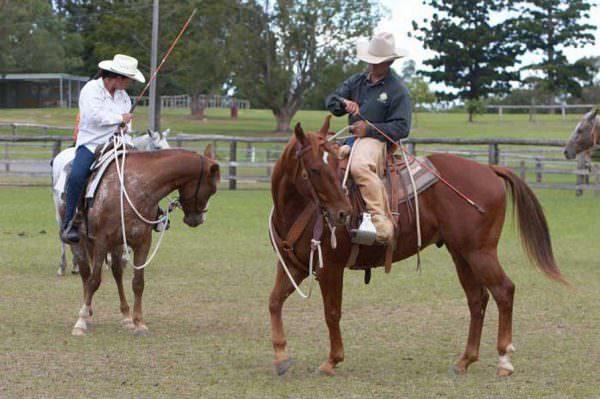
Natural Horsemanship gurus of all methodologies and followings have a tendency to employ this method to control run-away horses, to promote suppling and basic control over green horses. Most will also tell you it is the “must have” emergency parashoot to instill in your horse because, after all, you never know when he might go crazy.
Yes, it is true, I am slightly more outspoken in my disbelief in many NH methods – but I do believe that this maneuver may just be the one which rankles me the most. The reason is this – I was taught early on to ride based on many NH principles. I have used and trained horses to disengage their hindquarters in an emergency. My thinking has developed in this way however – how can I avoid the need for an emergency stop in the first place?
First, let me explain myself and the goals I have when riding a horse. I look to develop impulsion, straightness and lightness in every horse I ride. Impulsion meaning he is putting all of his energy into moving forwards without any reservations or hesitations. Straightness meaning that he is in line from shoulders to croup and travelling with his hind hooves landing in the tracks of his front feet. Lightness meaning every aid I give him is imperceptible to those looking onwards and the most subtle that I am capable of mastering.
The reason I strive for these three components is not so my horse is attractive to watch, to achieve specific movements or just because I have nothing better to do. I work towards these three things because when they are all in effect I am at my safest in the saddle. However, when one of them is out of place is when “crazy” can come about.
- For the horse to travel with true impulsion does not mean he is racing ahead uncontrollably, it means that so much of his energy is being exerted in just getting from point A to point B that his mind does not have time to worry about the things going on around him.
- For the horse to travel straight means that if something does, by chance, startle or upset him he is going to continue travelling straight ahead where he is already exerting his energy.
- For the horse to be light in all the aids means that when he falters in being straight or lacks impulsion it will immediately reflect in the quality of his lightness and how he is balanced between the aids.
Finally, when these three pieces are fit perfectly into the puzzle the horse begins to balance himself on the hindquarters rather than on the forehand. To any rider who has experienced this they will recognize immediately that directing the horse becomes more like that of controlling a sports car vs. a suburban or short bus. The horse responds quickly and efficiently rather than being heavy, pulling, dull or resistant.
Now, here is why I am in such opposition towards disengagement of the hindquarters – it goes against the ultimate goal of safety in the saddle. The horse is immediately displaced onto the forehand, he is no longer capable of travelling straight, heaviness is employed in the creation of this maneuver (in the initial training if not throughout the horse's riding career) and all impulsion is brought to a halt.
What this means is that now the horse is going to hesitate in putting himself into full impulsion because he is at risk of being pulled off balance, out of straightness, and having been done so through the use of heavy aids. For a horse who is already obviously lacking in confidence because he is spooking or being startled – this is the ultimate blow to then have the rider aboard further degrade this confidence.
So, what then does a rider use in an emergency? I always think in health as well as in riding horses that prevention is greater than a cure. To rid the horse of spooking altogether means to ride him in full impulsion at every gait and at all times, straight and in lightness. If the horse is spooking one or more of these elements is missing, plain and simple. If the horse is incapable of being ridden in this way then it is time to investigate a pain issue – be it muscle, joint, hoof, saddle fitting, etc.
- Impulsion starts with training the horse to track up properly – some of which is explained in my lunging videos.
- Straightness is simply keeping the shoulders in alignment with the hindquarters (but not the hindquarters in alignment with the shoulders – important difference).
- Finally, lightness is created through first a dynamically balanced seat, independent aids and separation of the aids (i.e., hands without legs, legs without hands).
From the perspective of retraining a horse who has had this “feature” installed, there are several obstacles that have to be overcome. There is a great tendency for the horse to throw himself on the forehand in preparation when single rein aids are used. He has to be retrained with great patience to understand a direct and an indirect rein cue. Simultaneously there is the issue of impulsion. Horses who are taught to disengage the hindquarters are notorious for sucking back – for not moving freely forwards. They constantly hesitate and question whether you truly want them to go forwards and whether they will pay for it later on through an “emergency stop.” Finally, these horses are never, and I cannot stress that enough, straight.
My encouraging words would be for those who have not yet taught their horse this, stop and think before you do! It is far easier to train the horse who has not yet been damaged than it is to overcome this issue. For those who already have a horse trained in this way who want to bring their horse to impulsion, straightness and lightness – patience is key. Working at the walk for a long time is necessary because these issues will be amplified as the speed increases. Impulsion must be built from the ground up, and overusing the rein aids is a large problem because the horse will be expecting to perform this action if you use too strong an aid. It can be done, however.
Join 3,000 Equestrians
Receive New Articles In Your Email

I totally agree with your explanation of the damage of the one rein emergency stop and disengaging the hindquarters.
However the people who seek to learn this are almost exclusively weekend pleasure horse riders on not very well trained horses and who are not well trained themselves who have a fear of falling and fear their horse going out of control because they have no control.
We both know the fix for this but I guarantee these people will not end up in a proper lesson program or end up with a properly trained, seasoned horse unless they have aspirations of showing. And for them it usually won’t happen because they can’t afford lessons and showing. That’s the real world of many horse owners. For them I think it is a tool they can use to their benefit if done correctly and not overdone.
False security? Maybe. But the NH guru’s attract these people because that’s all they have.
I agree with your sentiments, with one question to add… how can correct instruction be made more readily available and affordable? If we wish to prioritize the horse’s well being, and truly the rider’s safety, then I think this is an undertaking worth putting effort into.
Erica, if I knew the answer to your question I’d be the next guru!
First you have to convince them they NEED lessons 🙁
haha, nice Cheryl. 🙂
Next question… what if it wasn’t billed as lessons? Can education be spread sans riding lessons in an affordable manner that makes people want to get involved? 🙂
OK, I’m intrigued. What are your thoughts?
Remember most backyard horse owners are not interested in a horse with a lot of forward movement like us dressage based folks. They just want a horse that does what they want them to do without giving them any problems and don’t think THEY have a problem, it’s the horse. These “greenbroke” horses are bought and sold on craigslist every day seeking the one that will give them fewer problems. Again, they don’t want to believe they need riding lessons let alone how to understand their horse & it’s behavior. I have a small boarding farm in Mi. and sadly I see these people come and go all the time.
Are you thinking about a free demonstration to generate interest and show what is possible? I did something similar about 18 years ago at my place with my old instructor. She called it their dressage “Road Show” to bring dressage to the average horse owner to demonstrate that it was for any breed and improves any discipline even if you have no discipline. It was well received but generated no lessons for this instructor. Disappointing but hopefully it planted some thoughtful seeds. Maybe if it was done differently and the “D” word wasn’t even mentioned?
Convince them they need it and make it affordable. Huge task.
Cheryl, I think you already answered it – though perhaps unknowingly. The information cannot be offered up as a lesson – both because riders do not always feel they need formal instruction and also it is cost prohibitive for many. This is where Natural Horsemanship thrives, it gives away something for nothing at all the horse fairs and free demonstrations it makes available across the country. The information is presented simply enough so that riders feel comfortable going home and trying it before they buy it so to speak.
On the other hand, when one watches the demonstrations given by Dressage clinicians, unless you have a background in dressage already there is rarely any information you can just grab, go home and try out on your own. It is too complicated in the presentation, not enough simplification.
Also, there has to be some sort of disconnect from the term Dressage. The reason is because although Classical dressage offers something valuable to riders of every discipline and level because it is designed to create a calm, balanced and sound horse; whereas competitive dressage is aimed at the appearance and winning ability in the showring – something which has zero value to a rider heading out on the trail as their main endeavor.
You can apply dressage principles without getting too complicated. I mainly teach people who are not going to show and push the concept of calm, straight and forward. Even connecting with the horse and asking him to move from your leg pressure every couple steps to maintain communication can make a ride a safe one without putting too much lift and zip for the average rider.
A lot of riders are not focused and this can allow the horse’s mind to be on another planet as well. It can’t be all “fun’. Sky diving and scuba diving are great activities, but I don’t think fun can override skill and knowledge in those areas. Not many people would stay in the dangerous sports if they did not keep up the concentration and skill.
Sometimes the romance of the horse makes people think work should be on the back burner.
You really saved my skin with this information. Thanks!
Instead of “dressage,” I often use the word balanced-seat riding or balance training, and stress that once you have the basics from going down the “main road,” you can head off onto many paths — trail riding, hunters, western pleasure, reining or — gasp– dressage.
I’ve occasionally used a modified one-rein stop — more of a pulley rein — on a not-well-confirmed horse that may blow through the aids, but I try to avoid this as much as possible.
Sarah
PS Don’t EVER use a one-rein stop on a driving horse. The horse will fall over and likely tip the cart over as well.
Not sure I understand what you mean by your version of a modified one-rein stop, i.e. a pulley rein? When I hear pulley I begin to think leverage, which would apply if you are using some sort of auxillary equipment.
Although I think you are on the right track with dressage, I am disgusted with your comments about “natural” horsemanship. It is obvious you do not understand completely what true horsemanship is. Go to one clinic with Terry Church. Check YOUR ego at the door, learn and be inspired!
Anne,
I looked up Terry Church, unfortunately there is not much information available.
My dislike of the one-rein stop has nothing to do with ego, and if you are a supporter of a clinician who is working to combine NH with Dressage (as Terry Church’s website states) then you must also understand that the one rein stop and the whole of dressage are at odds with one another. One drops the horse on the forehand and reduces lateral flexibilities as well as setting up defenses against the rider and the hand; while the other (dressage) works to place the weight on the hindquarters and take it off the forehands, to improve lateral flexibility and eliminate resistance to the rider and all aids (the hands included).
Cheers,
Erica
Hello Erica,
I would first like to say that I’ve been perusing your blog and greatly enjoy reading your opinions about certain subjects, many of which I agree with you on.
I would, however, like to qualify a few of the general statements you made in your post. What you’ve written on the one-rein stop seems fairly correct if the rider is performing it incorrectly. I have seen heaviness used to create this maneuver, yes, but that’s definitely not the end goal. The end goal that I have found in using this maneuver is to get the horse’s hindquarters operating well and off a feel. Yes, it does put more weight on the front end, but when done correctly, the front doesn’t actually stop moving. This keeps the horse in balance, as opposed to spinning around one leg planted in the dirt, which might be what you’re seeing a lot of.
I agree that we want to prevent a bad situation happening before it happens, but what if something does spook our horse and we don’t see it coming? Do we just pull harder on the reins to stop our horse? That would create a significant brace in the mouth. Instead, the one rein stop (again, when done correctly) gives the rider the opportunity of gently winding the horse down and bringing it back to a maneuver the horse is familiar with. In short, it’s supposed to be comforting to the horse.
It is definitely not always applied in this way – and acknowledging that, most of the points you touched on are pretty spot on for people who use the one-rein stop incorrectly. I just want to add the caveat that when done correctly, it’s beneficial to the horse and human, and it actually becomes more than just an emergency stop. It’s a basic maneuver that is used to build up to more complicated ones.
I’m basing this information off of my personal riding experience, but also the experiences of horsemen like the Dorrance brothers, Ray Hunt and Buck Brannaman, just in case you were curious. Thank you for posting, and have a wonderful day!
Thank you for this; it clarifies my understanding of why my horse hates it (he finds safety in speed, probably because at one time in his life it was the only way to avoid punishment, and I’m stealing his safety). But there’s another piece to the puzzle. I had always heard that you should only do a single rein stop in an emergency, and that you should never practice it, because you could injure your horse or yourself. But in a clinic (I was the photographer, not a participant), Jonathan Field had everyone do it, gently and initially at a walk or trot, to get the horse used to it. Although he didn’t put it this way (iirc), what it did was give the horse a “not-so-unhappy place” through a known exercise. Many of the horses in the clinic “got it” very quickly.
I’m a real fan of countering the unexpected with routine. But you’ve convinced me that using a single rein to disengage the hindquarters is really counterproductive (especially since I ride in a rope halter and use a lot more single-rein than I would with a bit). So my question is, what would be a “not-so-unhappy place” exercise that would preserve impulsion, straightness, and lightness, reassure the horse, and do all this in a short enough space to avoid running out into the street or off the cliff? I’ve had some success with three half-halts in a row followed by “Ho!” (“Balance yourself…We’re gonna stop…I mean it…Now!”) but beyond a certain level of agitation, that’s not effective. I think I answered my question: Do ti before the agitation rises. But I’d still be interested in your take.