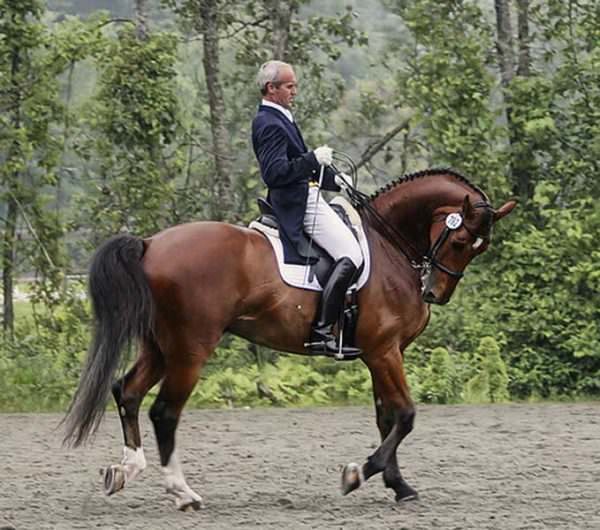
If you want to read more in-depth into rollkur there are some wonderful resources (unfortunate that they are necessary, but none-the-less available) on the web and I provide links to them at the bottom of this post.
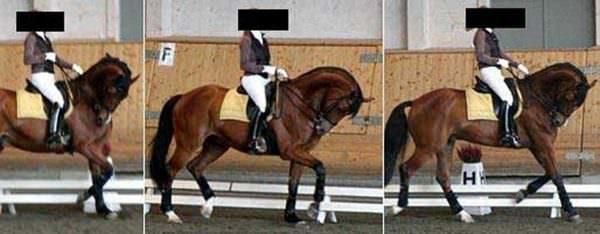
Q : What is Rollkur?
A : The word Rollkur was coined for what is now frequently referred to as hyperflexion of the neck. The term in german refers to a cure for stomach aches in which the patient rolls periodically in order to thoroughly coat the stomach with medicine.
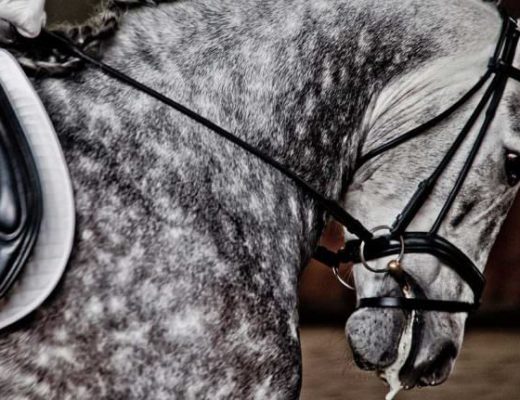
Rollkur itself is a method in which neck flexion is taken to an extreme for a period of time. Often promoted as being a fix-all for suppling and stretching the horse's neck it has also gained popularity as being able to raise and strengthen the back. Because of the way in which Rollkur changes the horses balance it will help to promote very flashy knee action, and is also used as a method of control because it limits the horse's oxygen supply, eye sight, and puts the horse off balance – essentially rendering the horse helpless to the rider's whims.
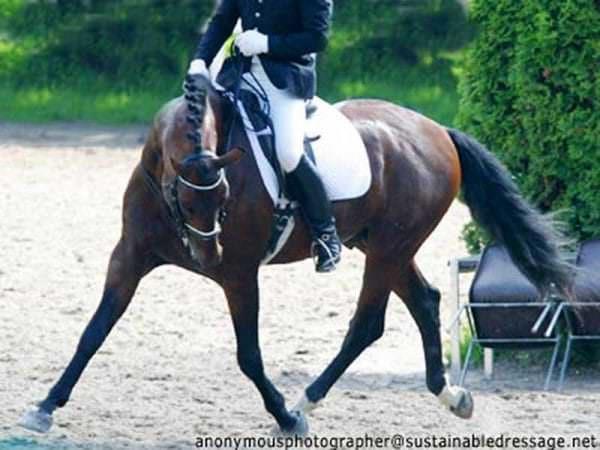
Q : Isn't Rollkur necessary in the sport of Dressage?
A : Rollkur's use and abuse has not been limited only to the sport of Dressage. Many western trainers and riders also utilize Rollkur however its use in other disciplines has not gained as much exposure and publicity to become widely known.
The sport of dressage was originally based off of cavalry riding which had been adapted from Classical Dressage principles. Unfortunately over time and evolution many practices change – some for better, some for worse – and the nature of judging and training has created an environment in which Rollkur is not only be accepted based on the marks given to riders using the method, but is inching towards the standard protocol based on those leading the sport in Grand Prix and Olympic level competition.
Rollkur is not necessary to being successful in Dressage, but is often resorted to because it promises results which many riders feel they cannot accomplish without it.
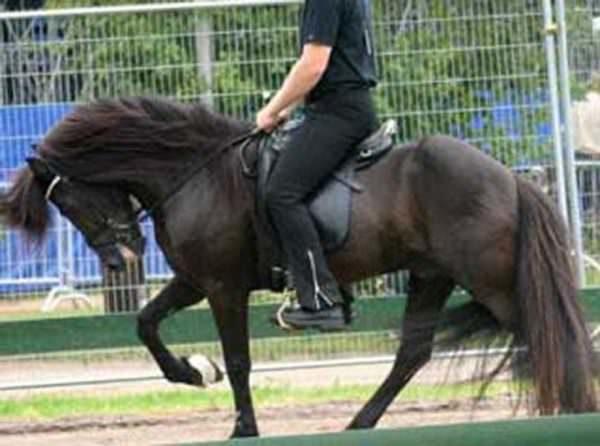

Q : How long is the horse held in a Rollkur position?
A : I have watched videos in which horses were placed in Rollkur throughout a 10 minute ride, others held in Rollkur for minutes at a time.
Q : Does Rollkur stretch the neck muscles?
A : It is important to understand the principles involved in stretching muscles, becase there is such a thing as over-stretching. Too much of a good thing quickly turns into a bad thing, and too much of a bad thing goes sour even faster.
Rollkur will indeed stretch certain muscles in the neck because of the position it places the horse in for an extended period of time. Just muscle fatigue alone will have set in. I looked for a solid answer on how much the average horse's head weighs, some sources say 12lbs while others say 6lbs. Either way, the horse's neck is not designed to contract in the way that Rollkur requires for long periods of time.. but getting back to the stretch of the horse's neck muscles. Overstretching can cause microscopic muscle tears, and can actually lead to more inflexibility over time as the muscle is constantly trying to repair itself.
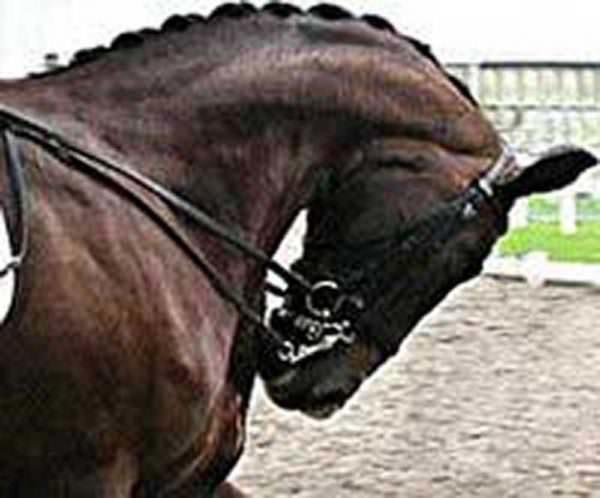
Q : What are the physical risks of using Rollkur?
A : Outside of risking muscle damage due to overstretching and muscle fatigue, long term muscle tension can also lead to bone spurs (osteophytes) as well as bone degeneration due to the position of the cervical vertebrae (neck bones) when placed in a position they are not designed for.
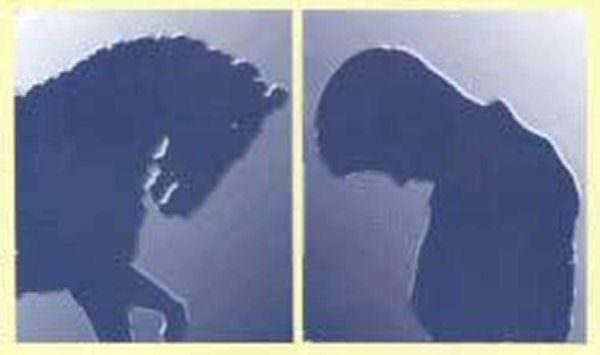
Q : Can Rollkur lift my horses back?
A : The neck plays a very miniscule role in the elevation of the back in motion. Think of your own body for example, Rollkur to lift the back is a little like bringing your chin to your chest trying to flatten your low back. What happens when you pull your chin to your chest is you round your shoulders, leading to a posture that tips forwards – in a horse this would place him on the forehand. On the other hand, if you want to flatten your low back effectively you achieve it by rotating your pelvis – which in a horse is what collection is, the horse's pelvis rotates bringing the hind legs further under the body which creates strength and support in the back and allows the horse to carry his weight more efficiently.
Q : If Rollkur is so bad, then why are the professionals using it?
A : The answer to this question may be more tricky. The individual motivations I cannot say, but I would be willing to guess that the amount of money involved in high level equestrian sports is enough to motivate a large number of individuals to using whatever legal tactics necessary to win.
- Exquis World Dressage Masters Palm Beach 2009 Prize : $135,000
- Rolex FEI World Cup Dressage Final 2009 Prize : $100,000
- Dressage At Hickstead Prize : €100,000 (roughly $145,600 US)
- 79th German Jumping & Dressage Grand Prix Total Prize : €500,000 ($727,802 US) / Grand Prix Dressage Prize : €300,000 ($436,681 US)
In Closing…
I think that it is important to remember that the term “professional” only means that a person is getting paid for what they do. You can be a professional con-artist just the same as being a professional human aid worker. Being a professional does not immediately guarantee that someone is basing their actions on the welfare of their horse, or clients for that matter. How many professional riding instructors have you ever witness berate their students?
Another key is that often our eyes are not trained to see past the beautifully groomed horse that has been perfectly turned out in the most expensive tack, ridden by a rider whose clothing is impeccably expensive. How many Americans were trained to see the collapse of our economy even while many signs were standing right in front of us? Just because we do not recognize it at the moment does not mean it doesn't exist.
The element of prize money is another factor that I believe has led, not only to the use but, to the continued use of a method in which no one can logically argue it is beneficial to and in the best interest of the horse.
More Resources
- Theresa Sandin's Blog : Sustainable Dressage
- Horses For Life : Special Edition on Rollkur
Your Opinion Matters
What are your thoughts? Do you believe that Rollkur's continued use is driven by success, fame, money? Are there elite equestrians you believe are using Rollkur to train but have not gained as much publicity as Anky Van Grunsven and Isabell Werth? What about Rollkur do you find appealing or repulsive?
Join 3,000 Equestrians
Receive New Articles In Your Email
what a great blog! i’ve just stumbled upon it reading up on the now infamous rollkur blue tongue…adding you in my RSS fed – keep up the great work
Thanks Petra, please share my blog with your equestrian friends… 🙂
you bet…keep up the great work…
I loved your article. A good deal of what is ‘wrong’ and ‘inhumane’ about the horse world today is indeed due to money. The almighty dollar tends to take-over a person’s mind and instill a drive that clouds over our thoughts of love and compassion. We see it everywhere, in all disciplines and every part/aspect of the horse-world. It’s also not just limited to hyperflexion/rollkur.
Money,unfortunately, will always be a huge drive…that and ego. (Another dangerous ‘disease’ that a rider can catch! When one start to ride for their ego…and the glory of winning…that is when the horse suffers most)
what happen to classialdressage? their is no skill in training a horse with all these artifital aids. real dressage is done through the natural aids so horse and rider can become one, thats brillant! thats dressage! Ihave been training horse and riders this way for forty two years. I made many champions and it all worked out very well I amvery happy to say everybody is happy horse and rider. robin leviton
Classical dressage is still around, though not primarily in competition anymore, a real shame!
This is so well written. I will need to go back and read it over more when I’m not so strung out tired.
I used to exercise racehorses at a local track, there’s a lot of criticism about that world (the money part is where and when it all falls apart for the horses). There are so many issues when money becomes the motive for how we train horses.
Horse racing has been called, “The Sport of Kings” but really all of the equestrian pursuits are. I don’t mean that harshly either. But for all my skill as a rider and for all the talent my horse has, we can’t afford to compete.
I guess what I would like to say to the horse world is this:
If you can’t afford to do it right, then don’t. I spend a lot of hours with my horses just being happy that they are happy. Why can’t that be enough?
Of course I know the answer is that people need to show that they have the ability to have power over another mammal. I can’t help but think that those people are very low on the food chain. How pathetic must one be that he/she has to pay a lot of money to prove that she/he can win out over a horse and make it travel in ways that are opposed to what is natural and healthy?
I forgot to add that it is not just that an individual pay a lot of money to prove that he or she can FORCE a horse to travel in a manner that is natural and healthy. But what is so strange is that anyone would want or need to do that? I mean, really? why? what have you proven and to whom?
I found myself saying “Amen,” and “Right on,” a lot, through reading several posts on your blog. So sad… I can always do what I’ve always done, and muddle through without taking short cuts in the training of my horse (or myself). I have seen that people who ride horses in rollkur lose the ability to ride w/ their seat, and engage their own hips, back and abs. In other words, it’s physically far easier to ride a horse in rollkur than to ride it correctly. That’s another reason why so many do it…. they don’t have to work as hard!
Trisha, thank you and welcome to my blog. 🙂
I do just want to say that riding correctly with the seat is actually very, very, easy once your body has learned the position and your muscles/joints have gained their suppleness. Riding these horses in rollkur requires a great deal of physical strength, in part because the horse’s back is braced and therefore the rider needs to use the reins and the strength of their legs to hold them into the saddle and not be bounced out with every stride. Like sitting on a trampoline – the taughtness of the horse’s back muscles in rollkur creates a type of spring that launches the rider out of the saddle. If you look at video of classically trained riders aboard horses whose backs are likewise supple you will not see any bouncing around. They don’t need to rely on the reins or their legs to hold them down into the saddle. 🙂
What is easier about Rollkur however, is that the amount of weight in the reins does help hold the rider in the saddle. So for a horse who is at the upper levels but maintains stiffness and bracing in the back, a rider who is not relying upon the reins to help hold them in the saddle will find it a very difficult time to sit such big gaits if not impossible. 🙂
Cheers,
Erica
I can not see why pain is beautiful horses might feel.
it’s so painful.
would like it looked at there eyes they look happy? it does not seem to hurt?
I think it does.
Think of jers horse or pony
they can not get enough air they can die from it can suffocate them.
I have two words and it STOP IT
Steffan does not ride his horses in Rollkur. If you watch his warm-up from Aachen it was so harmonious. Yes he rides Ravel low and LONG to warm up, but the horse is relaxed and the back is swinging. Sjef Jensen’s LDR (rollkur) is aggressive riding, and has nothing to do in my mind with the goal of dressage, which is supposed to create a harmonious partnership between horse and rider that demonstrates submission without damaging the charm and joy of the horses own personality. Simply read our “directives”. Many judges need to have their memories refreshed. What judges reward, competitors will produce. They have a very important job.
I like to think of stretching in terms of passive and active. One of my son’s boxing coaches wanted him to stretch. So while my son sat on the floor with his legs spread apart and attempted to reach his forehead to the floor, the coach came up behind him and pushed him down. That is a passive stretch that achieve a desirable goal but was very hurtful. Over time my son could have done it productively and actively by himself but his coach’s way got it done faster. Whenever I had physio, the therapist was more concerned about my active mobility in the affected part than the passive mobility. Using my good hand to bend the wrist of the healing arm does not indicate the true strength of the arm I am trying to improve.
WOW how refreshing. Great views and well expressed opinions.
Thank you.
It’s a shame that at the end of your article you started to express your opinion trying to manipulate the readers against it.. it was interesting at first, when you were describing “what it is”, “why?” and “how?”, but when your started saying “no”…
I really thought this could be helpful! Try and keep only the critical point of view when writing about training techniques, and when you want to express your disagreement with any method, please highlight that it is your opinion. Or just leave it out, ‘cuz in the end, it doesn’t really matter.
Why shouldn’t the blogger express an opinion? You are expressing yours and this is a controversial (to say the least) subject. It is not a training method but a lazy riders way of avoiding training by using force. It detracts completely from what true dressage should be about and but aside from that, the main reason it is banned is because it is physically cruel to the animal. You can see in their eyes how uncomfortable they are and if a horse starts to get bone growths and muscle damage due to what the rider has inflicted on it that is animal abuse plain and simple.
Hello eveyone, I have read with interest about rolkur because it makes me reflect on the difference between the two methods i.e rolkur and the classical methods of engaging the hind legs and quarters through the lateral movements of shoulder in, traver, renver etc. it seems to me when watching the many videos of rolkur there is little sense of the horse being able to carry itself and its own weight. It seems as if you took the riders hands away the horse would fall on its head or topple over. The classicallly trained horss such as those ridden by Anya Beran look up lifted at the front with the centre of gravity towards their rear end and their polls at the highest point. They are holding their weight correctly for themselves not being mechanically pinned down to the floor by their riders as with rolkur. Surely the transfering of weight to the horses rear quarters is what all good riding should be about. The horse is naturally weighted to the front so we should help him if we are to sit on his back and put even more weight on him to transfer his weight rear ward. I have sat on a horse trained this way , the French call the feeling they give you legerette, lightness. It is simply indescribable to feel as if the horse is perfectly balanced and could give you any pace at a moments notice with the lightest of aids. I have have also ridden and owned a dutch warmblood produced in the competitive way and know which I prefer. My horse now is a lusitano and I have strived over several years to train him myself according to classical ways. he is my dream , I can ride him with no bit and the lightest of aids. I am not competitive because there is such joy for me and him in the smallest things, a walk trot tansition, a halt just thought of by me and done by him. It is enough , because I feel complete when we are in unison.
Interesting post and web site. Can you point out any riders at the top level in dressage who do not use rolkur? Carl Hester’s horse looked pretty comfortable and easy moving today at the London Olympics. Does he use more natural methods? Anybody else?
Carl Hester does use hyperflexion methods, though the observation I have been able to make is that he is not quite so demanding in it (more in vein with the rule-description of Low, Deep, Round (LDR) rather than Rollkur). He is able to coax more relaxation from his horses than what other competitors show.
A top level (Olympic or World) rider who uses no Rollkur, or no hyperflexion? Because it is a tricky line that many toe. According to classical principles, and the current rules of Dressage itself, hyperflexion of the neck in any form which produces the nose coming behind the vertical is a fault. However, that being said there are a lot of riders at all levels who do not use Rollkur but are riding with their horse in hyperflexion, i.e. nose behind the vertical, and who are not being penalized appropriately by judges. It has become an accepted norm but does interfere with correct progress in the gaits and collection/extension.
See people? WAKE UP! Carl Hester trained not one, but two horses to Olympic Gold and of course he does Rollkur! Get out of that square world you live in and try to actually learn what dressage is: gymnastics of the horse. Carl says that a lot.
Is flexing at the poll and not the neck like rollkur & engaging the hind legs ok or is it just as bad? I hate the look and can’t imagine why anyone would want to put their horse into a roll kur position so if i;m doing it when i ask my horse to flex at the poll and come onto the bit i would want to stop it.
It is appropriate that the horse be developed to flex at the poll and engage the hind legs. It is important to keep in mind however that not every horse is meant to carry their head in a way that brings the nose to vertical. Many, even most one might venture, are built to carry their head slightly nose out, which in turn gives them the correct posture for their skeletal structure to engage their hind limbs.
It is a shame to twist the idea of dressage into one of domination / submission. To see a horse enjoying dressage training, full of attentiveness and excitement at his accomplishment bears absolutely no relationship to what is going on with this extreme and unnatural “training”. It is just a reflection of how too many humans relate to each other in all arenas, from the familial to the international, but, in spite of that, dominance by force never produces harmony or happiness no matter how often it is done or how pervasive the practice. Rollkur makes the horse and the rider appear ugly and strained, which, for me, is enough evidence that it is undesirable. It appears that all of the riders using this method have failed to realize that horses really like to please, and that they will give practically anything they possibly can if asked appropriately and with kindness, sensitivity and respect. What they cannot give in response to such a request should absolutely not be required or obtained by force, infliction of pain, or intimidation. Watch horses at liberty, or horses being ridden bareback and bridleless by their loving human friends, then go back and watch this and you will see that it is simply wrong, wrong, wrong!
Comes back to money. For most of these riders it is no longer about seeking a partnership with the horse or to become as united as possible with one another in communication, but rather about producing results for their sponsors and creating a high-paying clientele which in turn requires them to continue speed-training these horses in order to move them through the levels and again have an Olympic or World mount. Viscous cycle.
Then it is down to judges to penalize it strictly and then those practicing it will not get the results and their sponsors will desert. Unfortunately in too many sports it’s an old boys club and their will always be some judges who will reward those they know. So the governing bodies also need to engage with the problem and ensure judges tow the line.
Rollkur is terrible. Imagine having a cold, hard bit in your mouth – that’s bad enough without your head being pulled into an unnatural position and being held there, excruciatingly painful and unable to get out of that way that your head is held because there are strong, hard hands holding it there and not having the brains to empathise with their mount and be as one. Who’s with me?
http://i46.tinypic.com/294thna.jpg
What is also a factor in chasing the money for professionals is that use of Rollkur and other such methods started creeping about the time that the FEI said it was okay for pros to compete at the Olympics in dressage. If the rule had remained that only amateurs could compete in the Olympics, I don’t think we’d be seeing such practices there.
Laurie,
Absolutely, so many of the motives are money-based. There will always be a risk of the EGO pushing a person to abuse their horse in order to be “the best”, but combined with a cash reward there is little to dissuade someone from this path – except a major event in their life to open up some awareness/empathy/insight.
We are all at risk of thinking we know more than we do, of abusing the horse thinking we are doing the best training/riding/showing, and of waking up to learn we have only just begun knowing what it means to work with the horse. *shrug*
Cheers,
Erica
Thank you for this post! About “it will help to promote very flashy knee action” – in your eyes, do you think this effect lasts also after the “rollkur” moments?
The muscles in the base of the neck should be shortened as a result of repeated rollkur, causing higher lifts in the front legs when the neck position is more “normal”?
Linnea,
Certainly it could transfer over, if the horse becomes so accustomed to moving in this way at some point it will be difficult for them to move otherwise or psychologically ingrained as habit. Can a ballerina remove all physical habits of dancing once she leaves the studio?
Cheers,
Erica
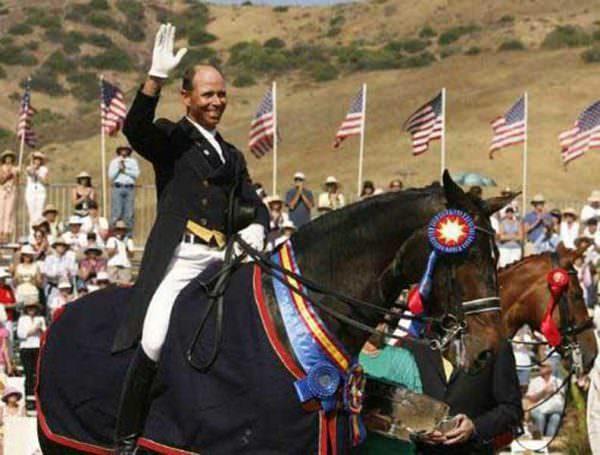
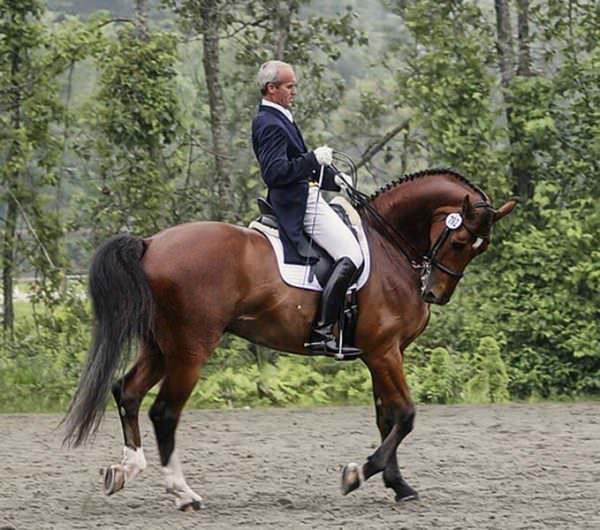
And yet another page with misleading material!!! Why have you included a picture of Steffen Peters with no explanation as to its inclusion? . Steffen Peters does not use Rolkeur in his training. To me it looks like you need to take a step back, do some more research and maybe some more hands on training yourself to understand the difference between rolkeur and getting a horse to stretch. Steffen Peters is one of the most sympathetic riders at international level. I don’t know how I came across this site but the more I read the more sickened I am by your skewing of information. If you have a point to make about rolkeur then do so without involving people who don’t employ the method at all!
And yet another page with misleading material!!! Why have you included a picture of Steffen Peters with no explanation as to its inclusion? . Steffen Peters does not use Rolkeur in his training. To me it looks like you need to take a step back, do some more research and maybe some more hands on training yourself to understand the difference between rolkeur and getting a horse to stretch. Steffen Peters is one of the most sympathetic riders at international level. I don’t know how I came across this site but the more I read the more sickened I am by your skewing of information. If you have a point to make about rolkeur then do so without involving people who don’t employ the method at all!
This has been an insightfull post! Thank you!
Thank you for this article. You presented facts as unbiased as possible. Anatomically, Rollkur makes no sense. It is used to achieve short-term results, my guess is with the aim of winning high stakes.
The cavalry training manual explicitly forbids any such flexion.
Furthermore, it demoralizes and humiliates the horse, degrades the horse to a mere ‘exercise equipment’, shows the horse as a living, breathing creature no respect or compassion.
in this position, the horse cannot see properly, it cannot breathe properly, and it is in total forced submission.
Dressage, as all riding activity, is supposed to be a partnership of horse and rider.
Rollkur, in short, is animal cruelty.
There are no shortcuts to proper schooling. Most riders are underschooled and lack understanding.
If you want to see what the result of proper schooling looks like, watch old videos of Reiner Klimke and Ahlerich.
Thank you.
Stefanie Reinhold
http://www.reinholdshorsewellness.com
Cheers!
Hi, great blog, thanks for speaking up, the equestrian world needs people who dare…. 🙂
Thanks Veronica, if we add enough voices to the mix at some point they can’t deny hearing us. 🙂
Hello everyone. A ‘kur’ loosely translates to ‘cure’ in English, or ‘therapy’.
I rode my first horse like this, due to my own bad training. I was a novice, and even I recognized that going around with his head nailed to his chest was wrong, wrong, wrong.
Took me quite awhile to undo that mess and get him move semi-correctly again.