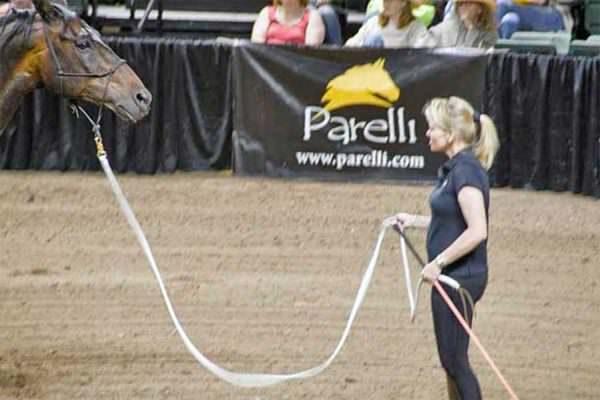
Natural horsemanship has been a method of which great expansion has occurred over the last 15 or so years. We've seen it flourish into a great marketing enterprise for many clinicians who expound on the amazing feats it can accomplish. I have a lengthy background in natural horsemanship thanks to one of my first instructors. Even still, there has always been something which struck me as “not alright” in the way that Parelli came across to me, right from the beginning. I've seen Pat's videos, listened to audio and watched demonstrations in person. As his wife, Linda, became more involved and publicly instructive I felt the same way. Unable to put words to those feelings for a long time I continued my own journey.
I hadn't thought about the Parelli's beyond a passing thought for some time, and it was only after being sent this video that my mind began perusing through those old feelings and finally able to put them into words. In the following video you can see Linda ‘demonstrating' how to correct a supposedly out of control horse, who is blind in one eye, after her owner/handler has failed.
[fbvideo link=”https://www.facebook.com/writingofriding/videos/1513808938666348/” width=”640″ height=”480″ onlyvideo=”1″]
I suppose everyone who watches the video will come away with a slightly different feeling, here are my thoughts on the video and my previous impression of Parelli Natural Horsemanship.
Trust: this horse has not come to fully trust his person. Obviously it is a bigger hurdle because the horse is also half-blind, but it's obvious in the way he's searching around him looking for any danger that could jump out and forget his person! he can fend for himself. He's distracted, none of the people handling him are providing any reassurance that there is nothing to fear and instead are reacting to his reactions.
In my mind, a method can only go so far. To apply the same practice to every horse in every situation is like saying that all people will respond the same to a style of teaching, environment, motivation, stimulation.. to which we all know that is not the case. That is where many horse training methods fail me because they don't allow any room for error or individuality, and why the Parellis have no appeal to me.
The Parellis have put forth a system that takes equestrians from one step to another in a very specific and methodical way, leaving no room for wavering. This can be beneficial in the learning process, but it then carries over to expect the same order of progression and results from the horses. If you're an experienced horse-person you can see where changes need to be made, but given that Parelli is pushed so strongly for beginners and those without a lot of educated experience those horse-people miss that there are areas you need to deviate from at times.
Which leads me to my second observation… of all the natural horsemanship clinicians, and perhaps connected with just how prevalent and wide-spread Parelli's popularity is, I have never observed a method producing so many dysfunctional horses. Through the years I have been conditioned to naturally shudder when I hear that a horse has been trained using Parelli methods, and now the owner is beyond recourse and needs help because the horse is dangerous. The other scenario is the horse is primarily a pasture potato, the owner has done the 7-games with him, and thinks the horse will make a great riding horse… only to visit the horse and find an animal which has learned how to use his size and strength against people, has no consideration or respect for you, and has zero inclination towards doing work of any kind.
There are happy exceptions, as there always are. I have a few (very few) close friends who use Parelli techniques and due only to their exquisite timing and understanding of the horse do they find a great deal of success with it. Largely because they don't follow it to a t, can read their horses and are developing a relationship with their horse outside the scope of strict Parelli Horsemanship. Then there are many others I watch and can't help but think, “they're going to get killed doing this, or inspire someone else to try this and themselves get killed!”
Don't get me wrong, the Parellis are a powerful marketing machine. I acknowledge I wish I knew how to market on their level (but not how to market horse training, that's another topic for another post), unfortunately it shows the inherent weaknesses when money trumps the welfare of their students and horses.
So where does this horse and rider duo fall? I see Linda's efforts screaming two things; she is afraid of the horse and the horse doesn't understand her. [Edit : The horse *may* have some understanding of what Linda wants, but the lack of trust trumps her attempts at communication in this style.] Keep in mind, horses move into pressure unless trained otherwise. Even when trained if there's a hole present the horse may revert to his natural instincts. In this case the pressure Linda is applying is in the front of the horse by shaking the lead, popping it at the horse's chest, swinging it in front of herself and the horse. What does the horse do? He moves into that pressure.
Eventually she begins to get a half-hearted response from the horse once her efforts become so great that she's showing fatigue over it. If you're working that hard something is out of place.
Why is she working that hard anyways? She's starting at the end result – shaking the lead to get the horse to step backwards. But what if the horse has never been taught to take a step backwards to begin with? Obviously this horse doesn't know what Linda wants with excessive lead shaking, and if that's the case then take a step back and fill in the gap. Start somewhere that makes sense to the horse, comes with less effort and you can wean into another step and another if necessary until you get to the end result you want.
If you were given a Calculus problem without ever having learned basic Algebra and given no steps in the learning process would you keep trying or throw your hands up in frustration? I'm in the latter camp.
That is the fodder for my dislike and distrust of Parelli Natural Horsemanship Methods. Being so rigid in your method that you put horse and rider at risk is completely inappropriate for a “professional”.
Parelli's Video Response to Horse Abuse Video
Update May 16, 2010
To be as fair as possible, I'm updating this to include the rebuttal video that Pat and Linda Parelli shared after so much outrage about the above video clip.
https://youtu.be/GEo-_pyz-z0
I just .. well it's hardly a response that makes me change my opinion of the situation. It's full of their marketing jargon and completely excuses the poor approach because the ends justify the means.
Join 3,000 Equestrians
Receive New Articles In Your Email


Excellent – thanks for writing this. 🙂
I always had a weird feeling too about them and you put it into words beautifully!
Erica,
Thanks for the good article. I agree with most of your comments, but I wouldn’t expect to change too many opinions. Parelli disciples are a dedicated lot and very defensive…
Doesn’t the fact that they are “very defensive” say it all?
Another agree…. I work professionally with remedial horses (although it’s generally the owners that are remedial) and I’d say over 50% of the horses I see have been messed up via Parelli. I’m a big fan of natural horsemanship and use a lot of the techniques in my work, but not the cult of Parelli, which seems to churn out preaching holier than thou “experts”. Thinking yourself an expert with horses is very dangerous. Never ever ever stop learning. The day you know everything and are convinced your way is right and everyone else is wrong is the day you should hang up your boots and hat and take up knitting. Like Lisa from Germany I use bits and pieces of everything and put together what works for each individual horse, but have found very little to like in the closed shop that is Parelli. I LOVED the comment above calling you an idiot because horses move away from pressure. Dear “P”, horses are naturally INTO pressure animals, meaning they increase pressure. If you put a halter on an unhandled horse and pull the rope it pulls back and away from you, INCREASING the pressure. Horses only decrease pressure when they have been TRTAINED to do so. Similarly if you try and push an unhandled horses bottom away from you, it will actually lean into your hand, as opposed to a well schooled riding horse that has been taught to move it’s quarters over in response to pressure. Go try it sometime P…… x
I think you said it perfectly with ” Thinking yourself an expert with horses is very dangerous. Never ever ever stop learning. The day you know everything and are convinced your way is right and everyone else is wrong is the day you should hang up your boots and hat and take up knitting.”
I feel like that sums up my thoughts on Parelli – I respect it for all the great things the programs have done, but I wish the propagators (Pat and Linda) were more humble and willing to admit when they make a mistake, which is bound to happen. Admitting that you made a quick decision and in hindsight you would change something builds trust and makes you human… I wish more high level practitioners of Parelli (and other) would practice that level of humble honesty.
This video makes me want to vomit.It’s not for every horse….ugh.
Hi just watched this and wouldn’t you think that a half blind horse would be treated with a bit more respect? Where is there any respect from anyone. Long time horse lover and owner I have taken bits from every where to create my own methods. By in no way am I an expert but seriously this video is awful
Yes!!!! And skirting issues is obvious!!!
this video isn’t pretty – the horse obviously does not understand and I believe there are gentler ways to introduce the horse to the idea – I agree with you – a little pressure on the nose to introduce the concept and LOTS of praise = happily co-operative horse…I really missed the praise in this video and so did this horse…thanks for this article…
All she was doing was distracting the horse by freaking it out, and going on and on with the same actions, flicking that rope at the horse, even at his faace. The horse clearly had absolute NO IDEA what was wanted (and half the time I could not tell myself, so what chance did the horse have?), and was simply getting more worked up and worried. When she did go to ‘reward’ the horse, the horse thought he was going to get hit again. Truly awful, I don’t understand how Parelli has become so popular. This is NOT good horse training or technique. Turns out the ‘behaviour’ she didn’t want was the horse to look at what was going on around him. Ridiculous.
Wow – I don’t think you have studied Parelli enough
Thank you! These people have no idea what Parelli really is.
I absolutely agree with you!!!! I couldn’t figure out what she wanted this horse to do. The horse was trying his best…..she’s fortunate the horse did not trample her!
What a great way to get a discussion going on Parelli. You have presented so many of the main negative arguments about Parelli Natural Horsemanship in way that I just have to respond. It seems that you have had some casual contact with Parelli and natural horsemanship, but have never attended a Parelli clinic or been to a Parelli event where you have been a participant.
Parelli horsemanship is so far from being one rigid method that it is close to the other end of the scale. If you learn the various “horsenalities” they teach and how to handle each one you will see that.
The people who have trouble with Parelli horsemanship are people who have either had insufficient exposure to it, or who are unwilling to change themselves, and keep approaching their horses with the same old mind set.
Anyone who says that Linda is afraid of the horse in the video does not know Linda very well.
Thanks for being so opinionated. It’s a great way to start a conversation.
Seth,
haha, glad to be opinionated… and hopefully bring about more conversations. IMO, they are essential to any learning endeavor! 🙂
I have audited Parelli events, and am familiar with their ‘horsenality’ theories. I can’t help but connect the idea of attributing a personality to a horse – whether it’s based on left brain/right brain, their facial features, hair whorls, etc with attributing a stereotype about a person based on their facial features, hair tendencies, etc. Actually, if I recall correctly that was food for some of the early ethnic cleansing and scientific ‘proof’ that certain people were inferior or superior by skull size and such. Truly though the scientific community as a whole would classify ‘horsenalities’ to the same realm as astrology, Chinese horoscope, reading tea leaves, etc. While people may believe in them and see some tendencies, there is no way to test and prove them as fact.
Any method could also claim that those who have not had success are simply inept in some fashion (i.e. unwilling to change) or haven’t had enough training, not just Parelli. A beautiful loop-hole? 🙂 And finally to counter your mention of not knowing Linda Parelli well enough to know she is unafraid in the video… I have a question in response. Does knowing a person on a closer level help or hinder your ability to see their actions without prejudice? Can knowing the person more intimately cloud your judgement? You know the old saying of rose colored glasses… 😉
I appreciate the conversation!
Sorry Erika, but you just lost a little bit of respect from me with the “I have audited Parelli events, and am familiar with their ‘horsenality’ theories. I can’t help but connect the idea of attributing a personality to a horse – whether it’s based on left brain/right brain, their facial features, hair whorls, etc with attributing a stereotype about a person based on their facial features, hair tendencies, etc.” comment. I really liked most of what you said til then. Sorry :-/ but you can’t be that familiar if you think whorls are part of ‘horsenality’.
For the record, I am not a huge fan of Parelli mostly because I think they have gone too far into it for the money and are ignoring a HUGE lot of people that could really benefit from them. With that said, I did use the 7 games to work with my Arab/Barb mare who, when I bought her was 6 years old, WAY beyond excitable and had only done Fantasia (the festivals in North Africa with the guns and shooting and whooping it up) 🙂 After working with her using Parelli methods, my 8 year old daughter was able to ride her on the beach with no problems. I got what I wanted out of it but wasn’t so strongly tied to it to say it was the ONLY way. Just my two cents 🙂
Stefanie,
You are right, if you continued reading through the comments you would find my reply to Jeanne pointing out that I had referenced hair whorls in place of the right brain/left brain, introvert/extrovert that is true horsenality. There were people going around at many events in 2000-2001 time frame who were proposing the horse’s personality based on head shape and hair whorls. This blunder on my part is why I no longer field comments and make replies at 3:00am. 🙂
There are always pieces of every method that are worthwhile and work on certain horses. You found the 7 Games to your benefit and that is not unique – which is why Parelli has so many followers. If a single thing he did worked on zero of the horses and riders then he would not have a business. 🙂
Cheers!
So far, this was Linda Tellington Jones who made the definition of the horse personality by hair whorls 🙂
Do you have children? or horses? or dog? or friends? There are some people that are more outgoing, some that are more quiet and reserved, some that take on the world and some that could care less about what is going on around them. Well let’s give them a name and figure a way for describe the best way to motivate, help build confidence, tone down, and make feel safe. If you don’t feel your horses/ kids or dogs even can fit into a category or a couple of them I feel very bad for them, you are missing out on how they are made.
There is actually debate in psychology about whether labeling people is helpful or harmful.
My own personal preference is not to place my animals, or other people, in boxes (er. Labels).
The truth is that even if someone tends towards one set of behaviors, they are apt to change drastically in the right company or under certain circumstances.
Also the phenomenon which is the horse mirroring us as riders. Often what you think is a trait of your horses is actually your trait or issue that hasn’t yet been resolved. Particularly in the case where you have a tendency to see the same/similar issues in several horses during a period of time. So in that case what use is a label that might not even be your horse’s?
Cheers,
Erica
if you have a child that is better taught by close contact and repetition, ( close guidance) and you tell the teach this, and one that you only need to shown one and will tackle the project, it is not labeling and putting them in a box. As you use the knowledge of how the child learns best to help them to succeed then you are doing a great thing. The child does not get frustrated or fails. It is sad you are not able to see the horsenalities give you a way as to understand the horse and environment that is best for him to learn in do to personality traits. When filling out the graph it is very important that you do not look at the horse as a human. I agree some people will call a horse stubborn if he doesn’t understand. Again it is using the information properly.
I had a terrible time trying to understand your first paragraph?
You aren’t supposed to give the horse human traits, but then compare the use of horsenality to teaching a child based on their traits? That confuses me.
Also you aren’t addressing the horse and saying, “he will learn better with visual imaging vs spoken instruction,” you are in fact giving a label that is open for bias depending on a person’s experiences with other horses and people who’ve been likewise labelled. That is one of the main features of labels is they allow us to shortcut the amount of time it takes to recognize something – well now you’ve automated the process of recognizing the horse as an individual. How is that not a box?
I had a terrible time trying to understand your first paragraph?
You aren’t supposed to give the horse human traits, but then compare the use of horsenality to teaching a child based on their traits? That confuses me.
Also you aren’t addressing the horse and saying, “he will learn better with visual imaging vs spoken instruction,” you are in fact giving a label that is open for bias depending on a person’s experiences with other horses and people who’ve been likewise labelled. That is one of the main features of labels is they allow us to shortcut the amount of time it takes to recognize something – well now you’ve automated the process of recognizing the horse as an individual. How is that not a box?
Describing techniques that someone better learns by is different from giving someone a label. So which is it you’re describing? The horsenalities prescribes the horse a specific label (a particular box, if you will). There are only certain traits that fit inside that box and everything else is excluded, just as there are certain ‘techniques’ used to address the horse that fits inside that box. But for the horse who doesn’t fit neatly into one box?
Labelling is a shortcut for convenience, which in many cases can be beneficial, but in the case of undestanding a unique individual it can frequently fall short.
If you fill out the chart you will see most horses do not fit all in one box, thus not “labeling them” but you will find many of their attributes collect in one area. My horse when he was younger had a majority in the RBE, but he had some RBI and LBE. So what I did was use that knowledge to help him be a better learner. AS our relationship emerged, I did the chart again at random times and it changed. He went from so many extremes with tendencies to bolt, and be overly suspicious, to much more brave, he doesn’t bolt anymore. And now that he is much more confident (LBE) I use different strategies to help him be a better learner. So never reassessing him would have been a disservice to him and we would have not gotten any farther because ways to help him learn has changed. But I know that innately he is a RBE. The good horseman plays with the horse that shows up. On day he may be more reactive ( which is still way less than he was years ago) I am going to play doing things that he is comfortable doing and bring the refinement up. Where there days he is confident, it is a good day to ask him to go forward farther and do many new things with him. That being said, I don’t see your statement that parelli is “a one size fits all” or ” like the public school system” it just shows that you are not as versed on this program as you state.
That is exactly what horsenality does, describes ways in which horses with different types of personalities traits, more fearful, more confident, etc can be taught to become more rounded and confident. As I stated in my last post. I just don’t see how you think horsenality is hard and fast permanent labeling when it is forever changing as the relationship grows. My horse has changed so much from what he was and the fact I learned how to help him become more rounded as time went he progressed very well. I just do not understand where you are coming from. It makes no sense. My horse started out being an extreme RBE/ RBI with a smattering of LBE. Now he is mild on many aspects of LBE/ RBE. I know that he may at times fall back on his RBE because that is how he is wired innately, but because of the relationship we have built he has changed sooo much. All because of knowing how to help him.
Describing techniques that someone better learns by is different from giving someone a label. So which is it you’re describing? The horsenalities prescribes the horse a specific label (a particular box, if you will). There are only certain traits that fit inside that box and everything else is excluded, just as there are certain ‘techniques’ used to address the horse that fits inside that box. But for the horse who doesn’t fit neatly into one box?
Labelling is a shortcut for convenience, which in many cases can be beneficial, but in the case of undestanding a unique individual it can frequently fall short.
I think your comment was very fair and well stated.
ok one question…
are u a professional horse trainer??
is pat parelli telling to his students that they will be professional horse trainers in one lesson???
is it tru that most of the people that get in truble or better hurt is just because they try to do things that they dont even know???
Pat never has even eluded to people being a professional after one lesson. Good better best , never let it rest, make your good better and your better best… I have heard him say that so many times. He always talks about never ending educations that horses give us and learning from horses is a lifetime commitment. No one knows everything….
i dont like parrelly onestly but i think people usually get to exited for having a little result with their horses that they think they are professionals…
You really don’t know what you are talking about Erika. Horsenality has nothing to do with facial features and/or whorls…and, they are not a “one size fits all” sort of thing. It is simply a way to analyze horse’s innate/potential behavior based on many things (training, experience, what he/she was born with, level of spirit etc) ..and, it changes under differing circumstances…just like people’s behavior will. Parelli does not put horses “in a box” and that is what you seem to be thinking.
As for the video.. the portion, taken out of context, is, indeed ugly and could have been done differently but, that was filmed almost 7 years ago and Linda’s expertise has come a LONG way. There is much more to that video that the person purposely didn’t post because it explains what is going on (by the way, posting this video is a violation of copyright laws I might add.) I don’t see anyone fussing over the behavior of so many other “professionals” who treat horses far worse at clinics or on film.
I am not going to say that Parelli is the end all and be all of horse training but it isn’t fair to knock something so hard without knowing more about it. There are horrible horse training stories attributed to the best training methods and there are wonderful stories found from the worst of training methods. Use what works for you but don’t slam other’s view and opinions.
Jeannie
Jeanne,
The idea that the Parelli’s are not putting the horse in a box by presenting a judgement on the horse’s personality period is proof against that call. Many people put heavy weight in horoscopes/signs/etc, but would it be fair of me to judge what type of person you are based on your astrological sign? Would I be putting you in a box? I know that I would certainly feel trapped in if everyone were to judge me based on certain criteria 100% of the time. How does that allow for growth if you already ‘know’ my potential and the way in which I think, act or react? The right-brain / left-brain and intro-vert / extro-vert argument I have a difficult time swallowing. Certainly it is an easy sell. Why? Because people can relate to it. You point out x and y traits and give them a name and if someone feels like they have those traits they say, “a ha! That must be what I am!” because humans love to label and identify things with names. We put names on everything… even if it hinders rather than helps us. In some ways it is what helps us to organize and make sense of our world. It can also keep us from seeing the trees for the forest. It can blind us from seeing more detail by assuming that a maple tree is always a maple tree. But, I digress.
I do not doubt that Linda has grown over that 7 years. Simply working with horses for that period of time requires growth and change. Regardless, as a professional this is one thing that you risk – critique, public or private. Anyone who puts themselves out for others to see does just that. I do not expect everyone who reads my blog to agree with me or to even enjoy the blog, and it has been my own experience that trying to please people only hurts you in the end and reduces the quality and value of your work. I won’t agree that Linda has grown to a place of perfection over that 7 years, or that I approve of her anymore now than I did when I was first exposed to her work alongside Pat. If you look hard enough you will certainly find people critiquing most anyone. 🙂 Public opinion isn’t always correct. A million people can be wrong… it is what makes fads and decides popularity contests. Think back to what seemed important in high school, does it still seem important? Probably not, but why was it so pressing for you at the time?
Another point about being critiqued. It is an invaluable tool for improvement. Some of the greatest people do not shy away from critiques but rather embrace them. There were no personal attacks towards Linda in my post, simply my observations. Nothing a person does in life is always perfect, and critiques can help us if we choose to use them. It is through isolation of ideas that we stop moving forward and stagnate.
If my own opinion came off as a slam, then so be it I guess. Is my own opinion of any less value than another person’s just because I am not in support? No, and that is the beauty of living in a Democratic nation (for me at least), rather than a nation such as China where my opinion might very well be blind-sided if it is out of alignment with that of the controlling interest’s. 🙂
Cheers,
Erica K.
Erica, I can tell you have not done a horsenality chart on your horse. Not one not 2 not any. It has nothing to do with a zodiac sign at all! It is a way for you to look at the many points of your horses personality and see what is the best way to help him learn from you. A horse rarely ever comes up in only one quadrant and while it is subjective as to extremeness, the goal is to help the horse become more mentally balanced and less extreme. You start with one and as you go on with your horse, you can randomly do more if you want and you can see the changes in you horse. I have a horse that was an extreme right brained extrovert for the most part and had some introvert tendencies as well. As we played more and more, his extremeness went away his confidence blossomed, he became more trusting, more curious and no longer has a tendency to try to bolt when something starts him> sure he may spook but spooking in place is much less dangerous. he now is on the cusp or a RBE and LBE. Those 2 horsenalities have very different ways in which you teach them or deal with them. and you have to be knowledgeable as to deal with the horse that shows up. So there is NO cookie cutter one size fits all putting a horse in a box. I have the charts I did on Freedom and he has changed so much because I knew how to help him.
I’m non-plussed with some of your arguments against Parelli Natural Horsemanship. If you had actually quietly and open mindedly attended a course or had some training from a Parelli professional I think you would find that it is one of the fairest ways of ‘training’ horses.
Like many clinicians, they start off with any horse by assessing it and guiding it through a step by step programme to help the horse gain confidence and not view the world as a scary place. There is a strong probability that horses that have been spoiled by this method would probably have been spoiled by the very same people who had ‘trained’ them no matter what method was used on them, because sadly most people just don’t have the time, commitment and consistency to make a good horse,just as most people can’t even train their own dogs. It takes years of practice to learn ANYTHING and people like you and me and many trainers or clinicians are really singing from the same song sheet – we really do want to make the world a better place for the horse, but how can we put years of dedication and hard work into the mind and hearts of a novice human being, we can’t.
Please, try and see the bigger picture here. Yes, some of the clinicians are making big money, but do you really believe that in their hearts they don’t have the well-being of the horse at the top of their list.
christine
Christine,
I find it interesting that you expressed your opinion that everyone who ‘quietly and open mindedly’ observes Parelli will walk away with the impression that it is one of the ‘fairest ways of training horses’. This reminds me of a boss I once had who would remark that “the bad staff don’t last and tend to weed themselves out” in an work environment that frequently changed management, wage policies, staffing and scheduling rules and so on. This set the stage that those making a decision in their best interest (not necessarily fitting of the business’ present policies) was therefore a bad person.
On the contrary, my tendency when being introduced to any idea is to pursue it with rampant, open-minded interest. My jumping wholeheartedly into learning more about something however does not mean that I will actually like it, nor does it mean that I will always spend a long period of time ‘testing the waters’ to see if my initial dislike is genuine.
At the present my stance is that anything which is money motivated is at risk of corruption – no matter the field, whether it is politics or horsemanship. Parelli Horsemanship is first and foremost a business. Like any business they will give certain things away for free – great tax write-off and even better PR. But their bottom line is making a profit or their business fails. If they were not money minded why is Parelli not a non-profit organization?
I agree with you that those who spoil with Parelli would like spoil with any other quick, gadget oriented, money motivated horse training method. The big picture in my mind is that there are so many of these kinds of trainers in every discipline and across the globe, that it is practically impossible to imagine some other kind of presentation of horse training.
Where I see the fault in any of these training methods – not JUST Parelli – is that so many are based upon the needs of the beginning rider’s whims. They want to do x,y,z with their horse before anyone has taken the time to teach them how to lead an old bombproof nag. They all want to train their young horse to be something fantastical without taking the time to learn how to ride properly a horse who has been there and done that. And clinicians help feed this. They are NOT addressing the necessity that riders must learn how to be balanced and quiet in the saddle, that they need educated, light and forgiving hands that are NOT used for balance, legs that can act lightly and independently from the seat. Instead they show people of any level of skill how to start a 2 year old in two or three days under saddle. How to fix head shyness in two days. How to cure spooking in a session.
These are the ideas which are being given away to the general public at horse fairs, demonstrations, clinics and so on. Sure, people can sign up for a long-term course and perhaps realize that these are not ideal training time lines, but what about the people who will not commit the time and money to go to these longer courses and instead go home with this free ‘knowledge’ and hurt themselves, ruin and torture (yes, I do mean torture) their horse from lack of understanding (not necessarily because that is their intent), and where do they go from there?
I do not assume that everyone has the horse’s best interest at the top of their list. When I was a teenager, yes. The more you see the less fantasy exists – luckily for me I still have the fantasy of how wonderful horses are in my life. Ignorance is bliss – I remember being in that place where everyone who was in the spotlight was magical, but I know better now. They are the same as the backyard rider, just better dressage with an entourage, more money and more expensive horses/tack/etc. 🙂
This is an old thread, so maybe my reply is inappropriate. I took one of the first clinics that Pat Parelli put on in Canada way back in 1996. I had read his book, and while it was somewhat confusing, his philosophy seemed sound. It was a horrifying experience. I saw horses that came to the clinic well behaved begin to rear and challenge their handlers. At the end, I saw Parelli do a trailer-loading demo with a big Appaloosa gelding who had been happy to get in the trailer to come to the clinic, but was so disgusted and antagonized by what he had gone through over the weekend that he resisted with everything he had the “carrot stick and progress string” also known as a very expensive whip and every other thing that was involved with getting him in. It took hours, and I left before he was in the trailer. This was a horse from a lovely home where he had been shown and had lots of handling and was in no way a “problem” horse before he came to Parelli’s clinic. I also saw people succeed. Overall, the impression I got was that this method completely lacked any means to convey “tact” to people, and that it would result in people getting hurt/killed, and horses being needlessly tortured and ruined. I don’t want to go on and on, but it was awful!
And it was multilevel marketing–AMWAY–in every sense of the word. Parelli tried to recruit people to host clinics and they were to get all or some of the proceeds paid by the auditors, or something like that. It’s so long ago I can’t remember the details. At the time, I estimated that he had made about $25 000 over the weekend
And people who didn’t buy his overpriced glorified cowboy halters made thin so as to be severe, got no attention. I was one of them. On the other hand, there was a fellow there named Glenn Stewart who had absolutely no horse sense or ability and created lots of problems with the horse that he brought. But he had tons of money, and bought into the Parelli Amway system, and is now one of the higher level trainers in the system and highly sought after as a trainer in these parts, but what does that prove? I don’t know. To my eye, he has improved very little.
My mare that I brought to the clinic had come from a very abusive trainer and I had spent a great deal of time gaining her trust and confidence. I was able to get her to “play” the seven games, but not using his methods–“Lead, Lift, Swing, and then Hit them in the head (He said they were running into the rope b/c they did not move)” to get them to go out on the circle, which was of course not lunging. I could not make myself hit my mare in the head with the soft cotton shank I was using, let alone with the nasty little leather popper on the end of his ropes. She was getting upset and worried, and I was able to stop and think for a minute, and then I “Lead” with my hand and gave a tiny click with my tongue and she said “Oh, you want me to go in a circle!!” and did it. God knows what sort of torture she would have been put through by him or one of his acolytes, or by a horse owner who did not have the confidence and knowledge to trust their own instincts. Bear in mind that this was a mare that I could turn loose in the arena and free lunge in a big circle while there were other horses being ridden, and horses tied all around the edges inside the arena. She would walk, trot, canter, whoa, and come to me. This was all done without a roundpen, or drilling, or forcing. Later I had my old mare there as well, and she knew different voice commands: walk, jog, lope. I could free lunge them together in the same situation.
One of the other Seven Games, the “Squeeze Game” is a game designed to teach horses to run over/mow down their handlers, and should never, ever be taught. The way he does it is not designed to instill trust and respect in the horse, but rather it is acheived through intimidation. A horse that is afraid and/or disrespectful and/or resistant can very very quickly figure out how to make the handler give ground, and then the wreck is on.
I watched the first versions of Parelli’s videos–they are probably not around any more. The horse he used as a demo horse for the seven games was high-headed, resentful (ear pinning/tail swishing), angry, and unhappy. He was constantly placed in a “flight or fight” mode–is that left or right-brained–who cares and what does it matter. It was plain, that although he was well-versed in the methods, he hated every minute of what he was doing. It was in every way counter to what we are supposed to be trying to acheive–relaxed, confident, thinking, engaged, focussed, willing partners.
There may have been great things acheived by people who use this method, but I would hazard a guess that their horses went through some misery before they got there. There are so many other ways to acheive success that are fair and just to the horse, and that don’t demean him and turn him into an automaton or a psychological wreck!!
I have NEVER put my horse through misery. EVER. I have never done anything to him that I would not be proud to put on Tv , or have my mother, or anyone else that wants to watch it see. I play with my horse out in the open and have had people going by the farm stop and watch for quite some time as questions and state they love watching me with him. I have even taught some young kids. My parelli horse is completely changed from the horse he was, his is kind, spirited confident, and funny. he is forgiving ( as sometimes the kids that have played with him make mistakes) and does his best. I am sorry you did not have a good experience. and I don’t understand how your horse got hit in the head by lead lift. But I can assure you there are no REAL parelli people out there that would or do put their horse through misery to get there.
If someone has a love and a passion for something, spends a lifetime living that has become a such master at it, that many are always asking him ” how did you do that” because they see his horses so confident, safe, and such a partner, is he BAD for turning it into his livelihood? People are so quick to bash them because they are good marketers for their product. I believe he and Linda do have the best interest of all horses at the top of their list. I am personally NOT a fan of how the corporate direction Parelli is gone but that is very different than living the philosophy that started it all. Seems like people expect others peoples blood sweat and tears to be given to them for free. That is why people have a problem with them making money.
Nicely said. Very fair and nicely said.
Hi Erika~
A much more well presented response. Thank you.
I still don’t think you understand the horsenality thing….it is actually quite helpful in knowing how to react to specific behavior. It is not at all stagnant and a horse can flip back and forth along the spectrum in the flash of a second. Yes, people like to label things but, if those labels are used as a tool while not “canning” a horse, then where is the harm? If you have children, you know that you would deal with a child very differently depending on whether he was tired, sick, upset, distracted, exuberant, etc. It is the same sort of thing with the horsenality theory. Horses don’t always respond in ways we anticipate so we all must adjust accordingly. PNH does address this and doesn’t profile the horse and set his nature in stone.
I agree, there is no perfect horseman out there though some would like to claim that title. We are all in this learning together. Pat credits numerous horseman in his path of learning and Linda has been actively taking lessons with Walter Zettl (sorry, probably didn’t spell his name correctly) to correct lots of problems in her riding and horsemanship.
Criticism is important and anyone in the spotlight, is indeed held to a higher standard. I think it’s fair to criticize but empty criticism only incites polarity. I’d rather discuss “what could have been done differently” rather than…oh, they/their methods are weird/I don’t like them. I suppose everyone is entitled to their own opinion, and, it makes for lively blogging….afterall, it *is* your website and you can post what you will.
I don’t think your post really came off as a slam but, it’s always easier to point and complain than it is to try to understand other methods. I believe they all can be helpful at some point in our life’s journey.
Jeannie
Jeanne,
You’re welcome. 🙂
I do get that the horsenality labels are changeable, but then if they are being redefined why give them at all? The issue I see is that by giving a label at all it brings us closer to making assumptions. Not only that, but often what is going on with the horse is our own issue anyways and we are projecting. The brain likes to skip over ‘small details’ and labels are one way of doing that. When we see a red cup it is only a red cup, but if we look closer at the details there are more colors in that cup than just red, various shades of red along with the reflected colors of objects nearby. But if we only say “the cup is red” that is all we will see.
I understand why the Parelli’s use this system, because they are trying to wholesale teach something which is an art as something which is merely actions and tact (or saavy). It is a difficult line to walk.
In the last two paragraphs I made my own observations, but also remarked about different things which could have been done. The beginning of the post I made a sweeping introduction about my initial impressions of Pat’s methods, which were unspecific feelings, though later I went on to sum up just what those feelings were once I had gained enough education to put those feelings into words as far as horsemanship goes. Did you read through the whole post?
Cheers,
Erica K.
Yes, I read the whole article.
Horsemanship is certainly an art and going through any packaged program won’t make one a horseman…but, it is the first step for many. I applaud all of the horseman in all disciplines who try their best to teach people. Horses know what they know…we need to learn from them and, like it or not, the Parellis have developed some good tools for the average person to work with. What they may call “Savvy” is simply “good horsemanship” to most. Do they make mistakes? Yep..don’t we all? I could do without the marketing hype but I suppose they need to make a living! lol
Anyway, I don’t want to start a debate about what qualifies “good horsemanship” or not…
By the way…you have a really nice site here. Good writing, great photos…glad I stumbled across it.
Jeannie
I wish sometimes that the top clinicians would stop and tell their audience that there is more, but in a way I think that might make people feel like the person is disqualifying themselves. Something like, “this is a beginning, but horsemanship itself is an art and I am merely helping you learn how to paint by number right now…” 🙂 haha, I just don’t see that happening too soon though.
I am glad you like my blog, I’ve enjoyed our discussion and am happy to have you here. 🙂
Cheers,
Erica K.
I certainly can understand your uneasiness with the Parelli method. There certainly are many folks out there that are in danger of getting hurt by their horses. I’ve witnessed many who have started working with Parelli methods and most of them never really continue through to an adequate level and many think they know what their doing but they’ve never studied under the professional tutelage of a certified Parelli instructor. I have to admit, my experiences watching Linda work with horses has left me a bit cold as well. However, I have seen many who have taken the Parelli method seriously and not only work with their horses multiple times per week over long period of time, but they also go to clinics and let their technique be criticized and corrected by an experienced instructor. For me, it was at those 3 – 5 day clinics that my learning and subsequent progress soared. I have since been able to take dangerous horses and transform them into safe mounts for riders of all experience levels. However, horses are an every changing being, as I’m sure you are well aware, and the behavior of a new owner could make a safe and bullet proof horse into a dangerous animal. So, I guess what I am saying is, don’t judge the Parelli method by the dilettantes who dabble in it or Linda who because she has the public’s ear because of her husband’s talents expounds like an expert. The stuff really works if you work at it and are willing to be corrected by those who can do, like my instructor, 5 star teacher, David Lichman. I’ve trained horses for over 35 years and I’ve gotten my best results since I began following Pat Parelli’s consolidation of the knowledge of hundreds of great horsemen.
I’m glad to hear you’ve had success with the Parelli method Joe. 🙂
Totally agree with you. I learned to ride with a woman who had been doing natural for 20+ years and she was great. most of her stuff was based off monty roberts, but with more convetional methods. It worked well and she made sure that the horse and rider always had a great, safe bond. I ride my own horse in the ‘normal’ conventional way, and it is my own personal belief that if you treat the horse right then you should have that bond with them, no matter whether you are ‘natural’ or not. I agree that Parelli’s methods, in general, are fostering the horse being in control of the partnership, and when the rider or trainer is already scared, and the horse had a stubborn, mean or disobediant streak in them, like most horses do, this doesn’t often turn out well. I give kudos to those that have managed to get horses working well using parelli, as they need to be confident and in control the whole time.
I would just like to say that I agree with you Erica, most especially about the marketing aspect of the Parellis. I think it is very dangerous to mass market a skill level & art form that takes a life journey to accomplish into something resembling a (very expensive!) paint by numbers package. I feel the same way about the Parellis as John Lyons, Clinton Anderson & on & on & ON that these people have taken very lucrative advantage of Joe Public Rider’s weakness in believing that many years of experience, hard work and thoughtful study can be bought in a weekend. I don’t doubt that these individuals themselves have talent and experience but the idea that you can package it & mass produce it I frankly find offensive and irresponsible & totally lacking in integrity. I am most offended on behalf of the horses who have no option but to become the ultimate trick ponies left with no dignity & no expectations. That said, I would be first to say that this sort of behaviour can be found in all disciplines, it’s just that the ‘natural gurus’ have done it on such a huge scale. I would also like to add that without exception every Parelli method trained horse I have ever met feels more programmed (a la Pavlov!) to me than trained (& they’re often kind of a pain to live with!)
PS that video made me just about sick to my stomach & by the time I hit send on this post I am going to be mad as hell! “Horse-man-shit” is right!
I didn’t watch this video. But I had a booth across from the Parelli’s booth one year at the World Equitana. I watched his video at his booth, where i was dismayed to see him galloping a horse up behind a horse trailer being pulled by a pickup truck, and leap his horse into the trailer, all while riding it bridleless and bareback. A feat no doubt!, but who does that? Why? I later went and watched his demo, and his horses circled around him behind his back, with apparent distrust? their ears pinned tightly in angry pissyness. I would not argue with his ability, but am not impressed by him. Salesmanship, yes. He never gives credits to the old Vaquero traditions… he claims to be the originator of “natural” horsemanship, forcing those who know better, to find another term. The old vaquero type horsemen will quietly give all due credit to their predecessors, and will tell you they will help you, but do not know it all, far from it. That is what I am comfortable with, and trust. One of my favorite local trainers in my area, has a Parelli background, and she uses it with dignity and wisdom, I am very impressed… so we can learn from the right things anyone puts out there, as well as from the wrong things, as we recognize them. Happy Trails.
I also have a close friend who uses some of the Parelli ideas – with a great deal of tact and talent – combined with common sense and a lot of respect for her horses and has great results. 🙂 For me, she is an exception and I know there are more out there, thank goodness!
I watched the video and it only confused me. What was she trying to get that horse to DO? If I couldn’t figure it out, what chance did the horse have?
Beth, those were my same sentiments – for the life of me I couldn’t discern her direct intentions without listening to commentary.
I think everyone has their own opinion on parelli and I love the I like the stages and the games my horse always freaked out then I found parelli and they helped me a lot I think a lot of people pick this natural horsemanship to criticize because it’s confusing and if you don’t understand what she is doing then you think she is hurting the horse but she isn’t, it’s a game the yo yo game and their are phases to the games, go on the parelli. Website and do some reacher before making these accusations on things that are not true, horses have a chance with parelli everything works we are partners with the horses and they love to play with us , you have to watch the full video other wise it won’t make sense either, just give parelli a break their great for some people a lot of people choose them cause it works for them when I was training a foal it worked I can get on him on two and not get bucked off just because of all the preparation work , I love parelli and I hate it when People criticize them if you don’t like it keep your suggestions to your self
And you don’t have to write a full article on how bad they are
Wow! folks are still discussing this clip! There is about an hour of footage with explanation in the level 1 dvd set of this particular horse/session. It made me uncomfortable to watch and I agree that there are probably better ways to have worked on this but…basically, this horse is quite dominant and distracted. He kept barging into Linda’s space and she was (not too effectively) working on getting his attention and getting him out of her space. Notice how he keeps trying to walk over her and isn’t even caring about her futile flicks of the rope. She wanted to get him at the end of the rope and to basically stand in one place. He more or less does at the end ..then she continues to make him focus on her by backing him at the end of the rope. I think it was a poor video to put in a level one dvd set as it shows Linda in a bit over her head in the way she deals with this particular horse. She ends up getting the desired results but I, personally, think she would have gotten further, faster by moving the horse’s feet more with lots of changes of direction. The last think I would want to do with a distracted, bargy horse is to try to keep him still (but, keeping him out of MY space would be important)
There are difficult videos to watch of all trainers. I just saw one from another trainer that disturbed me even more than this one…but, sometimes drastic measures need to be taken. Seeing a 3 minute clip doesn’t tell the whole story…..I think we all need to have some grace while watching others work with horses. Horses are amazing animals and great horses have been trained with rotten trainers just as rotten horses have been turned out by great trainers! Use what works for your particular situation and learn from all you see.
Animals do not have interspecies space. If a rabbit run towards us we let him even jump into our hand. a cat may be aloud up to our leg and a dog at distance of a byte as firs approach. A horse is not bully because invade our personal space as he does not have this concept. This is the typical error of this techniques not using proper training and covering error with invented natural behaviors. Like the ” passive resistance” reed brutal force used in the demo with the horse Catwalk in England
I’ve watched that Catwalk video and I don’t even think it is Parelli. You can’t tell who it is, could be *anyone*. It might have been a demo by someone
who said they are Parelli instructor, but I really don’t think that is
Pat. It just stinks of an anti-Parelli set up to me.
It is Pat it was confirmed by their PR office and the many people watching
Parelli issued a public statement saying he was sorry people misunderstood for brutality what he was doing
He was just matching with a passive resistance the energy of the horse !!!!!!
that is not what pat said at all.
the exact words are Passive, Persistence.
Like the Carrot Stick the fact that you call it carrot does not change the fact it is a stick
Call it Passive does not change what was done
The Parelli blog change continuously so I could not find in it, but the statement is present in a heavily edited video by the Parelli on youtube search
Horse Training in UK with Pat Parelli, Robert Whitaker,…
A carrot stick is not used to beat or bash a horse it is not a whip which is why it is stiffer than most sticks. It is used as an extension of the arm. If you are using it with the string think of it as akin to a horses tail it is a tool used to communicate. A horse communicates with its tail it can flick towards another horse meaning back off or I will kick you or it can be used to say I will flick the flies off you you flick the flies off me.
the exact word are Passive Persistence,
It is difficult to find it in the blog as it keeps changing, but you can find on youtube
Like the carrot stick , call it carrot does not change it is a stick
Call it Passive does not change what was done
if you knew what a carrot stick was, you would understand the term. Over and over it has been explained it is in the middle between a carrot( mean the horse likes it to be rubbed on him the string draped over him, ( like his mom’s tail) and a stick. which can be used as an extension of the arm, to encourage forward. ask to move over, ask to stop ( waving it in from of the horses energy) In my case I also use it to call my horse to me. I slap it on the ground lightly and he comes….. when we were perfecting trailer loading and he was asking questions, as If he was doing it right, he would put his head under the stick so I would rub his head. Then he had even more reassurance he was doing well. I was taking him somewhere when he was young and had no experience on this certain trailer and it was a ramp vs the step he was used too. I told my friend it would going to take about an hour to make sure he was confident before we closed it. We did a lot of in and out and within that 1 hour, he was not only standing calm and relaxed in the trailer he was getting rubbed ad scratched, and loving it with the same stick I asked him to move forward with. My friend said that was the most beautiful “new trailer” trailer loading she has even seen. He was not sweaty when we got to out destination an hour and a half away, He backed off perfectly. When it came time to leave, I rubbed is but with the stick, gave him a light tap taps and he was on, as calm as he was when we left the farm. Again he got rubbed and scratched by it. So yes, it is a stick and it is a source of reassurance if I cannot reach my hand to that spot on him to let him know he is doing a good job.
You have clearly never paid much attention townhouses if you believe they have no concept of personal space.
Clearly 🙂 you have not idea what is a personal space.
Intra-species (meaning same species) personal space exist, but even for human to human personal space change. We have 3′ in front face to face but les than a foot shoulder to shoulder and back to back. When it comes to horses our personal space change and it is let say 4′ all around, but for cat it is less than a foot. Why ? What you are referring is the safety personals space we want from horses. They cannot know it until we teach it to them therefore they cannot ” be dominant by barging into our space”. So she should not have punished the horse for behaviors she is mistaking to identify and spend gentle teaching time to make him learn how he is expected to behave
She wasn’t punishing the horse at no point in any parelli training is punishing a horse advocated. This one statement shows you have no understanding of what you were watching. Of course personal space changes according to many factors that is simply stating the obvious. In this case personal space was an issue because the horse had gone so far into either dominance or total lack of respect for people that it gave them no regard at all let alone personal space. This was a case when the horses behaviour had crossed into one where real personal injury was a very real possibility. You can not spend gentle teaching time on a horse that is about to squash you without first at least making it acknowledge your exsistance.
first you say Parelli does not advocate punishment, than you say you cannot be gentle with a horse that is about to squash you. Applying pressure to reduce a behavior of a horse is by definition called Punishment, as for the carrotstick Parelli like to call it in a different way so everybody are happy. the clear confusion of this concept is responsible for the behavior of the horse that is not dominant nore distracted. If a horse is calm at the beginning of the session and then try to run you over that means you did something wrong to make him do it. Instead to do more of the same thing expecting a different result ( definition of insanity by Albert Einstein) she should have stopped and reorganized the hole training session.
The constant use of the lead rope against his face is unsafe and could have blind the remaining eye
How can you say Parelli do not teach punishment and at the same time say that You can not spend gentle teaching time on a horse that is about to squash you.
Using pressure to decrease a behavior is by definition a Punishment “wiggling” the rope (Pressure) to stop the horse from moving towards you ( behavior to be stopped) is a punishment.
Not knowing the rule of operant conditioning is the first step of confusion, which is exactly what Linda is doing.
waking the rope on the other eye is also unsafe for the horse. could have been blinded on the good eye.
By your definition of punishment anyone that puts pressure on a horses nose with a headcollar when it goes to fast as they are leading it, or uses a bit to ask for a horse to slow down is punishing their horse, or if a horse moves towards them when they put there hand on its side to halt the movement it is punishment in fact you state that applying any pressure on a horse to decrease anything he is doing is punishment in that case you would have to say that almost all human horse interaction is a series of punishments and we should all stop interacting with them now. All forms of training horses involve the application of pressure to decrease an undesirable action at some point that is not punishment as most people understand the term it is communication and is part of how horses communicate with each other. My point with the gentle teaching time response was you have to be able to be safe in order to be gentle. If you watch horses with each other there communication between themselves is not exclusively gentle are you advocating that as a result they should not interact because they “punish” each other ?
Jean. That is not a correct deduction.
Pressure can be used also to increase a behavior in that case is called Negative Reinforcement ( negative not because it is bad but from the mathematician symbol – taken away) all the riding and most of the training use this principle
yes almost all human interaction with horses follow the rule of this two concept ( also because Parelli do not support the Positive reinforcement) but they are not necessarily mean. You are attaching the negative meaning to punishment. To the horse if the rule are clear and no confusion is made he is fine with it as he knows what behavior to use to stop the pressures. In nature horses use the same rules and are fine as you pointed out.
A pressure started before a behavior generate a response a pressure started after a behavior reduce that response. It is already complicated and I cannot write a dissertation, In Linda”s case she did not know how to coordinate this to concepts and was the cause of the horse’s bad behavior.
If you want to know more go to the International Society for Equitation Science and check the eight training principles
Example the electric fence work as a behavioral fence using the punishment principles. If you produce the behavior to escape you receive an electric shock therefore that behavior is reduced. But horses are not traumatized as they graze at less than an inch close to the fence wire knowing that nothing is going to happen if they do not try to escape. If I take the same wire and I start shocking them randomly they will panic and start emitting fight or flight behavior not knowing what they are supposed to do
two great scientist and trainers that can explain well this concept are Angelo Telatin here in America and Andrew McLean in Australia Check their youtube and web site and you will know more about the subject.
I am not trying to be confrontational just trying to educate. Linda and Pat after this mistakes have now more knowledge of this concepts. They use them better but, as they are not commercial, keep changing the terminology to maintain followers and confuse them.
I understand the principals behind negative and positive reinforcement. It is you that appears to be unclear on what you term punishment you appear to be varying your definition to suit anything you wish to say and attaching a value concept of mean which is a personal interpretation. Parelli most definitely do use positive reinforcement why on earth do you think they don’t? The electric fence analogy is interesting but parelli trained horses are not traumatised by carrot sticks or there halters or the ropes so exactly how is it different nobody using the techniques correctly goes round randomly punishing (in your terminology) the horse. The first time a horse is zapped by an electric fence he doesn’t instantly start grazing an inch from the fence it doesn’t take long to learn but it is not instant! Parelli teach that pressure motivates and release teaches a basic concept within the programme.
Jean
It is not my definition it was define by B.F. Skinner
any pressure applied after a behavior starts and released when a behavior stop is a Punishment of that behavior.
It is a difficult concept to grasp and is often confused and mistaken in the action of training with negative reinforcement.
this confusion involuntary transform action intended to produce a behavior in action done to punish a behavior.
Pirelli actually used to say that food should never be used as a training tool because we bribe the horses. Now after learning more about operant conditioning still discourage from the use of it and aloud it only in minimal circumstances. Food is the main reinforcer used in Positive reinforcement training
All the Parelli games and training are based and follow the rule of Negative reinforcement and Punishment
Again you are misinformed food is often used as a positive reinforcement tool in food oriented horses within the parelli programme where it is not used is as an inducement or bribe to initiate a behaviour e.g to tempt a horse to load. Other horses have other things as positive reinforcement for example scratching a favourite itchy spot or hanging out for a few minutes of stillness if that is what they like. Not all horses are the same and should not be treated as if they are. Your information if it was ever correct is way out of date you are therefore not educating anyone you are simply demonstrating your own ignorance of the subject matter and perpetuating misunderstandings.
Again what I am trying to point out is that we communicate and train horses mostly through operant conditioning patterns. They follow the rules of positive and negative punishment and positive and negative reinforcements.
The structure of positive reinforcement require a need for which the horse perform the behavior to receive the reinforce. In Your word “inducement or bribe to initiate a behavior” so if you say you us it therefore you bribe to initiate a behavior, if you do not than what you are referring as positive reinforcement is not
I appreciate that English is not your first language but your last post made no sense. The positive reinforcement occurs when you give food after a desired behaviour is shown the definition of positive reinforcement in terms of operent conditioning is something added after a desired behaviour is shown not give or offer something in order to initiate that behaviour.
Jean for the positive reinforcement to work there has to be a need first that will push the animal to do the behavior to receive reinforce. It is also called motivation to the reinforce. In the case of food it is hunger. When psychological experiments are done on small animals lab, for example, it is actually define the time of withdraw from food they need to have to be reliable. ( motivated)
in your and Parelli term this is simplified as bribe.
What I was trying to say is that you cannot on one side accept Positive reinforcement and at the same time deny its truth essence calling it bribe.
You are failing to understand the essence of the positive reinforcement concept versus a bribe at a very basic level. Positive reinforcement is something added after a behaviour is demonstrated. Or to put it another way a good outcome of a particular behaviour. The use of a motivator to induce a behaviour is not at all the same thing. Think of a student submitting an essay he will do so anyway because of previous conditioning or because he wants to pass the course but if he received 20 extra merits for that essay that would be positive reinforcement (something added after the desired behaviour or a positive outcome) without that added value no positive reinforcement. If however he was told he would get 20 extra points before handing in the essay just for handing it in that’s a bribe. Two totally different things even though the 20 points are the same in one it is a motivator or bribe and in the other a positive reinforcement. For horses receiving food as positive reinforcement after a desired behaviour doesn’t work because they are hungry it is usually a miniscule amount it works because the horse likes a particular thing such as a sliver of carrot, piece of an apple, or one treat. The motivator is usually the application of some degree of pressure at least in the early stages. The horse does not always get the piece of food or positive reinforcement in just the same way the student won’t get the extra 20 points every time he hands in an essay.
As for your comments regarding punishment it is you that began using the term as an implication of something bad you have to use the terminology as either one thing or the other (a defined scientific meaning or as the word is more commonly understood) if you hope clear as to your meaning you cannot switch from one to the other between sentences and hope to be understood. As for the horses learning the pressure motivates and the release teaches, whether this particular example is a good one or bad one in terms of timing t every learning experience using these e principals is the same in the beginning the horse doesn’t understand but when he hits on the right response and gets the release learning begins.
Jean you seem to give a personal interpretation of the subject.
What I write is what has been define by the scientists of Psychology of learning.
Going to school it is a contract student knows from the beginning that to pass they need a certain grade . The motivator is the need the reinforce is the grade.
this has some sort degree of pressure as a student knows non study no grade. The only school that decide to avoid this system is the Steiner school. what you are referring is the way in which you administer the positive reinforcement you are describing first a pattern that follows a variable schedule of reinforcement the extra point randomly and second a pattern of fixed schedule to be complete there is also a pattern of fixed interval( that produce certain type of behavior see kicking at feeding time) and variable interval. all of which are part of positive reinforcement
we use all the time positive reinforcement without knowing it because we take the horse away from his natural environment and limit his needs of freedom, movement, interaction and possibility to feed constantly. horses interact with us are often a way to satisfy this needs. One example are all the kicking and pawing at feeding time it is done because we then damp the backed of food and we positively reinforce that movement after that the horse will do it more and more thinking that is what trigger the relies of the food.
I never imply something bad with punishment.
But punishment and negative reinforcement require pressure and as parelli says you go from phase one to phase 4. ( WE CALL IT PAIN) If you move to phase 4 because the horse is not responding to your pressure, but the problem is that you are failing to recognize what you are doing because you confused the two thus the horse cannot give you the correct answer, than you go to phase 4 than you are doing something wrong.
you should stop recognize your mistake reorganize your training section and start again from phase one.
This concept is hard for the parelli as when something goes wrong it is usually the horse challenging your leadership and you needing to assert it. ( see the two hour of training with lip twitch and tight leg of Catwalk)
You may believe that you are using terminology as defined by experts in the field of learning psychology but your misunderstanding of those terms mean you are not. I used the analogy of the essay and extra points or credit because it is one often used to explain the term positive reinforcement and the difference between a reinforcer and a motivator because it is a familiar scenario for those needing help. I did give you a scientific description of the term in another post earlier but here one is again ……..
Anything ADDED AFTER a behaviour that makes it more likely that the behaviour will occur again in the future. ….
The capitals are there to emphasize for you that it is post the behaviour and an addition not a primary event or action. Some further examples for humans might be if you scored a goal when playing hockey and the coach yells great shot or you exceed your sales quota at work and are given a bonus. You then have to take that through into other scenarios such as the horse and loading with a treat of food or scratch on a favourite itchy spot after the behaviour. With the important bit being that it is after and in addition or added which is the very essence of what makes it positive reinforcement it is not the method of applying the reinforcement it is only positive reinforcement BECAUSE it is after and added. Offering food before is a motivator or in the terms I think will be more generally understood is a bribe because it is before the behaviour and is not an addition but in the scenario from the get go. I don’t know how to explain the difference to you any more clearly. I am not quite clear why you bought Steiner into the conversation?
I agree that people often use positive reinforcement unintentionally as with your pawing and feeding scenario but if you look at parelli advice around issues about feeding that although they don’t necessarily talk in terms of positive reinforcement it is obvious the concept is very well understood.
Now to your comments here about pressure, negative reinforcement, phases one to four, learning and pain versus what you Have said before and parelli definitions of the phases. Suggest, ask, tell and promise are used to aid understanding phase one is the suggest and may go on for some time (the other three are moved through more quickly) phase two is stronger and is comparable to asking for something, phase three is the tell where it is more firm still and phase four the promise is defined as what ever you have to do to be effective. ( I have never heard a limit being specified here but it is implicit in the philosophy and ethos of the programme)
You continued above by saying going to phase four (as you interpreted it causing pain ) was wrong as the horse was confused and you should stop reorganize and go back to phase 1 (incidently a perfect illustration of your albert Einstein quote the definition of insanity is doing the same thing over and over and expecting a different result. Y also by the way attributed to other people including Mark twain.) Whereas 2 days ago you said “I never made the implication that pressure equal pain. Pressure is always start light and then go high until the horse respond. In that instant immediately stop.” Then in the next paragraph you say ” I always have the courage to say it can go high to pain if horse do not respond” a perfect example of your fuzzy definition s over 2 paragraphs. Parelli says pressure motivates and release teaches and reward the slightest try.
Lastly horses are not people and think differently they are looking for and like to have a leader but will consistently challenge that leadership just to make sure you are a good a leader now as you were yesterday or in some cases an hour or so ago. It is bred in by year’s of evolution where having a good leader meant the difference between survival and not.
Jean I know that with the positive reinforcement the reinforce is added at the end of the behavior, but positive reinforcement it is not just the reinforce. This is where you have difficulty to grasp what I am saying and conclude that I am wrong. In order for the reinforce to be effective there are many other things that come in place such as Motivation which is not the reinforcer. One of its principle is Satiation ( in general not only food )
The effectiveness of a consequence will be reduced if
the individual’s “appetite” for that source of stimulation has been satisfied. On the contrary the effectiveness of a consequence will increase as the individual becomes deprived of that stimulus
another is the Size It is a cost benefit determination
If the size, or amount, of the consequence is large enough to be worth the effort, the consequence will be more effective upon the behavior
I go to work for 5 hours to receive 100$ Mr Rocfeller not
but if I freeze all his bank account he will also go to work 5 hours for 100$
100$ is the reinforce and is added at the end of the behavior freezing the bank account is done before to motivate the reinforce.
In any case even Parelli suggest to bribe the horses to teach them to be coat in the pasture
It is not me that is fuzzy in the definition. I say that the whip can create pain while the carrot stick not but then yes
you say “phase four the promise is defined as what ever you have to do to be effective. ( I have never heard a limit being specified here but it is implicit in the philosophy and ethos of the programme) ” Again another fuzzy way to justify tying the leg of a horse or using a gum line that blistered a lip. O sorry it was just a phase 4
Lastly the concept of leadership is an excuse to justify certain human behaviors.
Ethologist agree that not all animals has the same needs .Dogs and cats has completes different needs regarding leadership . Because dogs are non specific predators and need a pack to hunt a pack need a leader that organize the hunt. Cats are highly specialized predators and do not rely on a leader to survive.
Horses are non territorial herbivores different then zebras that are territorial herbivores It is the territorial or non that shape most of their behavior.
For a non territorial herbivore the main instinct is the togetherness not the leadership.
you say ” they are looking for and like to have a leader but will consistently challenge that leadership just to make sure you are a good a leader” another fuzzy way to justify a phase 4
Yes positive reinforcement requires lots of different things to make up the whole but each has to be correctly identified and applied at the correct point in order for it to be positive reinforcement. You have persistently failed to identify each bit correctly and want to apply them in the wrong order which is what makes a nonsense of a lot of your posts
As to catwalk he was examined by an independent vet on the same day post this incident and confirmed the horse suffered no physical injury, this is a fact that can be verified with a little effort so where did your information come from and have you verified the source? A basic tenet for scientific enquiry.
Horses are not zebras nor are they cats or dogs,herd psychology is not the same as pack psychology this is obvious. The position of leader in a pack is not the same as the position of leader in a herd the roles are completely different this does not make the concept of leadership wrong or irrelevant as the position definitely exists and translates for more than one species into animal human interactions the primary example that comes to mind being dogs .
I will try to be more clear.
a wild horse will not let the human put a halter easily.
If I confine my wild horse into a coral or a stall and finally I can put the halter and give the horse freedom, most likely the horse will learn to come and take the halter.
If I am in the wild and in some way I manage to put a halter to the same horse I will not lead him to freedom. the next time he sees me with the halter he probably will run faster.
Same reinforce different outcome as you need the motivator (confinement) for the reinforce to work.
Parelli teaches to catch a horse by creating a small confinement with food and water inside.When a horse really wants the water and food you open the door let them go in eat and drink. You do this several time the horse will be eager to come to you as you will be the that open the enclosure so they can receive the positive reinforcement.
if the wild horse has access to water and enough to eat most likely it will never go into the enclosure. In fact I never herd this as suggested technique to catch wild horses.
For this positive reinforcement to work you need that the horse is in a pasture with limited access to water or food. Thirst and hunger are the motivators you need the before the behavior to give the reinforce its desire result at the end of the behavior .
Failing to understand this is failing to use effectively the positive reinforcement and blaming the leadership problem as justifier for failure.
I do not need to know or not if catwalk was injured or not to define if what was done was correct or not
Facts
Parelli try to put the bridle to Catwalk Cat walk is quick to lift his head and this behavior take away the pressure Negative reinforcement.
next time parelli try the horse will be more likely to repeat the behavior
Parelli try to be faster but the horse is quicher than parelli. Parelli teaches the horse to be quicker This is also a negative reinforcement pattern.
the horse is calm and not exhibit any fight behavior.
Because parelli realize he cannot be faster than Catwalk he trays to limits Catwalk freedom tying his leg and using a lip twitch and holding his tong.
Because the quick movement of the head that was working before now it is not working the horse does what all animals do included human, before extinguish the behavior try to burst the one he knows. if lifting the head is not working anymore I try to lift it with a rear and a strike.
The rear and strike is now working as the gum line and tying released. Negative reinforcement
Parelli just thought or elicit to Catwalk the rear and strike. The more Parelli try the more Catwalk is negative reinforced and continue to do what Parelli unconsciously is teaching.
Parelli wanted to keep his hand on Catwalk until he would stand and then quickly release the pressure Negative reinforcement. when you start a negative reinforcement sequence to retrain a behavior you need to know if you can handle the burst of the behavior otherwise you end up teaching a behavior worst of the one you started . This has nothing to do with leadership.
Parelli thinks and explain. He started to put the bridle to catwalk and it was unsuccessful.
because he could not possibly doing any mistake it must be a leadership problem he had to show Catwalk who is the boss and he start upping his game.
Catwalk respond with stronger behaviors proving it is a leadership problem so Pat hat to continue with his Passive aka lip twitch and leg tie persistence 2 hour of doing the same thing over and over expecting a different resoult.
When you are close to two hour to work a horse doing the same thing over and over you might have a different result but now we go into another concept that has nothing to do with leadership and is called Flooding. Lets hope sooner than later parelli realize about this and save numerous horses from his followers that are asserting their leadership.
do you really believe that if a horse want to challenge our leadership we stand a chance. Have you ever see them challenging in nature.
Counterconditioning, what parelli was trying to achieve, is easier to do if you teaching a suitable alternative behavior in a non stressful environment first. behavior that will then be substitute to the one undesired. If you know you do not stand a chance with the extinction burst of the behavior you are trying to extinguish you do not start the counterconditioning sequence and then blame the horse for leadership problem
Sorry can’t resist one more effort ……. You used a statement that was untrue to justify your view and then said you didn’t need that to justify your view how if you don’t check your information and add falsehoods to your argument can you not realise that is a fault in your reasoning, particularly when you keep claiming a scientific basis for your arguments.
I didn’t understand your reference to bribery in relationship to behaviour in pasture and parelli at first because I couldn’t think of anything where the term could possibly apply, now I know what you are referring to.
Your example shows your lack of understanding of operant conditioning goes even deeper than I thought. The example you have picked on where access to water is offered at intervals rather than constantly is an example of classical conditioning and not operant conditioning at all. The practice is not carried out as you have described.
Access to the water at the Times it is offered is not dependant on a particular behaviour from the horse I.e. the horse doesn’t have to allow itself to be caught in order to drink, access to water is simply provided. Repeated this procedure will eventually mean the horses will know when water is going to be offered and will be waiting or if the intervals are varied will recognise the appearance of a particular person if they remain consistent as the queue that access to water is going to be available. ( this is exactly the principal demonstrated in the Pavlovian dogs) a consequence of this is that the horse will recognise the provider of access to water as friendly versus something dangerous and will be easier to approach or may even approach the person themselves but it is not! A prerequisite which it would be if it was a function of operant conditioning.
Your deeply flawed understanding of your subject matter means that any conclusions you draw based on that understanding are at the very least extremely suspect and most probably (especially when you add in your tendency to make wrong assumptions, or personal views and incorrect outcomes) out right wrong.
Jean It is unbelievable how far you go to justify Parelli
and how little you know about associative learning
Classical conditioning put under control of a conditioned stimulus an unconditioned response
the unconditioned response is the UNLEARNED response that occurs NATURALLY in reaction to the unconditioned stimulus. For example, if the smell of food is the unconditioned stimulus, the feeling of hunger in response to the smell of food is the unconditioned response.
•Operant conditioning is distinguished from Pavlovian
conditioning in that operant conditioning deals with the modification of “voluntary behavior” through the use of consequences Going to food or the person is a voluntary behavior
this is what parelli say :
“Establish a forbidden zone – a small corral your horse cannot enter unless you open the gate. This area should have the only food and water he can find. Give him access twice a day, only long enough to eat and drink what he needs.”
this is the motivation I have been trying to explain to you over and over. ( you call it bribe) For a reinforce to work you need to create the motivation for it hunger and thirst.
the horse learn that if he walk into the coral (volontary behavior ) he can eat and drink (positive reinforcement)
in operant conditioning first you create the behavior than you want to put under the control of a signal, stimulus
Parelli say ” Try this for 1-2 weeks every day with no exceptions until your horse gives you credit for providing these life-sustaining substances.”
you walk into the coral and open the gate ( signal)
the horse come to you and the coral and eat ( positive reinforcement )
trying 2 weeks every day with no exception , This is using in operant conditioning a fixed schedule of reinforcement that is the most effective when you want to teach a behavior .
now the horse has associate that you walk in signal he comes to you behavior, you open the gate and he can eat positive reinforcement
Actually I haven’t gone to any particular lengths to justify parelli. What I have done is consistently poked holes in your reasoning to condemn parelli not at all the same thing.
Classical learning theory …….
Involves learning a new behaviour via the process of association. In simple terms two stimuli are linked to produce a new learned response in a person or animal.
3 stages…….
1 before conditioning
The stimulus in the environment has produced a behaviour _ unlearned therefore a natural respond ( the horse is thirsty therefore it drinks)
At this stage you also need a neutral stimulus here which does not produce a response until paired with the unconditioned stimulus e.g. a person hovering around.
Stage 2 during conditioning
The two neutral and unconditioned stimuli are associated at which point the neutral becomes known as the conditioned stimulus (the person) giving access to the water
At this point it may have to happen a number of times for learning to take place.
Stage3 after conditioning
The conditioned stimulus (the person) has been associated with the unconditional stimulus (quenching thirst) to create a new conditioned response (the person “cs” is now associated with the “ucs” and is therefore friendly nice etc.
Jean as you pointed out it is evident that I am not an English speaker.
therefore I went to check the definition of bribe.
It is a word generated from old French ” it was a piece of bread given to beggars”
A person is hungry (motivation) start begging (behavior) receive food (positive reinforcement)
Parelli withhold water and food to the horses makes them hungry ( motivation) horses walk into the pen ( behavior ) receive the food (positive reinforcement)
If you are not hungry you do not go to beg. If parelli do not withhold food and horses have access to it elsewhere they do not walk into the pen it is too dangerous This is the concept of motivation to the reinforce you have struggle to grasp.
your steps of classical conditioning are almost correct
1 first you have an unconditioned stimulus that generate an unconditioned response. this two are related one is the consequence of the other . In classical conditioning, the unconditioned stimulus (US) is one that unconditionally, naturally, and automatically triggers a response. For example, when you smell one of your favorite foods, you may immediately feel very hungry and drool . In Ivan Pavlov’s classic experiment with dogs, the smell of food was the unconditioned stimulus. The dogs in his experiment would smell the food, and then naturally begin to salivate in response. This response requires no learning, it simply happens automatically. here is where you mistake the unconditioned response is not a voluntary behavior ( walking etcetera ) it is an UNLEARNED response that occurs naturally in reaction to the unconditioned stimulus
Some more examples of the unconditioned stimulus include:
A feather tickling your nose causes you to sneeze. The feather tickling your nose is the unconditioned stimulus.
Pollen from grass and flowers causes you to sneeze. The pollen from the grass and flowers is the unconditioned stimulus.
fearful object cause you a tachycardia
In each of these examples, the US naturally triggers an unconditioned response. You don’t have to learn to respond to the US.
step 2
In classical conditioning, the conditioned stimulus is a previously neutral stimulus that, after becoming associated with the unconditioned stimulus, eventually comes to trigger a conditioned response.
For example, suppose that the smell of food is an unconditioned stimulus and a feeling of hunger is the unconditioned response. Now, imagine that when you smelled your favorite food, you also heard the sound of a whistle. While the whistle is unrelated to the smell of the food, if the sound of the whistle was paired multiple times with the smell, the sound alone would eventually trigger the conditioned response. In this case, the sound of the whistle is the conditioned stimulus.
step 3
the conditioned response is the unconditioned response triggered by the previously neutral stimulus without the unconditioned stimulus .
The conditioned response would be feeling hungry when you heard the sound of the whistle without the presence of the food.
walking into a pen and then to the person to receive the food it is the modification of a voluntary behavior that is put under the stimulus control ( the person )
Bribe: Money or other valuable consideration given or promised with the intention to corrupt, change the behavior of a person.
Take away the human ethical meaning to it ( even for human it has different meaning, depending which county you are in )
in our case food and water are the valuable consideration promised that become such because you withhold the horse from them . horses moving into the pen is the changed behavior. eating and drinking positive reinforcement
than we start the STIMULUS CONTROL ( you confused it with classical conditioning ) . Behaviors are said to be under stimulus control when there is an increased probability that the behavior will occur as a result of the presence of a specific antecedent stimulus. Person walk into the pen, now the horse learn that he walk to the person ( voluntary behavior ) the person open the pen horse can eat (positive reinforcement)
you are definitely an intelligent person based on the reasoning you have produced so far. Please go and find this information in reputable sources.
Most of what is written in this post it is copy and pasted in Black and White from reputable sources , I can give you all the references if you need .
(being English as a second language I often try to find my thoughts correctly expressed in English from reputable sources)
This is better and a nearer understanding however your unnecessary complication means your still confusing which bits are which.
The horse doesn’t have to walk to the person for access to be given nor does it have to enter close confinement to obtain access in the parelli scenario additionally you have assigned the role of stimulus control to the person he appears therefore the horse is hungry or thirsty not correct in the experiment you have described the horse would be hungry or thirsty because of the environment it is an unconditioned response. The entire purpose of your proposed scenario appears to be to create the feeling of hunger or thirst without the unconditioned response in which case you would have to go through a whole raft of conditioning first.
I did not understand what you are saying could you explain it again
may be you have in mind a different example
this is what parelli say
” Establish a forbidden zone – a small corral your horse cannot enter unless you open the gate ( stimulus ). This area should have the only food and water he can find. ( reinforcement ) Give him access twice a day, only long enough to eat and drink what he needs ( motivation).”
by doing so you start creating hunger in the horse that will push him to go into the corral.
the horse does not have to go to the person but is the person that open the gate for him to walk into the ring to eat and drink .
horse walk into the ring and receive the positive reinforcement, the food .
with the time the horse realize that the gate open when the person come so it will run to the person knowing the gate will open and they can go into and eat.
this is a operant conditioning sequence where the Voluntary behavior ( going to the corral) is put under the stimulus control of the person. Step by step
there is no Classical conditioning involved
In operant conditioning we always strive to put the behavior under a stimulus control.
you tap the shoulder of the horse (Stimulus ) the horse bow (behavior) you give them a treat (positive reinforcement)
you say Whoa ( stimulus) the horse stop (behavior) you give them a treat/scratch ( positive reinforcement)
you walk into the ring (stimulus) the horse run towards you (behavior) you open the gate horse eat positive reinforcement
Now I think I know what you are trying to say , but the person cannot become the conditioned stimulus.
when the person walks in and open the gate the food and water is already there and has already trigger drooling and thirst. for a neutral stimulus to become conditioned it has to appear at the same time or slightly before the food appear in the equation, never after. Opening the gate happen after the food is already there.
The horse pick the conditioned stimulus that is the closest in time and most consistent with the appearance of food way before it gets in the roundpen. Probably is going to be the sound of the cart that is bringing the food in , the noise of the hose that fill the water.
even in the barn the horses pick the most predictable stimulus that is normally the sound of the food in the scoop not the person.
when we go to try to catch them with food they normally do not pay attention to us until we shake the scoop.
if you use this technique to teach a horse to load in the trailer it works very well. You withhold food and water to the horse in the stall. food and water is only into the trailer. At feeding time you lead the horse into the trailer
the horse walk into (behavior ) eat the food (positive reinforcement) It works well because you have starved and thirst the horse before so now he is really motivated to perform the behavior in order to receive the reinforcement.
why the same technique is perfect fore one thing and is banned in the other ?
I want to ad that to some people this could become an unethical way to train horses as withholding water is a way to deprive their dignity
A protocols should always be set up and is considered appropriate if animal discomfort is to be kept to a minimum while motivation for the task is maximized
Nitalet,
Great comments, I’ve enjoyed reading your remarks on the entire post. 🙂
Regarding food or water in the use of training – there are many who talk about the very damaging effects this can have if you were to apply it to children. If you do a search on Google there are pages of results.
Generally speaking, most of us not professionally involved in a nutrition-centric career (nutritionist, etc) have a very rudimentary understanding of the effects of food, nutrients, fasting, and so forth. We can look at a very black/white (either/or) setup of using food in training but I cannot agree that it allows us to set the horse up to succeed.
Can it work? Yes. Does it work? Yes. Obviously if it didn’t work at all to produce a desired effect then no one would use it large scale. But, I always inquire about the quality of the result. I can be manipulated into agreeing with someone and be lying to them about my agreement, because I wish to get through their manipulation and find relief. I can be very hungry and experiencing low blood sugar and saying anything the person wants me to say because at that moment I feel a very strong need to eat (the reward). But the quality of my answer is very poor, it isn’t true.
Also, what are potential side-effects of this? Horses bolting feed once they have free access to it? Horses developing ulcers? Horses developing micro-aggressions towards people when food is present?
Just because a method works, doesn’t mean it is the best solution. We wouldn’t say that tying a horse to a post, tying it’s legs up and throwing it to the ground to start breaking him to saddle is the best solution; even though it is a solution that has success (again with negative side-effects).
What are your thoughts?
Cheers,
Erica
I did not wanted to go into the multiple ramification of using food as training tool
just pointed out that the use of food to catch a horse work like a magic one time at is a bribery the next time
as for the use of pressure there are good aspects and bed aspects.
Clicker training can be useful. regarding making the horses food aggressive it is because we forget to teach the horse that the stay quiet behavior is the one that comes before the release of the food. So when we are not quick to give the treat they burst the behavior they know and could nip. like everything it need a lot of skill or you make a mess.
with clicker training you cannot push a horse to do something
withholding food and water you can but as you point out is unethical and can have devastating health consequence in the horse.
I think a combination of both work the best
pressure to start triggering the behaviors so you do not need to starve a horse and positive reinforcement to help the horse quickly understand which answer is correct so he does not keep guessing so pressures stay at their minimum
Oh, was not looking to get into a great debate on the nuances of any scientific method’s approach, just sort of airing my thoughts and questions. 🙂
Yes, the negatives of clicker-training I think come in line with what is seen with treat-training dogs. You can do it well and have a patient dog who waits for the reward or you can end up teaching your dog to mug you for treats.
I’d agree, that a combined effort of proper values, could be the most useful.
Cheers,
Erica
Actually I haven’t gone to any particular lengths to justify parelli. What I have done is consistently poked holes in your reasoning to condemn parelli not at all the same thing.
Classical learning theory …….
Involves learning a new behaviour via the process of association. In simple terms two stimuli are linked to produce a new learned response in a person or animal.
3 stages…….
1 before conditioning
The stimulus in the environment has produced a behaviour _ unlearned therefore a natural respond ( the horse is thirsty therefore it drinks)
At this stage you also need a neutral stimulus here which does not produce a response until paired with the unconditioned stimulus e.g. a person hovering around.
Stage 2 during conditioning
The two neutral and unconditioned stimuli are associated at which point the neutral becomes known as the conditioned stimulus (the person) giving access to the water
At this point it may have to happen a number of times for learning to take place.
Stage3 after conditioning
The conditioned stimulus (the person) has been associated with the
unconditionaunconditional stimulus (quenching thirst) to create a new conditioned response (the person “cs” is now associated with the “ucs” and is therefore friendly nice etc.
The basis of operant conditioning requires that a behaviour is demonstrated before the reinforcement is added not at all the same!!!!!!!!!
As you have been wrong on more than one occasion on what parelli says and on matters of verifiable fact I am afraid that without going and finding this specific thing in black and white written exactly as you have said and not your interpretation of something you have put your own slant on versus the only thing I know for sure about controlled access versus uncontrolled access to water that they do say I will go with what I know is true.
Jean as you pointed out it is evident that I am not an English speaker.
therefore I went to check the definition of bribe.
It is a word generated from old French ” it was a piece of bread given to beggars”
A person is hungry (motivation) start begging (behavior) receive food (positive reinforcement)
Parelli withhold water and food to the horses makes them hungry ( motivation) horses walk into the pen ( behavior ) receive the food (positive reinforcement)
If you are not hungry you do not go to beg. If parelli do not withhold food and horses have access to it elsewhere they do not walk into the pen it is too dangerous This is the concept of motivation to the reinforce you have struggle to grasp.
your steps of classical conditioning are almost correct
1 first you have an unconditioned stimulus that generate an unconditioned response. this two are related one is the consequence of the other . In classical conditioning, the unconditioned stimulus (US) is one that unconditionally, naturally, and automatically triggers a response. For example, when you smell one of your favorite foods, you may immediately feel very hungry and drool . In Ivan Pavlov’s classic experiment with dogs, the smell of food was the unconditioned stimulus. The dogs in his experiment would smell the food, and then naturally begin to salivate in response. This response requires no learning, it simply happens automatically. here is where you mistake the unconditioned response is not a voluntary behavior ( walking etcetera ) it is an UNLEARNED response that occurs naturally in reaction to the unconditioned stimulus
Some more examples of the unconditioned stimulus include:
A feather tickling your nose causes you to sneeze. The feather tickling your nose is the unconditioned stimulus.
Pollen from grass and flowers causes you to sneeze. The pollen from the grass and flowers is the unconditioned stimulus.
fearful object cause you a tachycardia
In each of these examples, the US naturally triggers an unconditioned response. You don’t have to learn to respond to the US.
step 2
In classical conditioning, the conditioned stimulus is a previously neutral stimulus that, after becoming associated with the unconditioned stimulus, eventually comes to trigger a conditioned response.
For example, suppose that the smell of food is an unconditioned stimulus and a feeling of hunger is the unconditioned response. Now, imagine that when you smelled your favorite food, you also heard the sound of a whistle. While the whistle is unrelated to the smell of the food, if the sound of the whistle was paired multiple times with the smell, the sound alone would eventually trigger the conditioned response. In this case, the sound of the whistle is the conditioned stimulus.
step 3
the conditioned response is the unconditioned response triggered by the previously neutral stimulus without the unconditioned stimulus .
The conditioned response would be feeling hungry when you heard the sound of the whistle without the presence of the food.
walking into a pen and then to the person to receive the food it is the modification of a voluntary behavior that is put under the stimulus control ( the person )
Bribe: Money or other valuable consideration given or promised with the intention to corrupt, change the behavior of a person.
Take away the human ethical meaning to it ( even for human it has different meaning, depending which county you are in )
in our case food and water are the valuable consideration promised that become such because you withhold the horse from them . horses moving into the pen is the changed behavior. eating and drinking positive reinforcement
than we start the STIMULUS CONTROL ( you confused it with classical conditioning ) . Behaviors are said to be under stimulus control when there is an increased probability that the behavior will occur as a result of the presence of a specific antecedent stimulus. Person walk into the pen, now the horse learn that he walk to the person ( voluntary behavior ) the person open the pen horse can eat (positive reinforcement)
you are definitely an intelligent person based on the reasoning you have produced so far. Please go and find this information in reputable sources.
Most of what is written in this post it is copy and pasted in Black and White from reputable sources , I can give you all the references if you need .
(being English as a second language I often try to find my thoughts correctly expressed in English from reputable sources)
Parelli says to do this every time for two weeks It is using the schedule of reinforcement in operant conditioning called fixed ratio in this case is continues ratio as it happen every time and not every fixed N times.
than he makes you move to a variable ratio schedule of reinforcement. You do it randomly. This is the most powerful schedule of reinforcement as you do not need to reward every time and the animal keep doing the behavior thinking that the next one will bring the reward.
it is the same principle of the gambling. The slot machine will reward you randomly, not every time , but thinking that it could be the next one that give you the jackpot we human keep putting money into the machine ( behavior ) expecting the big reward ( positive reinforcement following a variable schedule of reinforcement)
This is better and a nearer understanding however your unnecessary complication means your still confusing which bits are which.
The horse doesn’t have to walk to the person for access to be given nor does it have to enter close confinement to obtain access in the parelli scenario additionally you have assigned the role of stimulus control to the person he appears therefore the horse is hungry or thirsty not correct in the experiment you have described the horse would be hungry or thirsty because of the environment it is an unconditioned response. The entire purpose of your proposed scenario appears to be to create the feeling of hunger or thirst without the unconditioned response in which case you would have to go through a whole raft of conditioning first.
It is not that hard to distinguish a natural stimulus (motivation) from a bribe the two are not the same thing it is really not a hard concept to grasp!
It is not that hard to distinguish a natural stimulus (motivation) from a bribe the two are not the same thing it is really not a hard concept to grasp!
Again something verifiable for you if you try, catwalk after work continued with him the next day was able to be bridled with no fuss both during and after that session. This continued after his return home and either one or two days later can’t remember which he won a major jumping class. Not signs of a majorly traumatised or damaged horse. This is not an attempt to justify what many people found either distressing or disturbing to see, but more an objection to the failure to acknowledge that no physical harm or any apparent psychological harm befell the horse indeed what had been a very stressful and continuing problem for both the horse and hiS handlers was eradicated and as a consequence their vilification of what happened was at the least over the top and at the worse it would be easy to classify it as the sort of language associated with hate crimes.
the two hour session doing the same thing over and over expecting a different result generated the rearing and striking.
Than parelli had to stop with this behavior and started the training session the day after.
like I said for Linda if you realize that your timing is wrong or if the horse is not getting it in 3 to 7 repetitions you need to stop e reorganize your training session.
you said never or the horse learn to misbehave.
Well Catwalk is the example that after 2 hour of getting worst you stop, reorganize the training and things get better.
I found it strange that with all the cameramen available the video of the day after shows only the problem solved and not how it was solved. what Parelli had to hide in it ? we will never know. We know he thought it was important to show us him shearing a sandwich with Catwalk.
Nobody say he is not a good trainer but do not say one thing and do another.
not referring to this particular case but If your standard to justify a training session is “no physical harm or any apparent psychological harm befell the horse indeed what had been a very stressful and continuing problem for both the horse and hiS handlers was eradicated”
practically no visible sign of damage and problem solved
I can assure you that with this standard I can squeeze in many of the training session of NON Natural Horsemanship you blame as unethical
I’m not sure I would classify winning a Show Jumping competition as confirmation that the horse suffered no injury (mental, emotional or physical). It wasn’t very long ago they made the practice of poling (striking the horse’s legs as they went over a jump) illegal but the (abusive) practice of poling was used because it did result in competition wins.
Also we cannot know that the horse does not have lingering stress after the fact just because he now accepts bridling. As anyone can easily observe (often at your local horse show) many horses do not act out even when they are stressed or violently abused but instead seem to become slow, dull, ‘quiet’, ‘stubborn’, etc.
Certainly the owners would be less stressed. But the real question is whether this was the best option for the horse? I’d say the whole situation was not based around addressing the horse’s needs properly but instead to address the needs/wants/desires of all the people involved. The Parelli’s needed a demo horse to help market their franchise and the people who dealt with Catwalk every day needed a quick fix to make their lives easier. Where in that are any of the horse’s needs considered?
I would agree that this is not necessarily a measure of success or confirmation that this is a measure we should go by. However it is one measurable, observable and verifiable fact and therefore should not be ignored short of going and observing the horse in question yourself or having multiple sources confirm or deny the horse has subsequently showed stress when being bridled it is equally unfair to assume it is as that it is not. What is verifiable is that the horse no longer displays the extreme stress responses it previously exhibited and does not face an elongated period of stress when it is tied down and a bridle is assembled around its head piece by piece each and every time the bridle is put on. I would class this as a part of addressing the horses needs. The people involved with the horse were not and are not novices at handling horses and in general have a very good reputation and I am pretty sure would have met horses with the bridling issue before and have overcome them using other strategies which had obviously not worked with this horse (yes assumptions but ones with a high probability of being relevant)
In any action around a horse the needs and wants of those handling it are a relevant factor amongst lots of others and cannot be dismissed from the equation entirely else we would need to not interact with horses at all.
You agree that it isn’t a measure of success now?
I find it difficult to agree with most of what you write if you decide from one post to change your mind completely, but then attempt to make another argument why you are still correct (even after having contradicted yourself).
I will agree to disagree with you on most of what you write. Unfortunately I have such a difficult time trying to even discern what you’re trying to communicate that it just isn’t worth the time to sort through anymore. Sorry.
Your horses may appreciate if you took some time to proof-read your communications to them as well. Or read http://www.writingofriding.com/riding/horse-rider-miscommunication-problems/
You agree that it isn’t a measure of success now?
I find it difficult to agree with most of what you write if you decide from one post to change your mind completely, but then attempt to make another argument why you are still correct (even after having contradicted yourself).
I will agree to disagree with you on most of what you write. Unfortunately I have such a difficult time trying to even discern what you’re trying to communicate that it just isn’t worth the time to sort through anymore. Sorry.
Your horses may appreciate if you took some time to proof-read your communications to them as well. Or read http://www.writingofriding.com/riding/horse-rider-miscommunication-problems/
Again something verifiable for you if you try, catwalk after work continued with him the next day was able to be bridled with no fuss both during and after that session. This continued after his return home and either one or two days later can’t remember which he won a major jumping class. Not signs of a majorly traumatised or damaged horse. This is not an attempt to justify what many people found either distressing or disturbing to see, but more an objection to the failure to acknowledge that no physical harm or any apparent psychological harm befell the horse indeed what had been a very stressful and continuing problem for both the horse and hiS handlers was eradicated and as a consequence their vilification of what happened was at the least over the top and at the worse it would be easy to classify it as the sort of language associated with hate crimes.
the two hour session doing the same thing over and over expecting a different result generated the rearing and striking.
Than parelli had to stop with this behavior and started the training session the day after.
like I said for Linda if you realize that your timing is wrong or if the horse is not getting it in 3 to 7 repetitions you need to stop e reorganize your training session.
you said never or the horse learn to misbehave.
Well Catwalk is the example that after 2 hour of getting worst you stop, reorganize the training and things get better.
I found it strange that with all the cameramen available the video of the day after shows only the problem solved and not how it was solved. what Parelli had to hide in it ? we will never know. We know he thought it was important to show us him shearing a sandwich with Catwalk.
Nobody say he is not a good trainer but do not say one thing and do another.
not referring to this particular case but If your standard to justify a training session is “no physical harm or any apparent psychological harm befell the horse indeed what had been a very stressful and continuing problem for both the horse and hiS handlers was eradicated”
practically no visible sign of damage and problem solved
I can assure you that with this standard I can squeeze in many of the training session of NON Natural Horsemanship you blame as unethical
I’m not sure I would classify winning a Show Jumping competition as confirmation that the horse suffered no injury (mental, emotional or physical). It wasn’t very long ago they made the practice of poling (striking the horse’s legs as they went over a jump) illegal but the (abusive) practice of poling was used because it did result in competition wins.
Also we cannot know that the horse does not have lingering stress after the fact just because he now accepts bridling. As anyone can easily observe (often at your local horse show) many horses do not act out even when they are stressed or violently abused but instead seem to become slow, dull, ‘quiet’, ‘stubborn’, etc.
Certainly the owners would be less stressed. But the real question is whether this was the best option for the horse? I’d say the whole situation was not based around addressing the horse’s needs properly but instead to address the needs/wants/desires of all the people involved. The Parelli’s needed a demo horse to help market their franchise and the people who dealt with Catwalk every day needed a quick fix to make their lives easier. Where in that are any of the horse’s needs considered?
Lack of physical injury doesn’t instantly negate the possibility of emotional or mental injury.
Also, there are quite a number of victims of physical abuse who could likely testify that physical abuse can still occur without leaving visible damage. Some states will not even consider animal abuse charges against someone if the animal doesn’t have an open, bleeding wound. What about bruises or other injuries that don’t result in breaking the skin? This either/or definition of animal abuse is akin to it being legal for me to break someone’s arm on purpose (so long as it doesn’t break the skin!) and illegal for me to give them a deep paper cut (resulting in broken skin and bleeding). Is that logical?
Yes positive reinforcement requires lots of different things to make up the whole but each has to be correctly identified and applied at the correct point in order for it to be positive reinforcement. You have persistently failed to identify each bit correctly and want to apply them in the wrong order which is what makes a nonsense of a lot of your posts
As to catwalk he was examined by an independent vet on the same day post this incident and confirmed the horse suffered no physical injury, this is a fact that can be verified with a little effort so where did your information come from and have you verified the source? A basic tenet for scientific enquiry.
Horses are not zebras nor are they cats or dogs,herd psychology is not the same as pack psychology this is obvious. The position of leader in a pack is not the same as the position of leader in a herd the roles are completely different this does not make the concept of leadership wrong or irrelevant as the position definitely exists and translates for more than one species into animal human interactions the primary example that comes to mind being dogs .
Having reread your post again I couldn’t resist one final comment.You have said that there is no difference in essence between positive reinforcement a nd a bribe then have stated that parelli never use positive reinforcement whilst here you say they use bribes in something o do with pasture. ( Not sure what?) Yet again you can’t have it both ways. Bored with this conversation as you seem unable to maintain a logical or consistent thread to your posts.
Jean
I used that example to purposely pointing out the incongruence in Parelli.
I said that parelli says not to use some aspects of positive reinforcement and you confirmed he says never use it as a bribe and yet he suggest to set up a training session to catch a horse in the pasture exactly in a bribe scenario.
One more example of parelli incongruence.
It is funny that you see the incongruence when I am the one to describe it , But I am just pointing out what parelli is saing and what Parelli is doing
once more this is a cult like mentality
Having reread your post again I couldn’t resist one final comment.You have said that there is no difference in essence between positive reinforcement a nd a bribe then have stated that parelli never use positive reinforcement whilst here you say they use bribes in something o do with pasture. ( Not sure what?) Yet again you can’t have it both ways. Bored with this conversation as you seem unable to maintain a logical or consistent thread to your posts.
Jean
I used that example to purposely pointing out the incongruence in Parelli.
I said that parelli says not to use some aspects of positive reinforcement and you confirmed he says never use it as a bribe and yet he suggest to set up a training session to catch a horse in the pasture exactly in a bribe scenario.
One more example of parelli incongruence.
It is funny that you see the incongruence when I am the one to describe it , But I am just pointing out what parelli is saing and what Parelli is doing
once more this is a cult like mentality
It was my understanding that Nitalet was talking about the concepts of Parelli in her statement “I always have the courage to say it can go high to pain if horse do not respond,” as in she isn’t afraid to call pain pain instead of calling it “phase 4”.
And regarding the Albert Einstein quote, to see that something isn’t working, stopping, organizing and starting over doesn’t seem to be the definition of “doing the same thing over and over” because you could see endless escalation as being the “over and over” aspect while Nitalet mentioned breaking that cycle, reorganizing and starting from the beginning (without assuming you progress from the beginning in the same way).
This could be seen like a Scientific venture then, by starting your experiment and noticing after a time of certain actions that you are not getting the results you’re expecting you should stop, reorganize (perhaps study your notes), go back to the beginning and start over. But again, starting from the beginning does not mean traveling the same path forwards.
Lastly, your description of a horse’s need/desire to have a leader while also constantly challenging that leader, falls more in line with the type of power-dynamic present in humans. An excellent (and brief) article from Holistic Equine, and I quote:
“All animals that live in groups instinctively create a “pecking order”. Pecking order is the order of dominance. The pecking order starts with the most dominant animal that is the leader of the group. The order continues down to the last animal who is the most submissive. In most cases, pecking order is defined by age, health, and wisdom.
“All animals, including humans, thrive on pecking order. Is there a leader in your household? Who is the person who consistently provides you with food, shelter, leadership, education, and mental/emotional/spiritual support? Who is the person that provides a majority of the decision making? Do you respect this person for their leadership? If you see a weakness in this person’s leadership skills, you may try to take over.
“The only difference between the pecking order in horses and the pecking order in humans, is that humans have the ability to become dynamic leaders. Humans can switch their leadership skills on and off, depending on their strengths and weaknesses. One person in a group may be a leader and be respected by others for something specific, for example, by providing food and shelter. Another person in the group may take over leadership for other areas, for example, mental/emotional/spiritual support.
“In a horse herd, however, they do not typically swap leadership roles on a day-to-day or minute-to-minute basis. The herd leader often remains the herd leader until other variables are added (a new horse being introduced to the herd, a sickness or illness of the leader, etc.)”
http://www.holisticequine.com/new/training/articles/herdDynamics.shtml
You write about horses trying to ‘consistently challenge’ their leadership… but really only if some herd variable has changed where there is a potential need for new leadership – not just because horses are looking to one-up each other. And if you observe a healthy herd you can see this need-based behavior verified.
Now, that being said I will say that some horses will display behavior that seems counter to this. The keyword being “seems” because of course it’s easier to say that horses as a whole are constantly trying to challenge our leadership than it is to admit we’re not terribly good at being a leader and are creating this need-based response from our own horse.
On point with leadership, I really recommend anyone interested in ideas about leadership watch this TED talk – http://www.youtube.com/watch?v=UQrPVmcgJJk it has some very valuable points.
Cheers,
Erica
Jean you seem to give a personal interpretation of the subject.
What I write is what has been define by the scientists of Psychology of learning.
Going to school it is a contract student knows from the beginning that to pass they need a certain grade . The motivator is the need the reinforce is the grade.
this has some sort degree of pressure as a student knows non study no grade. The only school that decided to avoid this system is the Steiner school. what you are referring is the way in which you administer the positive reinforcement you are describing first a pattern that follows a variable schedule of reinforcement, the extra point randomly, and second a pattern of fixed schedule. To be complete there is also a pattern of fixed interval( that produce certain type of behavior see kicking at feeding time) and variable interval. all of which are part of positive reinforcement
we use all the time positive reinforcement without knowing it because we take the horse away from his natural environment and limit his needs of freedom, movement, interaction and possibility to feed constantly. horses interact with us are often a way to satisfy this needs. One example are all the kicking and pawing at feeding time it is done because we then damp the backed of food and we positively reinforce that movement after that the horse will do it more and more thinking that is what trigger the relies of the food.
I never imply something bad with punishment.
But punishment and negative reinforcement require pressure and as parelli says you go from phase one to phase 4. ( WE CALL IT PAIN) If you move to phase 4 because the horse is not responding to your pressure, but the problem is that you are failing to recognize what you are doing because you confused the two thus the horse cannot give you the correct answer, than you go to phase 4 than you are doing something wrong.
you should stop recognize your mistake reorganize your training section and start again from phase one.
This concept is hard for the parelli as when something goes wrong it is usually the horse challenging your leadership and you needing to assert it. ( see the two hour of training with lip twitch and tight leg of Catwalk)
I understand the principals behind negative and positive reinforcement. It is you that appears to be unclear on what you term punishment you appear to be varying your definition to suit anything you wish to say and attaching a value concept of mean which is a personal interpretation. Parelli most definitely do use positive reinforcement why on earth do you think they don’t? The electric fence analogy is interesting but parelli trained horses are not traumatised by carrot sticks or there halters or the ropes so exactly how is it different nobody using the techniques correctly goes round randomly punishing (in your terminology) the horse. The first time a horse is zapped by an electric fence he doesn’t instantly start grazing an inch from the fence it doesn’t take long to learn but it is not instant! Parelli teach that pressure motivates and release teaches a basic concept within the programme.
How can you say Parelli do not teach punishment and at the same time say that You can not spend gentle teaching time on a horse that is about to squash you.
Using pressure to decrease a behavior is by definition a Punishment “wiggling” the rope (Pressure) to stop the horse from moving towards you ( behavior to be stopped) is a punishment.
Not knowing the rule of operant conditioning is the first step of confusion, which is exactly what Linda is doing.
waking the rope on the other eye is also unsafe for the horse. could have been blinded on the good eye.
It makes no sense that you can measure each species personal space. If you know about animals at all, you would know that personal space changes from one to the other. A horse can have a huge personal space and feel pressure or a small one depending on a variety of thing. Walk into a horses stall that maybe is nervous. His personal space is a lot bigger than a more confident horse that knows you. Try an experiment. I if the horse turns his head away from you as you walk toward it stop and back up, the point where he brings it back to you is telling you were his personal space is. One day it may be 8 feet another it may be 8 inches. or have none at all.
agree thus the sentence ” a horse is quite dominant …… He kept barging into Linda’s space and she was ….working on …..d getting him out of her space” Does not make sense as we just established personal space vary so the horse is not committing any sin for which Linda needs to assert her Leadership. The horse need just to be taught what to do in a more clear and coherent way
exactly we just defined that there is not a set personal space so the horse is not guilty of doing something he cannot know. Therefore being punished for something he has not idea he is doing does not work.
Positive and negative reinforcement do not need the concept of guilt or an understanding of right and wrong
it was a figure of speech not referred to operant conditioning. I was referring to Linda. She is punishing the horse for invading her space but the horse does not know it. as we just said there is not definite personal space. so The horse cannot stop what he has no Idea he is doing In that sense guilty
Mix and match again? Learning begins somewhere if you have to teach the horse about your personal space you have to define it for him somehow again the pressure motivates the release teaches but initially there is no understanding at the very base level that is what teaching is replacing no knowledge with understanding.
agree this is exactly what Linda was doing confusing the horse. Thinking he was not understanding or respecting her request, moving to phase 4 which elicit more fight of flight reaction from the horse that needed to be punished ( reduced)
realizing when Negative reinforcement stop and positive punishment start would have aloud Linda to stop and rearrange the hall sequence of event.
It is not me that mix match terms I do not call the whip carrot and I do not all the gum line passive persistence
agree this is exactly what Linda was doing confusing the horse. Thinking he was not understanding or respecting her request, moving to phase 4 which elicit more fight of flight reaction from the horse that needed to be punished ( reduced)
realizing when Negative reinforcement stop and positive punishment start would have aloud Linda to stop and rearrange the hall sequence of event.
It is not me that mix match terms I do not call the whip carrot and I do not all the gum line passive persistence
it just baffles me how people says ” All I do is pointy my beam”…. or “all I do it is….” they horse has to learn how to interact with the human. So this is all of a sudden magickal… that just point their beam and it goes. They should be making more money parelli if their mere presence around the horse just gets the horse to do all these things…
Lol your a cynic Angela. 🙂 seriously though although I don’t for a moment believe that this is all they do it may be that in their eyes they truly believe this is all they do. Whilst it is rare in my experience I have met a couple of horse handlers who are so stuffed full of natural talent that they have had very little formal instruction and can do amazing things. From watching them I can pick up some of the things they do but when I have asked them about “why they did something when” the normal response is a blank stare or something in the line of did I? I think this is because their timing and focus is so good it all happens so seamlessly they don’t have to think about it like us more plebian mortals . The other ones who take instruction so well and internalise it so it becomes automatic and so they have attention to spare for the next bit of learning so quickly are also the subjects of my secret (not so secret now lol) envy. My saying when I watch such people is they are so good It makes me want to spit. 🙂
That is my point Jean. There are most definitely those people without and doubt. And I have had the pleasure to meet some. I find that it is those people that would be here bashing something so good.
it just baffles me how people says ” All I do is pointy my beam”…. or “all I do it is….” they horse has to learn how to interact with the human. So this is all of a sudden magickal… that just point their beam and it goes. They should be making more money parelli if their mere presence around the horse just gets the horse to do all these things…
Lol your a cynic Angela. 🙂 seriously though although I don’t for a moment believe that this is all they do it may be that in their eyes they truly believe this is all they do. Whilst it is rare in my experience I have met a couple of horse handlers who are so stuffed full of natural talent that they have had very little formal instruction and can do amazing things. From watching them I can pick up some of the things they do but when I have asked them about “why they did something when” the normal response is a blank stare or something in the line of did I? I think this is because their timing and focus is so good it all happens so seamlessly they don’t have to think about it like us more plebian mortals . The other ones who take instruction so well and internalise it so it becomes automatic and so they have attention to spare for the next bit of learning so quickly are also the subjects of my secret (not so secret now lol) envy. My saying when I watch such people is they are so good It makes me want to spit. 🙂
Positive and negative reinforcement do not need the concept of guilt or an understanding of right and wrong
it was a figure of speech not referred to operant conditioning. I was referring to Linda. She is punishing the horse for invading her space but the horse does not know it. as we just said there is not definite personal space. so The horse cannot stop what he has no Idea he is doing In that sense guilty
Here is exactly the type of confused language that I mean are you using scientific terminology or the more common understanding of the terms or mix and match?
besides the fact that science explain life so the lame terminology version of the scientific one are interchangeable if you know what you are describing
here is the scientific version of the previous comment ( many scientific abstracts require at the end one paragraph in a lame version that explain the same concept.
It takes 3 repetition for the horse to learn a new behavior if your timing and sequence of aids are correct ( science check out the ISES web site)
in this case the sequence went on way more, same happen with Catwalk 2 hour of pressure with an escalation of undesired behaviors by the horse.
If you think that the horse is doing something it need to be corrected, invading your space, you want to teach him to stop this behavior. (punishment).
you organize your sequence of pressure and timing following the idea you need to stop the horse from doing something he is not. Most likely your pressure will push a confused horse that do not understand what you are asking to try some fight or flight behavior. Those behavior will stop your pressure for a second . At this point you are shift into a negative reinforcement pattern where your pressure are generating the unwanted behavior.
If you do not know it, you think the horse is challenging your leadership and increase the pressure. Those pressures for the horse are requests of the unwanted behavior and he keeps giving you the behavior you are unconsciously asking
I cannot follow your reasoning here at all. Yes science is intended to explain life the universe and everything but like anything else science changes with time, education, understanding and new discoveries it is not a rigid thing simply saying this is a scientific explanation does not mean it is right and or superior to a none scientific explanation. both depend on the skill of the individual creating the explanations ability to communicate and on the life skills and ability of the individual hearing or reading that explanation to interpret it. Are you using the term lame for any non scientific communication?
As far as I can tell from your post you saying if a horse displays fight or flight behaviour patterns you need to stop what you are doing and begin again (not clear if you mean the same thing or something different) if you stop at that point you are teaching the horse that fight or flight is the desired response. Horses are very quick learners and take between3 to7 repetitions to learn something. Teaching a horse something new requires skill, timing and understanding and peoples abilities in these areas will vary therefore where the release happens will sometimes be unintentionally wrong that’s life some people’s skills are superior to others. Understanding a concept or theory is good but without the skills to convert that to a practical application of that theory means it is of limited use to be fully effective you need all three timing, understanding and skill. Yes if one is lacking you may slip into negative reinforcement, however that is not always what happens as sometimes nothing is lacking.
Sometimes the perception that a horse is challenging your leadership is correct, horses live in a dominance based society this is particularly true for stallions. It is something that most horses will do repeatedly in either small or large ways it is a natural behaviour for the species and translates from the same species behaviour into the different species behaviour between horse and human.
You say “education, understanding and new discoveries it is not a rigid thing simply saying this is a scientific explanation does not mean it is right and or superior to a none scientific explanation” agree on all points that’s why scientist like to confront their theories peer review their publications and when create an informative web site it is usually the fusion of many brains and it is always in evolution.
your information come from a cult like mentality, where the master is spreading the truth.
I answered the topic of leadership in the other post. I ad only that the concept of leadership is a good excuse to justify the fact that if we are perfect and the horse is not doing what asked he is challenging our leadership.
most of the time what we perceive as challenge to our leadership is the extinction burst of a learned wrong behavior picked up by the horse due to our mistake in timing. Exactly what happened in this video where her timing was of at the beginning. Same thing in the one of Catwalk.
this video is 10 years old as you said science evolve education change people learn new things, improve and yet few month ago Linda comes out with a video justifying what she did. Once more this is a cult like approach to education and knowledge.
Leadership is not the first need of a horse Togetherness probably is.
My information doesn’t come from any one source but from a number and I am not a member of any cult and I never said or implied that leadership was the primary need of a horse so your point is what?
I reply in the previous post.
when something goes wrong with the training done by the parelli the answer is often only one .
It is a leadership problem ….. amen 🙂
You say “education, understanding and new discoveries it is not a rigid thing simply saying this is a scientific explanation does not mean it is right and or superior to a none scientific explanation” agree on all points that’s why scientist like to confront their theories peer review their publications and when create an informative web site it is usually the fusion of many brains and it is always in evolution.
your information come from a cult like mentality, where the master is spreading the truth.
I answered the topic of leadership in the other post. I ad only that the concept of leadership is a good excuse to justify the fact that if we are perfect and the horse is not doing what asked he is challenging our leadership.
most of the time what we perceive as challenge to our leadership is the extinction burst of a learned wrong behavior picked up by the horse due to our mistake in timing. Exactly what happened in this video where her timing was of at the beginning. Same thing in the one of Catwalk.
this video is 10 years old as you said science evolve education change people learn new things, improve and yet few month ago Linda comes out with a video justifying what she did. Once more this is a cult like approach to education and knowledge.
Leadership is not the first need of a horse Togetherness probably is.
Fight/flight, no no no no no… please pick up even a used copy of Moving ‘Em and read it cover to cover to really understand the substance of flight zones. Actually just an overall great book any serious horseman should read.
If you’re applying enough pressure to drive your horse into fight mode you will gain nothing positive by “winning” the fight. Flight and fight are natural behaviors of the horse, responses to fear, stress, predators, etc.
If you have a friend who is uncomfortable with you holding their hand to the point they wish to fight you in order to remove your grip, would you still argue that you need to continue holding their hand until they stop fighting or they’ll learn you WANT them the take their hand away? How is that logical?
A horse who’s ready to fight you is severely uncomfortable with whatever you are doing, and continuing to do it will only help reinforce to the horse that you shouldn’t be trusted.
I’ll be posting a new article soon about flight/fight, but seriously I encourage you to pick up the book and read it as there is too much valuable information in it to properly summarize it.
Fight/flight, no no no no no… please pick up even a used copy of Moving ‘Em and read it cover to cover to really understand the substance of flight zones. Actually just an overall great book any serious horseman should read.
If you’re applying enough pressure to drive your horse into fight mode you will gain nothing positive by “winning” the fight. Flight and fight are natural behaviors of the horse, responses to fear, stress, predators, etc.
If you have a friend who is uncomfortable with you holding their hand to the point they wish to fight you in order to remove your grip, would you still argue that you need to continue holding their hand until they stop fighting or they’ll learn you WANT them the take their hand away? How is that logical?
A horse who’s ready to fight you is severely uncomfortable with whatever you are doing, and continuing to do it will only help reinforce to the horse that you shouldn’t be trusted.
I’ll be posting a new article soon about flight/fight, but seriously I encourage you to pick up the book and read it as there is too much valuable information in it to properly summarize it.
besides the fact that science explain life so the lame terminology version of the scientific one are interchangeable if you know what you are describing
here is the scientific version of the previous comment ( many scientific abstracts require at the end one paragraph in a lame version that explain the same concept.
It takes 3 repetition for the horse to learn a new behavior if your timing and sequence of aids are correct ( science check out the ISES web site)
in this case the sequence went on way more, same happen with Catwalk 2 hour of pressure with an escalation of undesired behaviors by the horse.
If you think that the horse is doing something it need to be corrected, invading your space, you want to teach him to stop this behavior. (punishment).
you organize your sequence of pressure and timing following the idea you need to stop the horse from doing something he is not. Most likely your pressure will push a confused horse that do not understand what you are asking to try some fight or flight behavior. Those behavior will stop your pressure for a second . At this point you are shift into a negative reinforcement pattern where your pressure are generating the unwanted behavior.
If you do not know it, you think the horse is challenging your leadership and increase the pressure. Those pressures for the horse are requests of the unwanted behavior and he keeps giving you the behavior you are unconsciously asking
Clearly 🙂 you have not idea what is a personal space.
Intra-species (meaning same species) personal space exist, but even for human to human personal space change. We have 3′ in front face to face but les than a foot shoulder to shoulder and back to back. When it comes to horses our personal space change and it is let say 4′ all around, but for cat it is less than a foot. Why ? What you are referring is the safety personals space we want from horses. They cannot know it until we teach it to them therefore they cannot ” be dominant by barging into our space”. So she should not have punished the horse for behaviors she is mistaking to identify and spend gentle teaching time to make him learn how he is expected to behave
A. The whole “space” thing is BS……..and B. This horse is blind in one eye, is clearly in a new surrounding, and will do two things: seek support and security as close as possible with his human, and turn around to see what is on his blind side, as his human is clearly not to be trusted: they just keep yanking and hitting on him, stressing him more. It is called natural behavior, nothing more.
Thats what I saw too- a totally confused horse who is trying to use his ‘good eye’ to make sense of a command he does not understand. In parts of the video he is also turning his body, protecting his blind side as the situation became more forceful and confusing. I also saw a pretty quick escalation from the handlers from more subtle cues to more aggressive use of the lead.
Thats what I saw too- a totally confused horse who is trying to use his ‘good eye’ to make sense of a command he does not understand. In parts of the video he is also turning his body, protecting his blind side as the situation became more forceful and confusing. I also saw a pretty quick escalation from the handlers from more subtle cues to more aggressive use of the lead.
Just thought I would give my two cents worth. I got my first ride at 4 years old and have not given up yet at 62. I have had no formal training or lessons.I have fallen off, been dumped, trampled, kicked and bitten. I have run a successful breeding program, shown my own horses and won against pro trainers. Trained my horses to saddle and cart. Those are my qualifications for saying that of all the clinicians I have seen in person, watched videos of, or spoken to Parelli is the biggest blowhard, The dumbest horseman and the champion of B.S.. His smarts are in marketing – getting people to pay for his line of horse puckey. I will not consider owning a horse “trained” by Parelli’s methods no matter what their bloodlines. Virtually every one I have met is an accident waiting to happen. They have no respect for humans. Would you if you were an equal partner? They know not much that is of value to a show rider, trail rider, or cowboy.
Sorry, but Parelli and Parelli practioners are given a wide berth by me.
I am in complete agreement and too find myself veering away from those horses trained with Parelli methods. I don’t think it is appropriate to ‘play games’ with a horse who is obviously dominating it’s play partner or to consider tack-less riding the epitome of horsemanship. Actually with experience and education comes the realization that giving those things up is not evolution but rather a way of skipping out on mastering some of the most difficult and complicated forms of communication – through the rider’s hands, seat and legs – because it is unnatural and generally against our human habits. 🙂
Welcome to the blog “Villen” 🙂
Hi Erica and everyone else… I am finding all of this very intriguing – I have been riding all my life and have a 5 year old gelding, whom I bred… due to study and having babies, I never had him officially “broken” in. A year ago a friend suggested I try Parelli to train him myself.. and I have been giving it a go! I think the fundamentals are good, but have been having some doubts lately… I find it hard being a beginner all over again! to re-learn everything! and although I think I understand the 7 games… I feel like every time I work with my horse I have to start again with the friendly game.. because he won’t let me pick up both his hooves from one side or doesn’t like me swinging the carrot stick around the place… which I’m not sure I really care about doing in the first place! generally the answer to this, when I ask why I have to start again each time.. is it’s your fault not the horse… fair enough, but gets a little depressing!
Anyway now I am ranting…. I guess I was hunting around online today, to see if there was any sort of happy medium? but from the looks you either do Parelli or don’t? I guess I don’t want to be pigeoned as a Parelli Person!! I’m my own person, I just want to have a good relationship with my horse!
🙂 thanks for listening…
um. very dissapointing.
So this horse has one eye right? (no left eye?) so he was being reprimanded for turning his head and looking at the trees? Is there no possibility that this horse was infact just trying to get himelf into a position whereby he could see Linda better in his right eye?
could this also be why he was panicked by the rope swinging on his left side but seemed better and more understanding with moving away from pressure on his right side?
Don’t get me wrong, I understand the importance of not having a horse that runs over you and I fully understand the phases element of the parelli system (that isn’t demonstrated as well here at all)however, surely a different approach is needed with a one eyed horse, an approach that builds more trust and has more physical contact, hands on and gentle requests but still definate and clear communication?
I have recently been considering taking on my freinds partially sighted horse and so have been doing lots of research on handling and ground skills with blind horses and partially sighted horses and there is some good advice out there and some good training clips on youtube.
This unfortunately was a chance for Linda to prove that Parelli concepts can be used in this situation but it saddens me to say this video did just the opposite and is far from a good training video.
This horse should not have been put in this situation
Second is that the horse has no idea what Linda wants and is completely confused. Another side-thought is that horses move into pressure, particularly when they don’t understand to do otherwise. Linda is applying pressure, the horse doesn’t understand, so in an attempt to stop the pressure the horse is moving into it. Yet, Linda is expecting a different result. Eventually she begins to get semi-correct responses, but only through the use of what I consider to be excessive pressure and force.
——
Erika – You’re an idiot. Horses move AWAY from pressure.
Appreciate the name-calling, it always inspires intelligent conversation.
Regarding moving into vs away from pressure. To be specific – physical pressure. A horse will move away from visual and audio pressure – for example when you are walking towards him to catch him from the pasture would be visual pressure. Yelling and shouting would be audio pressure. Physical pressure the horse will move into, to prove this all you need to do is take an unhandled horse, tie them to a solid object and just wait for them to realize they cannot just wander away freely. They will increase the physical pressure before they will release it. I could go on with more examples if needed.
I don’t agree with Erica’s article on whole at all, but she is right horse naturally move into pressure. They have to be taught to move away from it.
Hi,
I just found your site (I was looking at sites about rollkur/hyperflexion) and I noticed this blog. Your points are exactly why I never got into the Parelli techniques! I always felt something was “wrong”. Though I do think NH and Parelli (as other trainers) have made the world better for horses, allone allready because of the awareness. I have recently found another “trainer” that I find really interesting and his way I will use with all my horses (my future horses, only have one foal right now) simply because it works with all horses… The power in this method is that it is not a method, he just writes: you have to listen to the horse and go through ALL posibilities and treat every horse as an individual. He explains his “technique” through stories and how to solve the “problem”. I actually do not consider it a technique, I consider it being normal around horses… finally I can be normal around horses. No need for me to teach a certain method or technique like the 7 games, I can just be myself. That is also the reason why I never learned the Parelli method, it is a method and you have to learn how to be around your horse.. Well, this and other things about Parelli I don’t like: riding with spurs and a “harsh” bit is really natural right (do you smell my sarcasm 😉 ). I might take some things from Parelli, as I do with Monty Roberts and other trainers, but I will never teach myself only one certain technique. Though I do believe his technique will be helpfull for some horses ->the real dominant ones, but how many really dominant horses are there? 10% of all horses? Thos who would be natural born leaders, but the rest of the herd is natural born submissive, why bother them telling what there place in the herd is? They allready know!
That is just what I wanted to write.
greetings!
I’m a western natural horsemanship trainer, barefoot hoof trimmer, and professional writer. I’ve studied Pat and virtually all of the major players in the natural horsemanship field extensively for better than two decades. And, while I have my own system, I have more respect for Pat Parelli and his instructional methods than for any other trainers of that bent. In fact, I know of no one who’s even a close second. (And please don’t tell me, “Then you’re not familiar with…” Believe me, I am.) I’m also a three-time credentialed school teacher and former professional drama and audition coach – so I know more than one or two things about what works and what doesn’t in a learning situation. While we all, including myself, have the right as well as the professional responsibility to question and even doubt a few or even several of the tenets of the recognized experts in our respective fields, I have never even once seen, or personally experienced, any of the Parelli prinicples correctly and confidently applied not have a profound effect on even the most difficult horse. Allow me to re-emphasize…Not once! I’ve worked with many horses that were virtually ruined, and have been able to rehabilitate them using much of Parelli’s influences. This article is very ostensibly born of frustration, stemming from personal lack – some prejudicial apriori angst, and likely not a small parcel of jealousy. And, lastly – in your future posts I believe that it would be of benefit to you and your journalistic credibility to avoid drawing rather questionable, if not senseless, analogies …’heterosexual marriage…two children’… When someone diverts into such comparisons, as opposed to the simple adhering to, and dissemination of their topic or contention, it only serves to distract the reader, and can be a strong indicator of the writer’s overall ineptness. (And no, I do not know Pat Parelli personally…am not a devotee, and have no affiliations with his enterprise.)
wow Denial must be a river in Egypt
wow Denial must be a river in Egypt
This is absolutely disgusting! Makes me so angry!horses are so confused with this *hit! Horses who actually put up with this are being bullied and abused, tbh I would love to give that woman a slap!grrrrrrrrr
I do believe the drama teacher bit?
Thanks for the discussion, Erica.
I took my horse to a mini-clinic, & he was used as the sample for “getting respect from a disrespectful horse.” The trainer is a Parelli trainer. My poor horse was totally bewildered about what he was being asked to do, and acted out in the round pen – VERY uncharacteristic behavior from my boy. The trainer commented on my horse being “forward” – not a characteristic my slug has ever possessed. So the demonstration actually induced a non-characteristic behavior from my horse, and not a good behavior. The biggest thing I took away from that demonstration is that we need to understand our horses from hours together daily, trying a variety of training techniques, be open and flexible, and find what works best for the individual animal.
P.S. my boy was so sore after all the bucking & kicking he did in the round pen demonstration that I haven’t been able to ride him this week :/
I don’t know how old this article is and I guess I could scroll up to find out but I don’t even want to go back over what this woman has written.
I think this is a bogus article. If you have so many answers on horse training, then why aren’t you out there “front and center”?
I have been to trainer after trainer. Competition after competition for years. I have been to some of the best trainers in the world and no one has been able to articulate “horse training” as well as Pat Parelli. He breaks it down so that ordinary people can understand the horse’s perspective. He compartmentalizes things so that a regular person can understand. I have never seen anything but excellent results with his way of training and I have really spirited horses which makes them hard to handle.
I have been to so many other trainers clinics and I usually leave those clinics with more questions. I learned that most trainers want to leave you with more questions so you will become a repeat customer. It is their business and they do that on purpose.
I am a pretty good judge of character and I do not get that vibe with the Parelli’s. They really want to see people succeed. That is the feeling I get from them and their training methods.
Also, Parelli never comes across as he is the God of natural horsemanship. He always credits those old time trainers he worked with long ago.
In all fairness, I will somehow get a hold of your book and read it. I will let you know if you explain things as well as Pat or if your just another one of those trainers who leaves me scratching my head!
expertly said. Nice job. I did not grow up with horses like so many of these “30 year trainers”. I did grow up with a sense of right and wrong to treat and animal be it horse or dog. When I wanted to find what was out there, IF there was such a way to treat horses well while teaching them, I found Monty first. really jumped into it But there was a lot holes to big for the average joe like me to fill in. It is because he is such a master. I found that to be with John Lyons and well and Linda Tellington Jones. I have read more books, watched videos and gone to more clinics by a lot of big name professionals but again not taking away from each of them but just finding holes that the not lifelong horse person could. When Pat gave us a foundation that we, the average joe that had the heart and desire to do better for their horse could learn and use safely, I knew it was right for me. So if there are those out there that don’t like how Linda treated that horse, oh well. I am sure all those that bash her have some moments people like me might say ” what the hell are you doing to that horse”…..
I am sorry to reply twice. But I agree where some trainers give you enough ( or lack of)information to get you to come back. I can’t even count how many times Pat and Linda have said ” many people get to level 2 where they have safe with their horse and now are having fun with them, and are very happy in level 2. They go onto level3 and 4 because so many people that have been playing in Parelli have competition goals or just want to go to next level. I am playing in level3 and I am so happy here. My niece is 10 and she passed her level1 with flying colors. If she was using a longer rope she would have passed level2.
I have a horse who had impaired vision in his right eye! I can;t see the video however and would like to if it could be emailed to me etc. I am so mindful of the fact he can’t see me fully on the right side alway running a hand down that side and talking to him so he knows where i am at all times! By what i have read this is a Nasty video Clip!
I apalogize for commenting on an old article yet again, but I just had to! I usually go way back in the archive when I don’t have anything else to do. When I see those die-hard-fans, who says Parelli never does anything wrong. Well, just watch this; http://www.youtube.com/watch?v=5gf7w_1ifus. I couldn’t see the video either, unfortunately… And might I just add, I really love your blog. I don’t think I’ve ever comed across a blog written by someone with so many reflected, and understandable opinions, and I actually feel like I learn something from time to time. Which I usually don’t do on the internet. And I’m glad you don’t care about the people who say you don’t have enough knowledge to write these posts – because sometimes it’s better to look at things with from an outsider-point of view, then your able to look at things in an objective way. I hope you understand my comments, even though I’m norwegian, and don’t really like writing (or speaking) English.. 🙂
And one thing I’ve never understood is join up. If you take step back and look at what it really is, it goes something like this; Chase the horse around, until he suddenly gains trust in you and want to follow you around. It doesn’t matter if you have to chase the horse around for 15 minutes, until it’s exhausted – it HAS to trust you after running around for a while. Do not stop until it shows submission. And the horse has no option to get away, it’s surrounded by fences. How is that okay..?
Elisabeth,
I agree, there are a great many training methods which do not really stand up very well to conscientious scrutiny. The one who suffers the most from them will always be the horse, and by and large the motivations are driven by money. The actions of the Parelli’s have repeatedly shown their lack of professional responsibility – and the latest ‘mishap’ involved Linda falling off, while not wearing a helmet, resulting in an injury and followed by a plethora of excuses why she does not ride with, advocate for or recommend to her students to ride in a helmet. A little like when the press was told that the Titanic had fewer life boats than was needed for the number of passengers because the ship was unsinkable and would never need them anyways…
Regarding Monty Roberts you make a very good point. The horse is a flight animal and by chasing him around until he effectively gives up is not training, it is merely acting on the horse’s basic instincts when chased by a predator (us). He is very thick with the racing community, which has its own issues regarding the welfare of the horse vs. profit margins. I have a difficult time, personally, being able to accept the ideas of a trainer/rider/instructor who is being backed or funded or somehow supporting a business which sidelines the needs of the horse in order to make money. The racing industry may make attempts to argue this, but the evidence is shown in every horse who comes off the track with a major injury – broken bones, fractures, bone chips, bowed tendons, pulled muscles and torn ligaments… not to mention whatever poor habits they may have acquired during their track life. A larger number never even make it to be publicly sold as retired racehorses but instead are being hauled cross-country to slaughter plants in Canada and Mexico.
Without getting too far off topic, I do want to mention that I feel it is very important from a moral aspect that your actions reflect the words you speak. If you are for the welfare of the horse one cannot be morally accepting of participating in an activity or industry where the horse’s needs are not top priority.
Really enjoy your input Elisabeth – great to have you! 🙂
Cheers,
Erica
I hate the damn shaking the lead rope. Ridiculous and makes the horse flighty and head shy.
NOT AT ALL.
Would you comment on Clinton Anderson? I have a feeling you probably don’t like him either which is okay. I’ve done both and quite honestly I’ve had better luck with his methods. I do not follow them exactly, but I had a great time starting my horse as a 2-year old. I never abused him and he was the first horse I had ever started. I got him to the point where I could saddle him and have my husband pony us around an indoor arena. Then I took him to a professional trainer for finishing. The one thing I will give Clinton Anderson is he stresses safety, especially for the human. People get way too worried about how their horses are “feeling.” Don’t get me wrong, I love my horses, and I want to do all I can to give them the best lives possible, but I also don’t want to get hurt.
I know from the forum that Parelli People hate Clinton Anderson with a passion. Oh well. They love to go to his shows and complain about how obnoxious he is because most women love how touchy/feely Pat is. Pat never swears and he talks quietly, etc. Clinton is opinionated and very PC incorrect, but it’s a SHOW. He has to be different than Pat.
And the “horsenality” thing is interesting, but then you discover that they can change so your Right Brain Extravert becomes a Left Brain Introvert depending on what’s going on. Oh give me a break. Honestly, if you are into working with your horse, do you really need to worry about that? It’s way too complicated.
I really don’t practice either Parelli or Anderson at this point. My horses are well behaved and wonderful to be around. I love riding and I’m interested in dressage, but I certainly enjoyed this post!
Thank you Erica!!
Hi Anne,
I’ve posted briefly on Clinton Anderson before, I have very little respect for his training. I think that no matter how horrible a trainer may be you can always glean something good and positive from them.. but that doesn’t make them good at what they do or how they do it.
There really isn’t too much to expound upon with CA, to me he is a money machine and it doesn’t matter that he is making his money using the horse or something else – he is just after the money. He uses unique lingo and sells specialized products just like every major clinician does and will. I have never watched a ride or training session of his without walking away shaking my head in utter disappointment.
Unfortunately the ones who suffer the most from his ideas are always going to be the horses. He promotes useless flexion exercises, which is not surprising given his background in reining – just look at the debacle proven through video evidence of all the reining abuses happening at the International level overusing flexions, yanking on reins and extreme spurring. How you can support the habits of that discipline and then promote the horse’s welfare just does not work in a logical world.
Where my concerns lie with the blind praise and support of any clinician – not just Parelli or Clinton Anderson – is just that, the blind acceptance of every idea that they promote. We are all human and make mistakes, some mistakes being more detrimental to the horse or the riders you are teaching than others, but when you reach a state of faultlessness in the eyes of so many it is my opinion that you must be responsible enough to handle the situation in a way that promotes safety for all involved – horses and riders. These clinicians are not doing that. CA tends to be more on the safety of riders while sacrificing the well being of the horses, but Parelli is less respectable as he risks both. He promotes riding without helmets because if you are a good rider (as you will be if you follow his methods to the T.. ahem) you will never fall off, even though Linda just took a serious spill recently and was hospitalized. Then let’s not forget about the escapade of Parelli rushing the “training” of a headshy horse during an expo, attempting to tie the horse’s head down and so forth.
With anyone I learn from I want to believe I can trust them with myself and my horse before I jump in and start using their methods. Personally I would never let either one of these clinicians even LEAD my horse, let alone entrust their riding and training. I do not emulate what it is that they do and achieve with their horses, it simply is not in alignment with my goals of putting the horse’s needs first and foremost. Secondly from there I find that it is vital to establish the horse’s balance and to help improve it – whereas any clinician who uses and promotes a one rein emergency stop immediately violates this ideal by throwing the horse off balance on purpose. Would you be able to trust someone who kept pushing you off balance whenever you got scared, excited, or they did?
Okay, off my soapbox! 🙂
I don’t totally agree with everything you’ve said, but I have a lot of respect for your arguments. I’m not sure were the flexion thing with the neck came from, but I think I’ve seen all the top “celebrity” clinicians do it. I’ve owed and shown reining horses and the trainers I know (with a few exceptions) are way more abusive than Clinton Anderson. It’s one of the reasons I quit.
I do agree with you about the “followers.” I guess that’s true whenever a certain type of celebrity becomes popular, but I notice with horses, that it’s especially true. The trainer doesn’t even have to be well known. I think it’s because so many people get into horses without having a clue. Then someone comes along and appears to know what he’s doing (and, yes, it’s usually a man and most of the clients are women). Well, compared to the owner, the “trainer” does know what he’s doing. Of course, that doesn’t mean it’s right.
When I got into horses as a kid (I’m now 60, dammit), there were no trainers so to speak. My parents didn’t have any money and if there were books, I didn’t know about them. I can’t begin to tell you all the stupid things I did, just because I didn’t know any better.
When my husband and I got into horses, I was 40. I think John Lyons was just starting to become popular. But, I’ll tell you what, I was a sucker for the first trainer to come along who seemed to have a following. Oh boy did I learn the hard way. I think my husband and I worked with at least five different trainers over the years and the only one who was worth anything was the young woman who told me she would not do what it would take to make my horse a winner in the NRHA show pen. I have so much respect for her, and she also did a wonderful job training my horse.
I don’t know how I found Clinton Anderson, but yes, I used his video, “Starting Colts Under Saddle,” to start my two-year old. I did not follow everything to a “T,” but I did get good results. I think I worked with my colt for about 30 days, just long enough to be able to saddle him and get on his back. Then he went to the trainer I just mentioned.
Since then I have pretty much lost interest in all of these trainers. One of my last messages on Parelli’s forum was to a couple of complaints about what he was charging for the newest halter or lead rope. It’s about making money. Clinton may be the worse horse trainer, but Parelli is just as bad when it comes to turning it into a money-making operation. Linda has some new video out on teaching the horse to make contact and, surprise, it’s called the contact game (or something close to that). She has had this major breakthrough and now she will share it with the rest of us for over $200 for a DVD.
Anyway, thank’s for your response. I do understand what you’re saying and love the fact that you say it so well!
Anne,
First I want to comment on the wonderful way you opened your comment and then followed with your reasons for disagreeing with various parts of my last comment. You have a wonderful tact in keeping the conversation flowing whether you are in full agreement or have a differing opinion and I want to thank you for bringing that to the blog!
The points I made on Clinton Anderson are based on the public information available about his background. He has competed in reining, and there is photo and video online of him using and demonstrating flexion exercises which bring the horse’s head/neck into an extreme position both longitudinally and laterally. There is an image of him doing flexions on my post “A Beginner’s Guide to Rollkur”.
You and I both have had experiences of being involved with trainers who have a following, only to find some disappointment. It is a very tough lesson to learn and I empathize with you on having gone down that path – I will say though it is an eye opener which not every equestrian will get to experience and learn from.
That you’ve used the positive qualities of CA’s techniques in starting your young horse under saddle I think is an important point. I have a hard time jumping on the idea that there is ever a complete method or trainer who is infallible or does not have some weak points. Really CA or the Parelli’s are no different in this than anyone else, just that they are in the public eye and have a larger audience than most. Look at any discipline and you will find great, terrible and everything in between.
Thank you for sharing some insight into your experiences with trainers over the years. 🙂
common sense in everything you do has to be held first. The Parelli’s have helped more people than they have hurt. I started thoroughbred yearlings for many years and exercised them at the track for over 2 decades at the highest level, Parelli renewed my passion towards being with horses after being burned out, and has enabled me to help horses and their human partners have a better relationship. I am not a certified instructor, nor claim to be, but the foundation of earning respect from your horse, in a positive way that they teach is helping people and horses. There are so many people who struggle with their horses and have no direction to follow, I find your words a bit ignorant and maybe jealous.
Very well said. If you find ANY NH program that puts the horse first and gives passion to people in a way they want to make the horses in their world happier than yippee for them.
Dear Erica,
beatifull said. I am a horse trainer living in germany. And i too get shoulders when someone tells me a horse is trained buy this or that method. It doenst matter if it is parelli, Roberts or pure classical or pure what ever.
When people ask me How do you train? After whos or which method i always answer: After the horse! Of course i have my basics but i always have horses who will not work after these basics and than i have to find other ways. In order to be able to help as many horses and riders as possible i see it as my responsibility to look further and keep learning myself.
I am a classical dressage trainer with lots of influences from diffrent areay of riding like wstern style ore working equitation …and i am still learning!
I still belive there are sertain thinks which are nessecary so a horse can built up the right muscles to be able to carry a rider but the way how the horse ( and in the end the rider as well ) will learn these things can be as diffrent and multible as there a horses and riders in the world.
Greetings from Germany
Lisa Ferguson
Excuse the spelling…my enlgish writing isnt the best 😉
Lisa,
Yes, it can be very useful to pull ideas from every method and discipline. Much of the ODG (old dead guy) Classical Dressage is referenced in modern methods, though greatly diluted, still it is there. We’re all borrowing from one another, and still being too rigid can only force the horse into a position where it is lose/lose for him.
Very happy to hear you’re continuing the search for education and information, that is always my goal as well.
Cheers 🙂
Erica
Music to my ears Erica, I began noticing significant displacement behaviours with parrellied horses over the years. The horses seem to develop coping strategies of either hyper vigilance or learned helplessness, they are then given ‘personalities’ based on the ego of who ever they are unfortunate enough to be indoctrinated by, it is NOT training, it is an extremely clever psychological marketing tool, not unlike a cult, the horses are just pawns, willing, faithful, innocent pawns. Linda does not have a foundation in any form of horsemanship, she is a follower, a carbon copy of a poor image, the mother and father of bad horsemanship. Soon there will be enough scientific evidence to disprove any flowery incorrect language and ways for people to read between the lines. Klaus Ferdinand Hempfling is an artist, this pair are just poor quality and dangerous craftsmen, happy to pull the wool over everyone’s eyes and watch the money flow in.
Sarah,
I don’t know enough about Klaus Ferdinand Hempfling to form an opinion, good or bad. I’ve seen a lot of the trailers for videos/clinics but those short clips can always be misleading either way. I’d love to hear more about his methods/techniques/beliefs if you’d ever care to share.
Cheers,
Erica
This is so true and very well articulated Sarah. If only more people could read this there might be a more rapid sea change towards authentic horsemanship.
Sarah’s statement is most definitely not true it is riddled with inaccuracies from first to last. I am not quite sure what she finds so objectionable about the horsenality concept does she believe all horses are the same carbon copies of each other as far as their nature is concerned? If it leaves me and I’m sure other people confused as to her exact meaning it is not all that well articulated either. Lastly exactly what do you mean by authentic horsemanship?
Linda actually has a foundation in dressage. The very root of parelli training aims at horses becoming confident centred individuals who can work as partners with their handler. Parelli horses when correctly handled do not become either hyper vigilant or helpless. They are responsive, calm, brave and confident. As for the horses going back to behaving as they did before when being handed back to the owner yes that happens with traditionally trained horses as well it is down to the competence of the person handling the horse it is not a one session miracle cure all. Parelli is not simply a horse training or education system it is aimed at educating the human, horses know this stuff already as Alice has observed while watching the very human pat click with what ever horse he handles. Linda is most definitely not some kind of cypher she is an educator who has interpreted with pats help what pat does at an instinctive level, after many years of practice and made it accessible to the wider public. As to your observations about it being cult like people get very enthusiastic about parelli as often they feel something finally makes sense to them. couple this with the over the top nature ( to our eyes) of American culture versus our more reserved (generally) culture, then add in the amount of parelli bashing (witness what is going on here) that happens through lack of understanding and people tend to disappear into “parelli land” it can be a very nice place to be. I myself am uncomfortable with the sort of hero worship many people give to Pat and Linda but that seems to be a well entrenched part of modern society witness the rampant celebrity culture which seems to be endemic at the moment which I completely fail to understand indeed find quite bizarre.
How does recognizing different personality types in horse become a marketing tool? Aren’t some horses more brave and confident innately than others? Are some more spooky than others? Not recognizing is very disrespectful to the horse when you have no idea how he is wired and therefore left you without a clue as to how make his education fun and easy for him.
Every horse is an experiment. Evey cow you handle is an experiment. This means that the methods have to vary slightly between every animal. Controlled chaos works better than a set in stone method because the method changes to fit the animal
every well said. it is exactly what I have felt about the Parelli way myself. I find that each horse needs to be assessed as an individual and a training program set up accordingly. I have also come across a few horses that have been almost ruined due to the “I have to do it this way” mentality I see so often with Parelli. there are many different ways of natural when it comes to horses and one should first listen to the horse.
If I may add to the conversation about the coined phrase “natural horsemanship”, the very premise of the method is to create a relationship with the horse. If one can accomplish that and have the ability to understand how a horse thinks and learn communication skills to relay whats wanted by the human – it is a win, win. Parelli, Ray Hunt, Buck Branamen, Bill Dorrance, Stacey Westfall etc.. folks like that are models in what can be achieved by the highest level of understanding, communication and relationship. If folks take away even some of that knowledge, the horse and the human together are better for it. So in that, I support the Parelli program and what they promote. No matter who the clinician, if the horse benefits from the human interaction and is a willing partner – it is nirvana. Thanks for the thought provoking conversation.
Kerry
exactly, we all start our journey somewhere and when we are open to see other people and their methods ( I have seen stacy in person as well as Monty Roberts, and a variety of others,) we know what good horsemanship is about. And yes, we can take stuff way from each of them. I was watching Stacy with a young in a round pen and what I saw was not pleasing to me. She was shanking that horse around as it went by her so hard I was appalled. Probably about the same way folks are commenting on Linda’s video. The big difference there is, I do not go around bashing what she is doing. Maybe that wasn’t her best moment but geez, she is out there giving her all to make the world a better place for horses. I have also seen her be kind and gentle to a horse that was so tender. What did I learn when I came away from watching her? I would not jerk my horse around like that, and that the rest her methods are very similar to the ones I use. With every good horseman, you leave with more arrows in your quiver.
Couldn’t agree more. Beautifully put.
I could not possibly agree with you more. I could have written that. Nearly every professional trainer I know has the same shudder when they hear a horse has been Parelli trained. They might as well just cut to the chase and say they’re bringing over a horse who has no respect whatsoever for human beings and doesn’t think it needs to work for a living.
I have worked with many Parelli trained horses who were so confused and mixed up they were either dangerous, terrified, completely lacking in confidence under saddle or all three. The owners were at the end of their tethers having spent a great deal of money to effectively end up with psychological misfits. I don’t claim to know much about the system which clearly works for some but the results I’ve seen took months and even longer of consistent, patient, supportive training to help them forget their trauma.
Avril, that has been my experience also. I am a professional dressage rider and trainer of over 30 years experience, and I’ve never seen such confused, and as a result, anxious and dangerous horses as those that have been ‘Parelli’d’. I strongly advise any clients not to purchase a horse with any Parelli ‘training’ in its background as there is so much remedial work to be done before you can get them to anything like a genuine psychological response that is normal for a horse. Steer clear of Parelli, please!
Avril, that has been my experience also. I am a professional dressage rider and trainer of over 30 years experience, and I’ve never seen such confused, and as a result, anxious and dangerous horses as those that have been ‘Parelli’d’. I strongly advise any clients not to purchase a horse with any Parelli ‘training’ in its background as there is so much remedial work to be done before you can get them to anything like a genuine psychological response that is normal for a horse. Steer clear of Parelli, please!
I was surprised when I was told by some of my staff that they found one of my horses who is parelli trained pushy and rude. The surprise was because with me she is light, responsive playful but polite. As this was such a contrast I went to observe to see what was happening. The difference was they were handling her like a traditionally trained horse not respecting her parelli training therefore failing entirely to effectively communicate. It began with haltering they walked in slapped a head collar on and walked off pulling the horse after them she responded to the pressure by trotting forward only to meet with a sharp pull back which caused her to stop she was then tugged forward and the whole cycle repeated by the time she got to the barn she was unhappy and just wanted into her stable as fast as possible. One confused and unhappy horse when shown how to put her halter on politely in the parelli pattern which does not involve flipping the strap over her head and allows her to put her own nose into the halter this was a better start then showing how to allow drift in the rope whilst moving of and then allowing her to follow with a loose rope solved the trot stop pattern I guess what I am trying to s at the training is significantly different and if you don’t handle each horse in a way that makes sense to that horse you end up with a mess.
I can’t say for your staff, but it’s been my observation that most barn help/staff could benefit greatly from lessons in ground work with the horses. Many are well-meaning, horse crazy but not had a lot of formal instruction. I’ve always thought (and found) it wise when hiring anyone to immediately include them in some basic lessons for free. Not only do they feel more valued (which they should when they’re doing a lot of grunt work!) but those lessons pay off for yourself when you aren’t constantly dealing with issues that come up from the day-to-day management of the horses.
Unfortunately a lot of barn staff aren’t greatly valued, expectations of them are low (high turn over rate for some barns) and so forth.
Well said. Sadly, the video was gone by the time I saw this blog post.
Don’t read this article. It is a waste of your time.
a closed mind helps no-one.. there is alot of great info in this blog post and comments, open you mind to learning.. we all have something we can learn from everyone.. even if its what NOT do to.
Appreciate your opinion,, but maybe a little more insight as to why you think this article is a waste? I know that we all form attachments to our animals and I am no different. My horse is my love but all the same, this Vet has years and years of background and experience seeing so much more than we do. When we base our opinions on single cases or even several , it makes it hard pressed to come to a sound conclusion . This article is better able to generalize on the whole, just what the natural horsemanship technique brings to the table. I think for myself a combination of the techniques that Pat teaches along WITH the old school is a better balance. I have a friend who has trained from day one with Pats as well as others with Natural horsemanship backgrounds.. She is amazing to watch ride, no bridle, but saddle is there. I still can’t help but wonder what would happen if her horse went into a full all out spook. It would be like driving without any steering wheel! Just the same I applaud her work , but then she is another Vet Tech retiree. Years and years of experience , sadly that is what is lacking in many of the Natural horseman’s life. A vast level of experience just like the author of this article. So for me it wasn’t a waste of time, I was able to actually qualify some of my own feelings and I trust his background.
I have been subjected to the Parelli training for the past two years. Horses that would load on trailers are suddenly flying backwards dragging handlers with them. Horses that had stood tied since birth are suddenly breaking halters and sitting back on lead ropes. I was born riding, raised with horses all 58 years of my life. I started training with John Lyons Natural Horsemanship methods 25 years ago. I have incorporated others like Chris Cox and Dennis Reis’ methods and have trained many, many horses of different breeds but mainly Arabians successfully. Horses that I have birthed and raised have been changed into a dangerous, heads-up, wild eyed freaks because of Parelli methods. In my opinion the next person that shows up on my farm and says Parelli is getting run off at the point of a gun. I am here to say that I strongly disagree with the Parelli methods.
i believe you i dont like either
Wow,, sure glad you posted this! People don’t realize that “Long term” has real meaning in the world of , well , ANYTHING. We don’t realize that methods for training need to have studies done just like the world of medicine. We don’t know how things are going to work , really, until a generation has passed. Thanks for your post, I too have an Arab,,, love the guy, but applied old school to his training….That doesn’t mean I don’t enjoy a few tricks here and there,,, but you won’t catch this gal riding without a bridle or directional device of some kind… same reason I keep the steering wheel attached in my car,,haha
Amen to all you say Gail. My girlfriend has been a Parelli advocate fro 7-8 years, she just started riding her horse this spring. She got him as a 3 year old and now he is 10. 7 wasted years. All those years she could have been riding and enjoying her horse, not playing doggy games with him.
Two of the greatest faults by their ommission in horses trained by Natural Horsemanship practitioners: preparing the horse physically to accept the rider and bridle education for light control with the bit. These ommissions are blatantly obvious to any really open-minded and well-schooled trainer that I come across. The Parelli’s are wonderful at showmanship and marketing, and pretty good with horses. But, their offerings are a corporate venture, and with that in mind the bottom line is not the horses, it’s the money. How much wealth do you need? If the Parelli’s truly wanted to help horse owners, they would design programs that were affordable to the largest population of horse owners; the ones that can barely afford to have a horse. That is unlikely to happen because they are contracted to a board of directors to sell, sell, sell. And, what they are selling is overvalued, overated, and inclomplete. Never accept only one method, you will fail. But, open yourself to every humane possibility and your chances of success will improve, as will your horses.
Amen to all you say Gail. My girlfriend has been a Parelli advocate fro 7-8 years, she just started riding her horse this spring. She got him as a 3 year old and now he is 10. 7 wasted years. All those years she could have been riding and enjoying her horse, not playing doggy games with him.
Hasn’t your friend enjoyed playing with her horse on the ground? Have you asked her I certainly enjoy the ground work with mine and the horses enjoy it to ( I do ride mine as well) sometimes I enjoy a ridden session more sometimes a ground work one more. I get immense pleasure and feel hugely complemented by my horses on occasions like when my horses have left their herdmates when I enter their field to poo pick and come over and initiate a liberty ground work game usually beginning with an offer to circle but if I take them up on it including all seven games. As I and my horses enjoy playing on the ground I certainley do not consider it wasted time.
Agree. I feel that all the time I have spent on the ground with my horse ( because when you are teaching something new that is the safest place to be) has been a blessing. He has fun and I have fun. I do ride Freedom and enjoy it. He enjoys it. I also play with him on the ground and he enjoys that as well. I did not start him until he was 3 1/2 because that is when WE were ready. Others asked me why I did not start him earlier and it had nothing to do with Parelli. It had to do with mY timeline and HIS timeline. I also did not canter him until he was 4 because it was my confidence. The first time I asked him I gave a kiss said canter and off he went calm and relaxed. It was the greatest moment for us. Not because of Parelli’s time line, because of mine. Maybe your friend felt HER timeline was more important than your expectations. If you do any research parelli does not advocate spending years on the ground at all. They advocate making sure both are safe and ready. when they start young horses they seem to be doing it from ground and then undersaddle in a few weeks. ( if the babies haven’t been raised naturally,) So if your friend decided not to ride her horse it was because she wasn’t ready. Ground play time is never wasted time.
Having been a professional horse trainer for 33 years I too have encountered and studied the works of many training methods. I have found that the Parelli methods often create the kind of responses that you mention in the more responsive and reactive breeds. They are not a good match for the repetitive and often disrespectful methods in the Parelli method.
Having been a professional horse trainer for 33 years I too have encountered and studied the works of many training methods. I have found that the Parelli methods often create the kind of responses that you mention in the more responsive and reactive breeds. They are not a good match for the repetitive and often disrespectful methods in the Parelli method.
Does’nt sound like the parelli method to me. When a horse is confident then he would be calm in a trailer. You were around inexperienced people then to say horses would fly backwards and such.
I don’t think its the method you are using but how you are applying it. If your horses are reacting like this to what you are doing, you do not have a clear understanding of thresholds or horsenality. Contrary to popular belief, this is NOT a one-size-fits-all program. Most people who do not have success with this program do not follow it properly. They look at the ground skills in level one and say, “How silly! I’ve been riding since I was a kid! My horse can do this stuff!” Therefore, they skip level one and go straight to level two, or they try to implement level one without understanding horsenality and thresholds (without reading the horse). Then when this person attempts to do some level two stuff, their horse can’t do it or the human isn’t being clear enough for the horse so things start getting messy. This will cause the human to give up, to become frustrated and angry, or to become scared of their horse. The Parelli program addresses these issues on the parelliconnect video and article database. However, most people are unwilling to pay for this indespensible resource, so they continue to apply the Parelli method improperly, all the while blaming the method itself for the problems they are having with their horses. The Parelli program is a never-ending progression that makes the little things (that most riders ignore until it is a problem) a huge focal point because these are the things that matter to our horses. But as Pat says, “Some people can drive any horse wild.” Your gun comment is pretty indicative of this. If you aren’t willing to follow the program properly, that’s okay. Find something that works for you and your horses and dedicate yourself to it. There are a lot of clinicians out there that practice almost the exact same principles as Pat Parelli, so it shouldn’t be that hard to find a face that you like a little better.
As for the clip: It is unfortunate that Linda and this horse were having a tough time understanding one another. Do I think that Linda is as good at developing horses as Pat? No way. I think Pat would have make quicker progress with this horse and it would not have looked quite as messy. When you are working with a horse and things start to get messy and there are a bunch of people and cameras watching you, it is easy to get anxious and disconnected from the horse. However, if Linda were to stop teaching this horse what he needed to learn, the horse would be even more resistant the next time, making it harder to teach this horse a valuable lesson. There have been times when I have thought, ” You know what, I think that horse was confused by how I was asking him to do that. How could I be more clear next time to help him understand?” I’m sure Linda had that sort of conversation with herself about this. Any good horseman would. Linda is great at giving student lessons and I would love to be able to have a finesse lesson with her one day. However, I would choose Pat to help me with my young horse because that is his thing.
Personally, I think it is stupid that people hate Parelli people. We love our horses and we have big dreams with them. I found Parelli about 2 years ago and it has helped me immensely. I taught the Parelli method to my 15 year old horse and I have been able to work out a lot of problems that I have had for years though this method. I do a lot of research about the methods I am implementing so I know that I am implementing them properly. If I start having a lot of trouble with something, I consult a Parelli professional. I feel so much safer around my horses now. Of course I could be a little braver, especially with my older horse. But to me, its not worth getting hurt trying to show people that I’m bigger and more powerful than my horse because how stupid is that? Even my little pony could crush me in a second if she really wanted to. But I have established respect with my horses though this program and I am so glad that I have done so. I could not have done it without the support of the Parelli community.
good luck to you all on your horsemanship journey and I hope that you find something that works for you. Just remember, there might be a baby in that bathwater.
I attended a Parelli clinic several years ago, and it was taught by Pat himself. He was very entertaining, and just “clicked” with each horse he handled, all of which were misfit horses being handled by their owners.
He seemed to effortlessly combine his lecture with spontaneous demonstrations with these strange (to him) horses, instantly reading their preferences and thereby influencing them. He struck me as a real genius with his timing and instincts, and each horse adored him within minutes. Then he would hand them back to their owners and the horses went right back to their original resentful demeanor.
I have since observed the Parelli techniques applied by amateur horse owners, and they always strike me as antagonistic toward the horse.
My impression is that Pat Parelli did a wonderful job applying his own practices, but there is just no substitute for his experience and instinct that all great trainers share. His techniques do not parlay well into amateurs’ hands. They work really well for him, but back-yard amateurs are left with expensive videos and tack, and a horse whom they do not understand any better than the day they started using the “techniques.”
To understand the horses mind and why he reacts you must first understand the horses vision.
Binocular vision is vision using both eyes at the same time. Is around 220 degrees on a horizontal plane with vision acuity of 20/33
Monocular vision (vision using one eye) is around 175 degrees
The blind spot is in the middle of the forehead.
Puts things into perspective as to what common sense training methods should or should not be!
Thank you ! I’ve never cared for the Parelli”s Every time I see them on RFTV I change the station.
AMEN,, and the one size fits all mentality ,, well you already know that answer. My thoughts have always been the same. A horse is a THOUSAND POUND ANIMAL.. Animal is self explanatory,, and a thousand pounds of ANYTHING should wake up even the most inexperienced owner. I must say I AM an avid fan of Cesar Milan when it comes to the canines.. even he admits to drawbacks in methods for training and conditioning animals. I worked as a tech for 24 years at a large and small animal clinic. Much like the ” Incredible Dr. Poll” show. The Parelli method left me feeling the same way… just a little un easy… Thanks for this outstanding letter!!!!
Fantastic article, thanks!
Thanks Victor!
I totally agree with the author. The 7 games may be fun and useful,but I have seen so many Parelli followers spend years on the ground. I actually was a clinician along side a high level Parelli instructor. The horse he rode did not ride well at all.
This system was designed primarily for middle aged women who want to feel like the horse is their baby. These women never get on, or if they do are on the whole afraid of their horses. They have no horse sense, and the system keeps them from riding. It keeps them on the ground.
I have never met a Parelli follower that had any knowledge of mechanics of the horse. How to soften and supple a horse, and also respect.
I call myself “Natural Horseman” but that term is not magic, its the way I communicate with my horse. Understanding herd dynamics. The way horses think, not focusing on the left brain right brain.
So silly.
The video link is missing? Do you have another link to the video? Is it on YouTube?
video could not be found
I, for one, am thankful for what Parelli has done for me as a trainer. He and Monty Roberts were the only 2 folks out there promoting NH early on, and I learned their approaches as I started training for the public about 13 yrs ago. I started with my own horses, and was quite sure this was the best thing going and my new horse (who was quite the challenge) and I were going to be the best of partners. My big gelding was not so convinced. Fact was, he hated these approaches, and became worse, not better over time. I insisted he do it my way. Quite possibly he thought I was schizophrenic as I played the “friendly game”, made him feel good, then ‘porcupined” him instead of politely just asking with a feel and waiting. He finally wheeled and kicked me with both hind feet, leaving 2 colorful hoof marks on my thigh. You might consider that disrespectful. I saw it as a wake up call to change what I was doing. I was not new to horses, or afraid, or uninformed about handling them. I had over 30 years of owning, training, riding and competing under my belt by the time I started trying NH.
Here’s what Parelli’s approach eventually did for me.
It brought me lots of business. I’ve been graced with hundreds of horses to restart and goodhearted people to work with over the years thanks to Parelli’s approach. They came to me with tears and confused, angry horses. Once the “I’m the alpha and you’re the tool” mindset was dropped, the horses started trusting handlers as a guide, and a true friendship was possible. By slowing things down and blending in with each horse, and adjusting a presentation depending upon what the horse showed he needed, I have kept myself safe, helped the horse understand and have shown many others how to do the same. It’s amazing what horses know about us. I have an equine assisted therapy program, and the horses adjust to each person’s way of being. They all do have different temperaments,yet they change with each person based on that person’s way of being.
I believe the best we can offer a horse is our comfort, protection, and gentle guidance. And my own horses and I really have a great friendship. I don’t offer clinics, except to a local rescue. And when I am doing it right, you may want to leave since it’s quite boring to most onlookers. It’s not flashy. But it’s so gratifying to those who take the time to learn a great patience the horses have to teach us.
You know, as a horsewoman and a horse lover, more importantly,the most valuable tool one can have is the knowledge that each horse is an individual, and as such should be treated as such at all times. I actually won tickets to a weeks session with Parelli, way back when he was just hitting the scene, at the Rolex 3 day event. He, along with Monty Roberts both struck me as phony. I proved MR was, before we left his clinic. We were volunteers. he told me that I should put down my then 12 year old rescued horse, he was dangerous and I was not educated enough to change that. Well, that was wrong, because he is not now, nor has he ever been dangerous, if you treat him with the respect he is due, and as an individual. I am glad to read your post. Glad we weren’t alone in our early assessments of these book store horseman.
Sincerely Grateful I Ignored those tickets!
Mary C. King
Hi Erica, You have put into words something that has bothered me not only in Horse handling but also Dog training as well…. I played with the parelli way when my daughters got into horses. I found it really helpful in handling the horses and also gave me a bit of confidence… But in saying that I did not do it to the letter. I have handled dogs for years and find animals are a lot alike and you have to be versatile in your thinking and methods… what works for one does not necessarily work for the next…
I attended clinics but found my self even as a beginner shaking my head thinking mmm I think there is more to this… I call these ppl that follow to the letter Devotee’s and that could be said for clicker training and food reward in dogs, religious points of view and horse trainers… just because one person has a great result does not mean that you have the skills or the ability to read your animal in what is required to get the same results…
My only advice to people is dont blame the animal if something is not working, stop and ask your self what am I doing wrong that the animal is not getting the message. It could be you are in the wrong position it could be your presence. Any number of things and always ask advice from people that have more experience than yourself…..
My pet hate is food reward in dog training not that I wont give my dog a treat but the fact that so many ppl get the timing wrong and end up bribing there dog instead of rewarding then you end up with a dog that is disobedient when no treats are to be found…. well that is my little rant over thanks for the article cheers Mandi
Two of the greatest faults by their ommission in horses trained by Natural Horsemanship practitioners: preparing the horse physically to accept the rider and bridle education for light control with the bit. These ommissions are blatantly obvious to any really open-minded and well-schooled trainer that I come across. The Parelli’s are wonderful at showmanship and marketing, and pretty good with horses. But, their offerings are a corporate venture, and with that in mind the bottom line is not the horses, it’s the money. How much wealth do you need? If the Parelli’s truly wanted to help horse owners, they would design programs that were affordable to the largest population of horse owners; the ones that can barely afford to have a horse. That is unlikely to happen because they are contracted to a board of directors to sell, sell, sell. And, what they are selling is overvalued, overated, and inclomplete. Never accept only one method, you will fail. But, open yourself to every humane possibility and your chances of success will improve, as will your horses.
parelli offers so many ways to access their level one for free. And it helps you and you horse communicate and puts safety first. That was their dream to do it and they have done it.
That is way they have parelli instructors that go to different stables. Got to love how ppl dis something that they hvnt done or say a horse is that way because of Parelli .they r that way because their owner couldn’t figure it out and more what I see owner doesn’t follow through and do the work.
thank you. I did not have much horse experience when I got into horses. I wanted a way that was effective that I could have fun with and never ever go to bed feeling bad about what I let someone else do or I did to my horse. Parelli is not a one size fits all mentality at all. Level one is step by step. But geez, you have to start somewhere. I agree with you Sarah 100%, if a horse is screwed up it is because they did not follow through and put in the time. Or they could have tried to exchange bits and pieces before they had enough experience to know what they were doing. THAT is where you run into problems with anything.
Oh dear you are advocating openness but at the same time dismissing a complete method. Not following your own philosophy is it.
Oh dear you are advocating openness but at the same time dismissing a complete method. Not following your own philosophy is it.
While I agree on some counts of this article, I have trained a very successful horse using the Parelli method; however, I’ve been around horses since I was seven. One big point for Parelli though is that the first level does teach the person quite a bit of horse safety, but like the article says, one needs to know when to deviate, and that comes from experience. This comes to the main point, if you have no idea what your doing, you shouldn’t turn to a video to help you. Learning comes from someone one-on-one helping you with you and your horse’s specific needs…so use your brain people. If you know nothing about horses you really don’t need to jump head first into something you may not be able to handle; take baby steps and use common sense.
I would much rather see someone invest the time and money into a video than be taught by some very harsh bad trainers one on one. I was at a horse show where a trainer took a handful of dirt and shoved it into a horses mouth. Because he was schooling him….. When the owners were questioned if they were okay with it, they said ” well he knows what he is doing he is the trainer.” That was abuse! The kids that rode under him at the barn he worked at were thrown more times than one can count. Anytime he took hold of a rein or bridle the poor thing was literally jumping out of it’s skin… Wide eyed and trembling. Emotional sweat the whole 9 yards. I was just horrifying. I quit going to shows and schooling events because of him. I would not want him teaching anyone I know one on one. Not to mention my young niece had her trainer tell her that if her pony won’t go forward he is telling her he wants her to whip him….. Now Ihave taught her Parelli and loves playing with horses more than anything else in the world. She is learning that reading them is as important.
While I agree on some counts of this article, I have trained a very successful horse using the Parelli method; however, I’ve been around horses since I was seven. One big point for Parelli though is that the first level does teach the person quite a bit of horse safety, but like the article says, one needs to know when to deviate, and that comes from experience. This comes to the main point, if you have no idea what your doing, you shouldn’t turn to a video to help you. Learning comes from someone one-on-one helping you with you and your horse’s specific needs…so use your brain people. If you know nothing about horses you really don’t need to jump head first into something you may not be able to handle; take baby steps and use common sense.
wow I have been saying the same thing…I watched the video for about 2 min and that was enough, the poor horse is looking for some one to help him….all I see is some person throwing a rope at the poor horse……..sad concidering I used to be a parelli lover…that I don’t agree with…….no longer a parelli lover
wow I have been saying the same thing…I watched the video for about 2 min and that was enough, the poor horse is looking for some one to help him….all I see is some person throwing a rope at the poor horse……..sad concidering I used to be a parelli lover…that I don’t agree with…….no longer a parelli lover
I find this video abusive – I don’t know much about Parelli method but this would put me off totally. It goes against everything I try to achieve in working with horses.
I made a comment yesterday re this looking like abuse to me. The most obvious thing is that the horse is blind on one side – if you study a bit re horse anatomy/ eyesight you will understand his behaviour far better & I would suggest ‘bullying’ him like this is pointless & just making him [?more] head-shy – he’s confused & trying to escape, not a nice picture for me…
I find this video abusive – I don’t know much about Parelli method but this would put me off totally. It goes against everything I try to achieve in working with horses.
I made a comment yesterday re this looking like abuse to me. The most obvious thing is that the horse is blind on one side – if you study a bit re horse anatomy/ eyesight you will understand his behaviour far better & I would suggest ‘bullying’ him like this is pointless & just making him [?more] head-shy – he’s confused & trying to escape, not a nice picture for me…
Great article, Erica! You did a good job explaining things that can be lacking in any system of training.
I really do think that many people take a horse like the one in the video and have a hard time getting the horse’s attention. Of course every horse is different, but I can remember dealing with horses like this. I remember one who had just go off the trailer at my place for training: this gelding was just dancing around and not paying attention to anyone. The horse was bumping the handler with his shoulder. After watching this for a moment or two, I ask to take the horse, which I get permission to do. The horse has a regular halter and 10 foot lead rope. I move to where I have room and stand still the horse rushes past me, so I quickly move to the side and gently slap the the lead rope against his side (the part that is between me and the horse). The horse quickly turns to look at me after I startled him. I stand quietly. He decides to ignore me and circle me, so I do the same thing and then he started standing quietly and paying attention. Not that this will work with every horse, but with very minimal pressure and no effort on my part, I taught this horse to stand still even in a brand new environment.
“If what your doing doesn’t work, try something else.”
Thank you Ivy. 🙂
I think where the largest struggle can lie is that we spend so much time attempting to gain the horse’s attention when we really must spend that time gaining the horse’s trust.
Surprising to me are the instances I encounter where people assume the horse (or even another person) ought to trust them from the start and only through your actions do you lose their trust. But the reality is that trust is not immediate nor guaranteed and must be a consistent thread woven through our training methods. If our relationship lacks actions to build the horse’s trust (or confidence in us if you prefer) we will constantly fight for the horse’s attention and interest.
And as you pointed out so well, building this trust can be less than complex and be very strongly impressed upon the horse in a short period of time if done properly. In certain cases it takes longer but it’s similar to building trust with other people – depending on their history of relationships they can be more immediately trusting or skeptical of you; all are individuals. 🙂
Cheers!
What the fuck is this nipple doing! you don’t have to know anything at all about horses to know this is simply mental! If he came to train my nervous and hot headed mare like this, not only would he be wearing the muck heap but id also be wrapping him up in his skipping rope and beating his ferociously with his stick. And what an earth is that women doing flapping her arm about at the poor horse which obviously has the patience of a total saint…………..I cant watch this anymore its infuriating, im going to make a brew!
and why is your mare like this? You said she is nervous and hot headed. Maybe if you studied your horse and parelli ( or tom dorrance, buck brannaman, ray hunt , even monty Roberts) she would not be that way. Obviously there is lack of knowledge happening somewhere.
tom and bill dorrance and ray hunt have a totally different approach – they see every horse and every human as an individual and preach to adjust your actions so they fit you and your horse. never ever do they apply the same methods to every horse in every situation…
Love this – yes every horse and rider should be treated as unique. Programs like the Parelli’s remind me of the public school system – if you don’t fit in the box they’ve created then you are either fatally flawed or too stupid to understand.
As some have remarked, there ARE Parelli-taught trainers who have a clue. Primarily because they aren’t stuck in the Parelli bubble but also have talent in listening to the horse and looking for other ideas from other methods, disciplines and trainers. They aren’t out to blame someone for not fitting in the program but instead continue to look for solutions to suit the people and horses they work with. That to me makes sense. This video, however, shows Linda making zero effort to find a solution to fit the horse and that is greatly unfortunate.
Cheers,
Erica
Pat spent years learning from the dorracne brothers and ray hunt. It is THIER teachings as well as great others that he is sharing. And I am sorry, Just because someone has been training for a long time doesn’t mean they are nay good. Seen lots of that.
For goodness sake parelli is all about treating each horse as an individual and adapting to the situation and the horse that shows up on the day!
tom and bill dorrance and ray hunt have a totally different approach – they see every horse and every human as an individual and preach to adjust your actions so they fit you and your horse. never ever do they apply the same methods to every horse in every situation…
Love this – yes every horse and rider should be treated as unique. Programs like the Parelli’s remind me of the public school system – if you don’t fit in the box they’ve created then you are either fatally flawed or too stupid to understand.
As some have remarked, there ARE Parelli-taught trainers who have a clue. Primarily because they aren’t stuck in the Parelli bubble but also have talent in listening to the horse and looking for other ideas from other methods, disciplines and trainers. They aren’t out to blame someone for not fitting in the program but instead continue to look for solutions to suit the people and horses they work with. That to me makes sense. This video, however, shows Linda making zero effort to find a solution to fit the horse and that is greatly unfortunate.
Cheers,
Erica
Angela, believe me, if you do THIS to a horse that has a character, it will give problems because they do NOT put up with this insanity…the woman needs to go ride a bike….I have 25 years, almost 30 of training impossible horses, mostly Arabians, and you have to work WITH each individual character, not against them, NOT like this…I hot headed horse may very well be an excellent one, and NOT a crazy one, people confuse that too often !
PLEASE do NOT group horseman such as Ray and Buck, who are incredible men and actually know what they are doing, with the joke that is the Parellis.
buck and pat were both “students” or tom and bill. I do not know of buck worked with ray.
What the fuck is this nipple doing! you don’t have to know anything at all about horses to know this is simply mental! If he came to train my nervous and hot headed mare like this, not only would he be wearing the muck heap but id also be wrapping him up in his skipping rope and beating his ferociously with his stick. And what an earth is that women doing flapping her arm about at the poor horse which obviously has the patience of a total saint…………..I cant watch this anymore its infuriating, im going to make a brew!
not entirely sure what she was thinking when she was waving that rope around the horses face with a weighted line that has a very large metal clip at the end, i wouldn’t be surprised if the poor horses has facial fractures. as a person coming to the industry late and form a more traditional education i was under the impression that you NEVER HIT a horse in the face to get it to do as you are asking! i struggled to watch this clip all the way through, but i am glad i did as it seams that towards the end you see her almost realize that she is beating this poor horse around the face and it is completely oblivious to what response she is wanting. there are at least 3 moments when you can clearly see the horse lower its head and liking and chewing!!! note to Linda he says i submit i give in i would like a cuddle now, you can be my head mare!!! i could go on but i’m too pissed off at a supposed profesional charging extorsionate ammounts to beat horses with closed eyes!!
Worse to imagine is that this horse is actually BLIND IN ONE EYE… kind of puts the training “methods” in a different perspective if they weren’t already bad enough on a horse with full vision.
But you pointed something out very interesting – that Linda seems to realize as she’s gone on a bit that what she’s doing a) isn’t effective and b) might be over-the-top/abusive. I think we’ve all witnessed people do this even outside of horses – where they’re reacting out of some kind of fear and so they overreact and make actions or say remarks that are completely out of line with the situation and go on and on until they’re emotions stop boiling over and their brain reconnects to say, “hey, wait a minute…”
I can be understanding of someone who’s learning and figuring out how to control their fear and abundance of emotions in working with horses, but it’s a shame how they publicly deny that they (the Parelli’s themselves) make mistakes and ride these rollercoasters. It could be more beneficial not only for them to learn from and become more conscious before it overwhelms them in the moment, but also for their students. I doubt the Parelli methods would look much like they do right now if that were the case, they’d have to evolve.
Cheers 🙂
not entirely sure what she was thinking when she was waving that rope around the horses face with a weighted line that has a very large metal clip at the end, i wouldn’t be surprised if the poor horses has facial fractures. as a person coming to the industry late and form a more traditional education i was under the impression that you NEVER HIT a horse in the face to get it to do as you are asking! i struggled to watch this clip all the way through, but i am glad i did as it seams that towards the end you see her almost realize that she is beating this poor horse around the face and it is completely oblivious to what response she is wanting. there are at least 3 moments when you can clearly see the horse lower its head and liking and chewing!!! note to Linda he says i submit i give in i would like a cuddle now, you can be my head mare!!! i could go on but i’m too pissed off at a supposed profesional charging extorsionate ammounts to beat horses with closed eyes!!
Worse to imagine is that this horse is actually BLIND IN ONE EYE… kind of puts the training “methods” in a different perspective if they weren’t already bad enough on a horse with full vision.
But you pointed something out very interesting – that Linda seems to realize as she’s gone on a bit that what she’s doing a) isn’t effective and b) might be over-the-top/abusive. I think we’ve all witnessed people do this even outside of horses – where they’re reacting out of some kind of fear and so they overreact and make actions or say remarks that are completely out of line with the situation and go on and on until they’re emotions stop boiling over and their brain reconnects to say, “hey, wait a minute…”
I can be understanding of someone who’s learning and figuring out how to control their fear and abundance of emotions in working with horses, but it’s a shame how they publicly deny that they (the Parelli’s themselves) make mistakes and ride these rollercoasters. It could be more beneficial not only for them to learn from and become more conscious before it overwhelms them in the moment, but also for their students. I doubt the Parelli methods would look much like they do right now if that were the case, they’d have to evolve.
Cheers 🙂
My first large horse was trained with parelli from birth, he was one of the most ignorant and grumpy horses I know. Now riding using traditional methods he luvs it, goes like a dream. Deviated from the plan with my mad welsh & I didn’t see the benefit in sticking to it, as I could see he wasnt listening & would get very frightened by all the rope and stick action when instructors worked with him; ignored the set plan and used elements from many horseman techniques that he needed as well as traditional riding. This horse has become a dream to ride and a show ring winner everyone says what a beautiful partnership we have. Parelli is too strict and I reccomend that you tailor it to your horses needs, and do what fits you best.
My first large horse was trained with parelli from birth, he was one of the most ignorant and grumpy horses I know. Now riding using traditional methods he luvs it, goes like a dream. Deviated from the plan with my mad welsh & I didn’t see the benefit in sticking to it, as I could see he wasnt listening & would get very frightened by all the rope and stick action when instructors worked with him; ignored the set plan and used elements from many horseman techniques that he needed as well as traditional riding. This horse has become a dream to ride and a show ring winner everyone says what a beautiful partnership we have. Parelli is too strict and I reccomend that you tailor it to your horses needs, and do what fits you best.
I watched exactly 37 seconds of the video and read only up to its placement in the article.
Since I wrote a critique of it for a university course- In short, the problem I see is that the horse is not rewarded with release of pressure for backing as he’s asked. The pressure cue is continuously applied, no matter what the horse does. That lacks the most basic logic of ALL good horse training. A well trained cutter, reiner, jumper, dressage horse… they all learned to respond to increasingly refined cues by being rewarded consistently and immediately when they got it right and (in my personal opinion) proactively trained to create correctness rather corrected for being wrong.
I do find natural horsemanship tends to use the term “feel” which is a word my logical mind despises because it’s vague. Language has the ability to define this feel more specifically as appropriate timing, consistent application of aids, increasing strength and combination of aids until the desired result is produced, and complete release of the aid(s) at that time.
Good horsemen don’t have to tell anyone- the horse already knows.
You have to know the context of what you are looking at in order to comment making assumptions means your comments are largely invalid. The parelli programme teaches that for the horse pressure motivates and the release teaches. One of the most often repeated phrases especially in the material intended for the beginner or novice is reward the slightest try. The application of aids in the programme follows much as you have listed and can is defined as suggest, ask, tell and promise. The suggestion is light and can be a fairly longish time, the ask is stronger and a bit more insistent, the tell firmer and more emphatic whilst the promise is strong enough to be effective. In fact apart from your initial assumptions you are describing the aims and some of the philosophy of the parelli programme perfectly lol
Thank you. This is what I have been looking for someone to talk about, and is the first thing I noticed in this video.
I watched exactly 37 seconds of the video and read only up to its placement in the article.
Since I wrote a critique of it for a university course- In short, the problem I see is that the horse is not rewarded with release of pressure for backing as he’s asked. The pressure cue is continuously applied, no matter what the horse does. That lacks the most basic logic of ALL good horse training. A well trained cutter, reiner, jumper, dressage horse… they all learned to respond to increasingly refined cues by being rewarded consistently and immediately when they got it right and (in my personal opinion) proactively trained to create correctness rather corrected for being wrong.
I do find natural horsemanship tends to use the term “feel” which is a word my logical mind despises because it’s vague. Language has the ability to define this feel more specifically as appropriate timing, consistent application of aids, increasing strength and combination of aids until the desired result is produced, and complete release of the aid(s) at that time.
Good horsemen don’t have to tell anyone- the horse already knows.
No matter what training method you use, you have to show more heart and sensitivity than the person in this video. It’s horrible to watch.
No matter what training method you use, you have to show more heart and sensitivity than the person in this video. It’s horrible to watch.
You left out the video of Parelli in England I believe it was, so here it is=http://www.youtube.com/watch?v=5gf7w_1ifus…….I have seen the other video’s and thought I was seeing things, what the heck is wrong with them and how the heck do they have a following, horrible just horrible and Abusive, shame on them ALL
http://www.writingofriding.com/in-the-media/parelli-woes-continue/
When people have a limited exposure to ideas or a method resonates with something unconsciously within them (maybe a fear or some kind of core belief), even if that method is illogical, abusive or full of holes it can draw people in to support it wholeheartedly.
With that said I will say that I don’t believe the whole of Parelli ideas is useless. I also do not believe that everyone who uses Parelli methods is somehow instantly failing with their horses. My impression of the whole system however is that it is not nearly as successful among everyone using it as the Parelli’s would like to claim or make it seem; and also that the people seeing success with it are likely talented enough in their own right that they’d be able to spin any method into a semblance of success.
Great essay of Parelli. The main problem with the Parelli and his ilk is they are ignorant of the basics of horse behavior and how horses learn. The result of thieir ignorance is that they don’t read a horse’s behavior correctly and try to impose their “cookbook” brand of horse training on every horse.
Excellent article – subtle, intelligent and to the point. Thank you.
I agree wholeheartedly. I love Clinton Anderson, Chris Cox and a few others but I do not like in particular Linda Parelli. This video was ridiculous and I hope she sees that when she watches it. The horse was not paying any attention to her and she wasn’t getting anywhere. Total fail. People need to get a grip and stop blindly following step by step, video by video, all these so called trainers. There are certain things that I follow from several trainers but at some point you have to decide what works for you and your horse.
This video is agony. I’m a human and I can’t figure out what the hell she wants. There is no release to give me any clue. I know a lot of people that like Parelli stuff… personally I don’t get any of it. If you want a relationship with a horse you first need to listen.
Well said Laura! ~~ If you want a relationship with a horse you first need to listen.~~ Horses are great communicators– but that means the person has to have the sensitivity and awareness to watch and learn what the horse is saying.
This particular footage is not about forming a relationship with the horse in the sense you appear to mean, it is a response to a dangerous situation and an attempt to both teach the horse that it has to register a humans presence and not run over them and to show his owner how to at least demand his attention enough that she is not seriously injured.
do not agree at all with this article. To say it is one size fits all is so wrong. Level one ( where this clip is hijacked from) is he basics and they do teach it as a step by step program because the horse and the human have to come to common language. The human has to learn it and so does the horse. They have tons of info out there on the different horsenalities of the horses how to use that to help them learn effectively. I have one horse that is a LBE and one that is a RBE. you teach them in different ways. Spending 2 weeks at Parelli with my horse every morning there was a sign above the grain bin that said ” experiment”. Yes, it is not about 1,2,3…. that is the basics like learning ABCs. Once the 7 games are understood, and it does not take long, there is no like on what you and your hose can do if you put the time in. The person that wrote this article did not experience it or do enough research on it. I hope her boot tastes good..
Not true at all. It is designed for a person that want to be safe on their horse. I am a woman that got into horses ( because I could afford it finally) in my 30s. Found Parelli and have done great things with my horse that was a baby when I got him. I did the best thing in the world for my horse. I am NOT stuck on the ground. I ride him with a rope halter and a lead, bareback. I developed him from the ground up and love everything we have accomplished. I know very good “trainers” they are blown away with what I can do with my Arabian as he responds so well to me and he is proving himself to be great with new horse people as well as non parelli horse people.
Right….well…..I have been riding and training Arabians for 30 years, and let me tell you something. I know a few of my stallions would have killed Mrs. Linda for doing what she is doing to this horse here, as they do not wish to be approached in such a crappy, crazy, disrespectful manner, and I will tell you that a big percentage of the Arabian horses would not put up, with what is being displayed here ! And right they are.
If your horses ” stallions” or not would kill someone for this you have done very bad job of raising , handling and keeping them.
Jean, you obviously do not really know too much about a horse.. let me explain: my stallions can be led around by 3 year old children, and ridden by them between a herd of mares, no problem, they are the best behaving horses you could want, and have a deep respect for me, and trust in me, THAT is how it works.. . BUT they DO have intelligence, and a heart ( and some have more then others)….and being a stallion, and Arabian ( they have a little more pride and intelligence then the average breed and are a little more sensitive), they will never accept being treated like a dumb piece of something, which is what this incompetent and dominant, frustrated woman from Parelli is doing. Wave a rope like that, and yank and hit any stallion around like that, smacking him in the face, and he WILL get tired of you, and deal with the “fly in his eye sight” the way a stallion by natural behavior does: he will plant a front foot in your face, as he should do, it is natural behavior..it really does not matter if you are “in charge” at that moment: nag and push them enough and it will happen. Now mind you dear Jean, in my case we would not have to worry about them harming the crazy woman: I would have placed a shoe in her neck MYSELF after 12 seconds so to speak, if I saw her treat a horse like that. It is incompetent, frustrated behavior, and the poor horse has NO clue what she wants and gets more stressed and panicked by the minute. Even my almost 80 year old mother saw that. Also, she could talk to the horse, they DO understand that you know, and for people who think that this is the way to do it: GO RIDE A BIKE !!! And stop abusing a horse.
I have never abused a horse in my life and would not start now. You are getting very hot under the collar about something you have clearly not studied or taken the trouble to even get your basic facts right. Secondly you incredibly rude person I am not your dear anything. The horse was not harmed by what happened and has gone on to become a therapy horse after following the parelli way of training and is healthy and happy doing so. As to your horses and others yes some do understand being spoken to and others dont just the same as some understand a leg aid or a wriggle of a rope and others don’t so stop making assumptions about that particular horse!
If this event would have caused you to attack someone then I can only assume you haven’t been around many horse events or you would have been locked up long ago for multiple assaults!
As for your horses and shaking ropes or otherwise at them if they are so polite and respectful then no one would be shaking anything at them would they because there would be no need they wouldn’t be trying to run you over and refusing to acknowledge you as a being an object of any importance!
Dear Jean, as I said: you obviously do not really know too much about horses…..I feel sorry for you…I have seen a lot of Parelli….about as long ashe exists….and have never been impressed by him. If you think that iit is right what happens here on this tape, I feel sorry for your horse, as it is VERY far from right. That horse is getting more nervous by the minute. And no Jean I have not been around many horse events…I have only trained horses for almost 30 years, and events were only almost every week, so you can do the math….it adds up to not too many. I always enjoyed working with the most “difficult” ones, who all went on to enjoy a great career and life….I have studied them all, in person and otherwise, Roberts, Parelli, Hunt, etc….You are a little bit short in knowledge and judgement here, and since I have seen SO many horses turn into nervous wrecks or dangerous animals from these “methods” I dislike them greatly. Not every horse is the same and can be treated the same, they are not cars from which you turn the key, and they require the same action. Every horse and every person is different and should be treated as such..!! But I only have done this for a living for almost thirty years…..
Assumptions again and still rude. I have been working with horses in a professional capacity for many years although I do not keep stallions having no intention of breeding. In fact I have worked and trained horses for longer than your touted thirty years it is in fact how I make my living. My horses just as you have stated yours are are polite, respectful and a pleasure to be around some are trained in a traditional or classical way whilst others are trained in the parelli way. Each is handled in the manner it’s training requires. Parelli does not and never has advocated treating each and every horse the same in fact it tells you to deal with the horse that turns up (so if today your horse is fresh, active and engaged you would do something different than if he turned up dull and distracted) and that another horse might need something entirely different to achieve the same ends so your study of parelli obviously missed some pretty basic facts. If you attend as many horse events as you say and have never seen examples of bad handeling as heinous as you seem to think this is you have to have been going around with your eyes shut. Many horses are unfortunately badly trained and as a result dangerous to be around although if you don’t handle a horse in the way it has been educated to expect the same might appear to be true when actually it may be because you are treating them ALL THE SAME JUST LIKE A CAR. (Oh dear driven to descend to your level)
I despise sarcasm it truly is the lowest form of wit it is a shame that I have allowed your rudeness to drag me down to the same level .
Just because I am fond of sarcasm, you only referenced part of the quote (which is common).
“Sarcasm is the lowest form of with, but the highest form of intelligence.” –Oscar Wilde
Regardless of what the Parelli’s say is to be done, in this situation it was obvious that Linda allowed herself to become enraged and out of control in working with this horse. She was physically exhausted from “wiggling” the rope at the horse.
Has no one asked the question of why they felt they needed to force the horse to give them their attention. If you interact with people long enough you realize that the ones jumping up and down and yelling for everyone to pay attention are the least likely to gain it – or your interest for that matter. Attention comes as a piece of respect as it is built. Often, we as equestrians assume that the horse ought to trust us immediately, that trust is a baseline, when in reality trust is something earned.
Would you trust someone who’s willing to smack you in the face in order to get your attention?
Cheers,
Erica
Hi Erica yes you are right ‘re the sarcasm and this clip might not be ideal but it doesn’t merit the crap it is getting nor does the training method deserve to be trashed in such an ill informed way. The demand for attention was in response to a horse that was totally ignoring the humans around it and with respect in that situation being quiet would not have worked in the same way being quiet around a hysterical person wouldn’t work. In that instance I probably would trust someone who the sense to slap me in the face and allow my logical brain to take over. Whilst if I wasn’t in that state and they slapped me no I wouldn’t, appropriate action to suit the circumstance.
Jean, it would be a good thing to figure out WHY the horse was acting like that…..
As I said before: that behavior, is typical for a horse that is blind on one side, and is brought into a new surrounding, and not allowed to look around for 10 minutes, and typical of one that does not entirely trust his human…..I have seen this behavior many times in blind horses, as a few have come to me, and they all did that to begin with. Smacking them in the face, and stressing them by NOT allowing them, will only increase the feeling of insecurity of the horse, and it will make him ignore you completely.
Had they walked around for 10 minutes, showing the horse there was nothing to fear, stood still and then asked him in an understandable way to back up, he would have too.
There is always a why, as to the behavior of horses, and we often simply misjudge that why…
Jean, it would be a good thing to figure out WHY the horse was acting like that…..
As I said before: that behavior, is typical for a horse that is blind on one side, and is brought into a new surrounding, and not allowed to look around for 10 minutes, and typical of one that does not entirely trust his human…..I have seen this behavior many times in blind horses, as a few have come to me, and they all did that to begin with. Smacking them in the face, and stressing them by NOT allowing them, will only increase the feeling of insecurity of the horse, and it will make him ignore you completely.
Had they walked around for 10 minutes, showing the horse there was nothing to fear, stood still and then asked him in an understandable way to back up, he would have too.
There is always a why, as to the behavior of horses, and we often simply misjudge that why…
Oh…I am very politely sorry that you had to descend to my level….
You are repeating me…and I will say something else: that HE can do something with a certain horse a certain way, does not mean that the same thing will work for someone ELSE.. No, I have not missed much…I was merely answering your question as to if I attended many horse events, I never said I saw nothing heinous….because I did, and I do, PLENTY. And I, with many other people have reported to show organizers, but guess what ? They do: absolutely NOTHING, because the horses abused most by trainers, are the ones that win, and are owned by the shows biggest sponsors…The goal justifies all means, as long as it brings enough money…
I have yelled at people, and in riding cases, pulled some off their horse, in fear that they were going to kill it, if nobody acted…..do not even get me going on that one….I have had several of them that were well “trained”, won shows, and were labeled killer horses, because they decided they were SICK of the beating and started attacking people….and some were usch a nervous wreck that they came with crap around their neck so they could not bend it: if they could, they would tear pieces of skin out of their chest and legs, out of sheer stress and frustration……And that is only two cases….I detest people who do this, smile with it, win, and smile on the winning picture and owner stands there, smiles too and says “it really is not bad, he really loves the horse, and it is treated with a great deal of respect”….yeah right, go look behind the barn when evening comes, ad see how they are beaten into the ground literally….OK…enough about it, before I really get heated up about THAT….
In that case jackie I don’t see why you haven’t been locked up long ago if you would put your foot on Linda’s neck why wouldn’t you have done worse to someone you thought was going to kill a horse? I have been an official at horse shows and have ejected people from the show ground for abusing horses on a couple of occasions and in one instance have ensured they never returned to that show ground unfortunately that was the limit of my ability to affect their behaviour. You went further than simply replying to my remark about events when you said you had seen many horses turned into nervous wrecks by these methods and that not all horses could be treated the same like a car equating the two showing a distinct lack of knowledge about a system you claim to have studied. You just like me are entitled to your own opinion and we are all entitled to express that opinion I just find it frustrating that people go so over the top and equate this with the sort of happenings you were talking about in your last post. Even if you still see that clip as badly as you have interpreted it and let’s go with a cliche to finish (maybe a partial one Erica) don’t throw the baby out with the bath water . Lol
well said.
Yes, well, sadly, our show officials do not quite function that way. SADLY….if we report, they rather go with ” we did not see it” or..” it is not that bad”…”nothing we can do” ..I know very well what the “system” is, I just do not like it, see also my comment below to Angela. I watched the clip about 20 times, and my opinion does NOT change: handled completely WRONG, and making the horse only more nervous. Sorry, but if you think this is ok, you are in denial BECAUSE it is a certain method, and that is wrong. You need to learn to read: I said “if this was MY HORSE”…..and I assure you, NOBODY gets the chance to approach MY horse like that, so I have not been locked up…..Happy now ?
Actually just went back and checked your comment you said ” a horse” not “my horse” so my reading was correct of course you could go back and edit it to read as you apparently meant it. You are of course entitled to your own opinion and this clip is not ideal to show the concepts intended but it still is not as dire as you keep claiming.
Sometimes I think opinions would change very quickly if the person defending a violent moment with the horse were to experience that same treatment themselves. Imagine yourself, a rope halter strapped to your face, being repeatedly slapped around in the face with the lead rope. You’ve got a blinder on one eye so you have only half your vision, and the person trying to ‘communicate’ with you decides to make you move forwards by hitting you on the butt from the side you can’t see.
If someone was to have done this same thing to another human they’d be arrested and criminally charged. But to a horse, and the incident is “not as dire”? 🙁
Erica everything is subject to judgement on a sliding scale and your scale is different to mine….. I cannot see how you can justifiably ignore the abuse of the horse racing industry which injures horses both physically and mentally each and every day to the point where very many are crippled physically and or die as a result and yet concentrate on this and not accept that one is more dire than the other.
You must not have read my comments on the other post yet?
Where have I been excluding/ignoring abuses and only focusing on this particular issue of the Parelli’s? I post about a lot of issues that come up in many disciplines both here on the blog and on our fb page.
It would seem more accurate that the only articles you’ve read have been the two you are currently commenting on. Here you state I’m ignoring other issues and on the other post you say I’m focusing on every issue except horse racing. Which is it?
If there are abuses happening you wish to see me address (aside from what you’ve already vocalized, that being horse racing) please share them with me.
Erica everything is subject to judgement on a sliding scale and your scale is different to mine….. I cannot see how you can justifiably ignore the abuse of the horse racing industry which injures horses both physically and mentally each and every day to the point where very many are crippled physically and or die as a result and yet concentrate on this and not accept that one is more dire than the other.
It is not so much that I object to your opinion of this incident although my view as to its gravity or impact remains different from yours it is the nature and extreme reaction whilst ignoring other issues that I find so inexcusable just because they are more insidious or hidden or not widely recognised. It results in just the sort of overblown hyperbole As is being exhibited here.
If you are going to compare treatment of a horse to treatment of a human in terms of what would be criminal if applied to a human you have to say that anyone who puts a horse in a stable from which he cannot voluntarily exit at any point should be arrested and charged with wrongful imprisonment this would certainly be the case for poor horses confined for 23 out of every 24 hours only going out for an hour’s ridden exercise or an hour on a horsewalker a day. Such horses would show more verifiable, observable and permanent damage and more evidence of continued stress as individuals and as a group than this horse or horses who had the same happen to them. Neither stress or happening might be regarded as desirable if you so violently object to one where is your outrage for the other when the harm is more long term and more easily measurable and quantifiable versus a matter where it is more an opinion and there is no measurable or observable long term affect and not see one as more dire than the other.
Pretty much your entire comment I want to say, “huh?”
Can you please proof-read, the grammar and readability of your comments is so poor. Not trying to criticize but I want to understand what you’re saying.
I do object to stalling horses round the clock or out of convenience.
As for long term effects of stalling a horse round the clock, have you never seen a horse stall weave, pace, paw obsessively, kick the stall walls, crib, chew or windsuck?
I dare say you haven’t been around horses much then because it is more common than not to enter a boarding or training stable where the horses are stalled a large portion of their day and who exhibit these stress responses than to see horses living outdoors their entire lives to enjoy grassy fields.
I agree Jackie, that often show officials are not very good at regulating apparent abuses, but again they are part of the $$ machine, largely influenced by politics and personal relationships, as well as simply not seeing anything wrong with abuse – as it’s so widely accepted in horse culture (presently).
I’ll continue to say that appealing to the general public’s opinion (and often outrages) could be one tool of leverage to help institute change. What is considered ‘okay’ to many equestrians you would see a great deal of non-horse people screaming about the obvious abuse and calling for criminal charges as well as changes to the sport.
Cheers,
Erica
Erica this post is directly opposite to the view you expressed in the other blog where you said anyone from within the horse community could not attempt to appeal (educate or motivate) to the general public as we had no moral high ground which is it? if it can be used as a tool here why can’t it be used as a tool elsewhere?
Actually, no it isn’t.
Saying that something “could be one tool to help” is not the same as saying that your primary tool is to address the general public.
An example of this would be the public outing of the abuses present in the TWH big lick community to the general public. Has appealing to the public solved the underlying issues? No. It has helped to put some pressure back on the industry (which it did previously in the 80’s as well when news covered soring/padding/chains) but the industry is supported (financially) primarily by ‘equestrians’. They lost some backing by corporations and still the shows go on.
I have followed the TWH issued closely over the years. My feeling with this kind of abuse with the Big lick., the QH world where the horses heads we dragging like peanut rollers, and the dreaded roll kur, ( don’t even get me started on that!) is when the judges STOP rewarding it, it will make a huge dent in it, But then there is the governing body that tells the judges what to look for as preferred. Not until the governing body disqualifies these people for what are not natural head sets, and natural gaits, and you can certainly tell the difference, it is not going to stop. But please if you see abuse at a show, and I HAVE stand up for the darn horse! I was at an arab show where a women was doing a liberty class ( forgot the official name of the class) but basically you release the horse and get him moving to show his pretty movements his gaits for 3 minutes then you have one minute to catch him. She released the horse and whipped him right across the chest with a whip! Knowing this woman as I had previous unfortunate encounters with, and knowing she is incredibly harsh on horses, my reflex was to jump up and scream “disqualify her!” I went to the steward and made a complaint. Though it is not a sanctioned class, she did get told if she exhibits anymore behavior like that she will be asked to leave the show forfeiting her stable and entry fees and any prizes. I was an only person that did that. Did it change her? maybe but probably not, but it DID maker her take stock in herself for at least that show. I would not hesitate in doing it again.
Yes, well, sadly, our show officials do not quite function that way. SADLY….if we report, they rather go with ” we did not see it” or..” it is not that bad”…”nothing we can do” ..I know very well what the “system” is, I just do not like it, see also my comment below to Angela. I watched the clip about 20 times, and my opinion does NOT change: handled completely WRONG, and making the horse only more nervous. Sorry, but if you think this is ok, you are in denial BECAUSE it is a certain method, and that is wrong. You need to learn to read: I said “if this was MY HORSE”…..and I assure you, NOBODY gets the chance to approach MY horse like that, so I have not been locked up…..Happy now ?
I agree Jackie, that often show officials are not very good at regulating apparent abuses, but again they are part of the $$ machine, largely influenced by politics and personal relationships, as well as simply not seeing anything wrong with abuse – as it’s so widely accepted in horse culture (presently).
I’ll continue to say that appealing to the general public’s opinion (and often outrages) could be one tool of leverage to help institute change. What is considered ‘okay’ to many equestrians you would see a great deal of non-horse people screaming about the obvious abuse and calling for criminal charges as well as changes to the sport.
Cheers,
Erica
It’s a disgrace that you think this is acceptable. It’s 100% pure animal abuse and I hope full charges and many lawsuits are brought against the Parellis and their company. #boycottparellli #stopanimalabuse #parellihorseabusestory
Please spread the hashtags everywhere in social media – keep the story going until we get justice for the horses!
Assumptions again and still rude. I have been working with horses in a professional capacity for many years although I do not keep stallions having no intention of breeding. In fact I have worked and trained horses for longer than your touted thirty years it is in fact how I make my living. My horses just as you have stated yours are are polite, respectful and a pleasure to be around some are trained in a traditional or classical way whilst others are trained in the parelli way. Each is handled in the manner it’s training requires. Parelli does not and never has advocated treating each and every horse the same in fact it tells you to deal with the horse that turns up (so if today your horse is fresh, active and engaged you would do something different than if he turned up dull and distracted) and that another horse might need something entirely different to achieve the same ends so your study of parelli obviously missed some pretty basic facts. If you attend as many horse events as you say and have never seen examples of bad handeling as heinous as you seem to think this is you have to have been going around with your eyes shut. Many horses are unfortunately badly trained and as a result dangerous to be around although if you don’t handle a horse in the way it has been educated to expect the same might appear to be true when actually it may be because you are treating them ALL THE SAME JUST LIKE A CAR. (Oh dear driven to descend to your level)
I despise sarcasm it truly is the lowest form of wit it is a shame that I have allowed your rudeness to drag me down to the same level .
Oh…I am very politely sorry that you had to descend to my level….
You are repeating me…and I will say something else: that HE can do something with a certain horse a certain way, does not mean that the same thing will work for someone ELSE.. No, I have not missed much…I was merely answering your question as to if I attended many horse events, I never said I saw nothing heinous….because I did, and I do, PLENTY. And I, with many other people have reported to show organizers, but guess what ? They do: absolutely NOTHING, because the horses abused most by trainers, are the ones that win, and are owned by the shows biggest sponsors…The goal justifies all means, as long as it brings enough money…
I have yelled at people, and in riding cases, pulled some off their horse, in fear that they were going to kill it, if nobody acted…..do not even get me going on that one….I have had several of them that were well “trained”, won shows, and were labeled killer horses, because they decided they were SICK of the beating and started attacking people….and some were usch a nervous wreck that they came with crap around their neck so they could not bend it: if they could, they would tear pieces of skin out of their chest and legs, out of sheer stress and frustration……And that is only two cases….I detest people who do this, smile with it, win, and smile on the winning picture and owner stands there, smiles too and says “it really is not bad, he really loves the horse, and it is treated with a great deal of respect”….yeah right, go look behind the barn when evening comes, ad see how they are beaten into the ground literally….OK…enough about it, before I really get heated up about THAT….
It’s a disgrace that you think this is acceptable. It’s 100% pure animal abuse and I hope full charges and many lawsuits are brought against the Parellis and their company. #boycottparellli #stopanimalabuse #parellihorseabusestory
Please spread the hashtags everywhere in social media – keep the story going until we get justice for the horses!
There is nothing in parelli that says to treat them all the same. Nothing at all. And you should know how to play with the horse that shows up. There are many different approaches to develop different personalities of horses. And some horses can even flip in and out of those.
Oh yes, but they do……Sadly, the problem only increases largely when people that do not have any experience or feeling to a horse, and start using a method that is questionable, or may only work with a certain type of horse, and do it a wrong way at a wrong time. Horses do not think the way it is presented, I am truly sorry, but they do not and horses, are not to play, that is how accidents happen. But, if you want to be blind, and stuck in a certain way, that is fine: you can not explain things to a closed mind. I just know that you can teach one thing at the time, and that it has to be clear to a horse what you want…and I will assure you Angela, that there are only very very few people that have more experience with Arabians then me. And no, I never used any sort of draw reigns, whatever reigns, whipping or yanking or what so ever. I do not believe in that. I use for riding for the stallions just an ordinary snaffle with an ordinary noseband, not the so called very “friendly” Anky nosebands for example, as they seem very unfriendly to me, tying the horses mouth shut. If I am lazy, I will just ride with a halter and no saddle even, never a problem. My point HERE is that a BLIND (!!!) horse displays absolutely normal behavior in a strange environment, and is yanked and slapped around for NO reason, and does have no clue what the hell she wants from him…As I said, allow him 10 minutes to walk around, and SEE everything, and the result would be the same…And then: what Parelli can achieve with a horse, may very well be impossible for the owner to achieve: I had a warmblood, half thoroughbred, that was a wonderful, fearless, bombproof horse, that every child could ride on, despite him being 17 HH…..Comes a friend, and wants to ride him….before she gets on, she asks of he would not be possibly afraid of a ray of sunlight, on the floor of my arena. I said no way: he never had been, and I was riding him already for 20 minutes before she got on, so no issue……I thought…..She got on, rides around for 6 minutes, and after that, suddenly, the horse jumps away for the light spot from the sunlight on the floor, and refuses to go there ever again….So she said “you see, I told you that it would be a problem”…..I get on again, and we ride by it, over it, past it as if it never existed.. So whatever you do, whatever may “work” for you, will not work for anyone, and I consider that a BIG issue !!
Lol that really is funny that is just a sensitive horse picking up on someone’s nerves and is about the person’s skill set in controlling their own emotions nd their focus not about a particular training method.
Yes, it totally is…..
Which is my point also, that THIS is why a person might try a “method” BECAUSE it works for a certain person, and it will NOT work for them, because a horse will feel that they have a different attitude, a different mindset…Extra obstacle….there simply are people that should never want more then a rocking horse, because they are incapable of putting their own brain at ease….and they will make each horse they meet nervous…The friend I am speaking about, went through 6 horses, Parelli, and Roberts, and Emiel Voest (Dutch guy) and I also believe Hempfling…..and STILL the horses were unmanageable for and with her…….
THAT training method, or any training method, will simply NOT work for them…..
That is the person’s error or inability to learn or change, it is not the fault of the system, the trainer or the horse. There will always be bad or lazy students not the methods fault.
And NOW we have a point, if not the point…..The system, does NOT work for those people……BUT…..the majority of these people, will try it, because they have already tried everything else which did not work for them….and after a while, they will figure out THIS does not work for them either … Ad thus the system should say, or explain, that it is not suitable for many people, and will do more harm then good for those people…Sadly, if I saw let’s say 10 people use Parelli, or any other, 9 of those 10, used it because nothing ELSE worked for them…So there you have a group of “bad” students…
The system, simply does not work for everyone, or every horse.
I hate to say this, but you do have to have “feeling” to a horse to be able to work with it, you have to be able to feel it’s mood, character, and anticipate…THAT is your main ingredient, and it can not be taught. You have to watch their facial expression even……And what Linda here demonstrates in this video, is just plain wrong, because she is unclear, and the horse acts like that for a very legitimate reason…My horses will not back up if you wiggle a rope, just put up their head to avoid the annoying thing….but…if I say “back up” they will, without hesitation. My stallions easily travel with a mare in the trailer, never an issue, and will be nice and quite, and stay if I unload, and untie them in front, then walk to the back to open up, and will back off, if I tell them to. Nothing crazy. Takes some time and effort to practice, but no wiggles….As an example….
Really whilst a lot of people find parelli because they have found themselves experiencing difficulty with a particular horse it is not the only way they do, most not all the students who do if they work at it get the help they need and devote time and effort will make progress but not all will become expert or reach great heights that’s the same for every form of training and not a particular fault of parelli.
Your constant focus on rope wiggling is more than a little annoying it is one aspect of the parelli system not even a large part, it is perhaps the most visible to some people because it is not something they have done or seen from the first time it’s used until it is refined to the point it is practically invisible or only used very rarely. It is a method of communication just like saying back up is communication or applying a leg aid is communication. If you cannot see there is more than one way to communicate that is your problem but even verbally signals vary a French horse handler and trainers horse wouldn’t respond to back up unless it was first translated into French even if you shouted nor presumably would your horse back up if you simply said revers without the associated body language because the verbal signal would not be understood.I bet your horse would back up for you if you went through the same procedures as you usually do but just neglected to say back up because of your body language, expectation and habit there is nothing magical about saying back up and I am very sure your horse did not understand it the first time you said it they aren’t born understanding english. This is the same thing that happens with rope wiggling but we make a conscious Choice to refine it down to that point and don’t expect horses who have never been trained like that to understand instantly, it is not a crazy thing to do but very useful in lots of situations.
you are so awesome Jean.
I don’t know if it’s a fault with my tablet but I did say thanks for the complement and it seems to have disappeared so if it’s not thanks again.
you are so awesome Jean.
I does work for every horse. It is the person that has the problem., And my horse will also back up if I say back up OR if I wiggle my finger, My horse will also load on unload if I say ” up up” or back. If I look at his but out in the field or in the barn he will move his but. If I ask him t “over” he will move sideways in the barn, outside where ever. I can even ask him to back through a gate, turn his butt 90degrees and continue to back into his stall all without ever touching him. That took me about 15 minutes to teach him because of the TIME I spent with him and the method I have used.
it is not the system, it is the person.
And NOW we have a point, if not the point…..The system, does NOT work for those people……BUT…..the majority of these people, will try it, because they have already tried everything else which did not work for them….and after a while, they will figure out THIS does not work for them either … Ad thus the system should say, or explain, that it is not suitable for many people, and will do more harm then good for those people…Sadly, if I saw let’s say 10 people use Parelli, or any other, 9 of those 10, used it because nothing ELSE worked for them…So there you have a group of “bad” students…
The system, simply does not work for everyone, or every horse.
I hate to say this, but you do have to have “feeling” to a horse to be able to work with it, you have to be able to feel it’s mood, character, and anticipate…THAT is your main ingredient, and it can not be taught. You have to watch their facial expression even……And what Linda here demonstrates in this video, is just plain wrong, because she is unclear, and the horse acts like that for a very legitimate reason…My horses will not back up if you wiggle a rope, just put up their head to avoid the annoying thing….but…if I say “back up” they will, without hesitation. My stallions easily travel with a mare in the trailer, never an issue, and will be nice and quite, and stay if I unload, and untie them in front, then walk to the back to open up, and will back off, if I tell them to. Nothing crazy. Takes some time and effort to practice, but no wiggles….As an example….
I does work for every horse. It is the person that has the problem., And my horse will also back up if I say back up OR if I wiggle my finger, My horse will also load on unload if I say ” up up” or back. If I look at his but out in the field or in the barn he will move his but. If I ask him t “over” he will move sideways in the barn, outside where ever. I can even ask him to back through a gate, turn his butt 90degrees and continue to back into his stall all without ever touching him. That took me about 15 minutes to teach him because of the TIME I spent with him and the method I have used.
it is not the system, it is the person.
Sounds to me like your friend did not out in the time, tried to mix programs, and does not have business training a horse. Or maybe she is n unconfident person or she was not picking the right horse for her. It is not the parelli programs fault.
Yes, it totally is…..
Which is my point also, that THIS is why a person might try a “method” BECAUSE it works for a certain person, and it will NOT work for them, because a horse will feel that they have a different attitude, a different mindset…Extra obstacle….there simply are people that should never want more then a rocking horse, because they are incapable of putting their own brain at ease….and they will make each horse they meet nervous…The friend I am speaking about, went through 6 horses, Parelli, and Roberts, and Emiel Voest (Dutch guy) and I also believe Hempfling…..and STILL the horses were unmanageable for and with her…….
THAT training method, or any training method, will simply NOT work for them…..
Hindsight for this horse is 10/20. 😉
There is nothing in parelli that says to treat them all the same. Nothing at all. And you should know how to play with the horse that shows up. There are many different approaches to develop different personalities of horses. And some horses can even flip in and out of those.
Oh yes, but they do……Sadly, the problem only increases largely when people that do not have any experience or feeling to a horse, and start using a method that is questionable, or may only work with a certain type of horse, and do it a wrong way at a wrong time. Horses do not think the way it is presented, I am truly sorry, but they do not and horses, are not to play, that is how accidents happen. But, if you want to be blind, and stuck in a certain way, that is fine: you can not explain things to a closed mind. I just know that you can teach one thing at the time, and that it has to be clear to a horse what you want…and I will assure you Angela, that there are only very very few people that have more experience with Arabians then me. And no, I never used any sort of draw reigns, whatever reigns, whipping or yanking or what so ever. I do not believe in that. I use for riding for the stallions just an ordinary snaffle with an ordinary noseband, not the so called very “friendly” Anky nosebands for example, as they seem very unfriendly to me, tying the horses mouth shut. If I am lazy, I will just ride with a halter and no saddle even, never a problem. My point HERE is that a BLIND (!!!) horse displays absolutely normal behavior in a strange environment, and is yanked and slapped around for NO reason, and does have no clue what the hell she wants from him…As I said, allow him 10 minutes to walk around, and SEE everything, and the result would be the same…And then: what Parelli can achieve with a horse, may very well be impossible for the owner to achieve: I had a warmblood, half thoroughbred, that was a wonderful, fearless, bombproof horse, that every child could ride on, despite him being 17 HH…..Comes a friend, and wants to ride him….before she gets on, she asks of he would not be possibly afraid of a ray of sunlight, on the floor of my arena. I said no way: he never had been, and I was riding him already for 20 minutes before she got on, so no issue……I thought…..She got on, rides around for 6 minutes, and after that, suddenly, the horse jumps away for the light spot from the sunlight on the floor, and refuses to go there ever again….So she said “you see, I told you that it would be a problem”…..I get on again, and we ride by it, over it, past it as if it never existed.. So whatever you do, whatever may “work” for you, will not work for anyone, and I consider that a BIG issue !!
You know it Jean. I to have done parelli with more than one horse and have never abused one. Actually most people think I am to soft. Well. I am as soft as I can be. There are times a phase 4 is needed. I just think it is stupid how these people that claim the are seeing abuse in this will use ties down, draw reins, big bits with long shanks, and spurs incorrectly. Yet feel the need to bash something that has been proving over and over that it is a great way to develop your horse.
you’ve designed your argument around the point that stallion’s of any breed are male, there dominant, there guys, and if you think this guys getting hot under the collar with words, imagen what a horse would do. They don’t have words- there reasoning includes a hoof, and whoevers face that’s getting on there nerve. its as simple as that. Just looking at the method’s in the videos give me the shivers. Apply that to a cat or a dog and imagen its perspective, even better, apply it to yourself and see if it would work. I like what jackie’s said to tell you the truth, its straight up and honest, just like the spirit of the horse. I might not own a horse myself, but my mom (Liliana Gomez) is a artist for horses, and I’ve been around enough horses to know that that’s not how you treat an animal, or a person, or any other being.
you’ve designed your argument around the point that stallion’s of any breed are male, there dominant, there guys, and if you think this guys getting hot under the collar with words, imagen what a horse would do. They don’t have words- there reasoning includes a hoof, and whoevers face that’s getting on there nerve. its as simple as that. Just looking at the method’s in the videos give me the shivers. Apply that to a cat or a dog and imagen its perspective, even better, apply it to yourself and see if it would work. I like what jackie’s said to tell you the truth, its straight up and honest, just like the spirit of the horse. I might not own a horse myself, but my mom (Liliana Gomez) is a artist for horses, and I’ve been around enough horses to know that that’s not how you treat an animal, or a person, or any other being.
Jean, you obviously do not really know too much about a horse.. let me explain: my stallions can be led around by 3 year old children, and ridden by them between a herd of mares, no problem, they are the best behaving horses you could want, and have a deep respect for me, and trust in me, THAT is how it works.. . BUT they DO have intelligence, and a heart ( and some have more then others)….and being a stallion, and Arabian ( they have a little more pride and intelligence then the average breed and are a little more sensitive), they will never accept being treated like a dumb piece of something, which is what this incompetent and dominant, frustrated woman from Parelli is doing. Wave a rope like that, and yank and hit any stallion around like that, smacking him in the face, and he WILL get tired of you, and deal with the “fly in his eye sight” the way a stallion by natural behavior does: he will plant a front foot in your face, as he should do, it is natural behavior..it really does not matter if you are “in charge” at that moment: nag and push them enough and it will happen. Now mind you dear Jean, in my case we would not have to worry about them harming the crazy woman: I would have placed a shoe in her neck MYSELF after 12 seconds so to speak, if I saw her treat a horse like that. It is incompetent, frustrated behavior, and the poor horse has NO clue what she wants and gets more stressed and panicked by the minute. Even my almost 80 year old mother saw that. Also, she could talk to the horse, they DO understand that you know, and for people who think that this is the way to do it: GO RIDE A BIKE !!! And stop abusing a horse.
Right….well…..I have been riding and training Arabians for 30 years, and let me tell you something. I know a few of my stallions would have killed Mrs. Linda for doing what she is doing to this horse here, as they do not wish to be approached in such a crappy, crazy, disrespectful manner, and I will tell you that a big percentage of the Arabian horses would not put up, with what is being displayed here ! And right they are.
.-. Reading this gave me cancer. Seriously Lady? Take a step back and look at the whole picture. Are you ONLY using Parelli? Or your own spin on it? If youre not using ONLY Parelli, this post has no meaning. Just sayin. Also ‘when my horse that was a babywhen i got him’ learn proper Equine terms before you try and argue…
Really you are criticizing someone’s terminology and using it to say they shouldn’t express an opinion, if that is really what you believe then by the same token you should shut up until you learn to spell and punctuate correctly!
Thank you for your back up. I do not try to impress people with equine terminology. Yep,. I know it and probably know more than most people.
listen, a horse is a being. if your not willing to put yourself in his “shoes” (pardon the pun) then you cant handle a horse. when I see a horse, I see a person, I treat it with the same respect id give my mother or the president. to say that its ok to believe a single method is kind of antisocial to the definition that you enjoy and concentrate on something that isn’t social, and tell ya the truth Parelli has a bad reputation- let me correct myself, a VERY bad reputation. That alone rings bells. If your the kind of person that likes forceful discipline, so be it, but I guarantee you, that if you look at your horses with the same love and kindness as your own human children, everything will get exponentially better.
Really you are criticizing someone’s terminology and using it to say they shouldn’t express an opinion, if that is really what you believe then by the same token you should shut up until you learn to spell and punctuate correctly!
Thank you for your back up. I do not try to impress people with equine terminology. Yep,. I know it and probably know more than most people.
listen, a horse is a being. if your not willing to put yourself in his “shoes” (pardon the pun) then you cant handle a horse. when I see a horse, I see a person, I treat it with the same respect id give my mother or the president. to say that its ok to believe a single method is kind of antisocial to the definition that you enjoy and concentrate on something that isn’t social, and tell ya the truth Parelli has a bad reputation- let me correct myself, a VERY bad reputation. That alone rings bells. If your the kind of person that likes forceful discipline, so be it, but I guarantee you, that if you look at your horses with the same love and kindness as your own human children, everything will get exponentially better.
YES I use ONLY Parelli. I was able to use level one and level two and started him under saddle myself. I had never started a horse before. Had only owned horses for 2 years when I got this young horse. When I got him he could barely lead at 8 month old. NO I have not put my own spin on it. So if you have cancer about it,. So sorry that my horse and I are living proof that this is the program it claim to be because I put my heart and soul into learning it and putting my horse first.
he was a “colt” are you happy now? Really, fishing for straws.
YES I use ONLY Parelli. I was able to use level one and level two and started him under saddle myself. I had never started a horse before. Had only owned horses for 2 years when I got this young horse. When I got him he could barely lead at 8 month old. NO I have not put my own spin on it. So if you have cancer about it,. So sorry that my horse and I are living proof that this is the program it claim to be because I put my heart and soul into learning it and putting my horse first.
Riding with a rope halter and lead does not mean you have a well trained horse. It just means the horse was trained differently. Don’t go waiving it around in people’s faces, and don’t think it makes you better than everybody.
I never said it made me better but when I don’t have to clamp my horses mouth closed and cause him to be uncomfortable in one of the most sensitive parts of him, it shows that I can trust him and the foundation I gave him. I have had so many people talk to me about the control I don’t have without a bit. I think it is stupid, because I have been run off with a bitted horse. SO as far as control goes, it comes from the mind, not the mouth. If my being able to ride him with a rope halter and on a loose rein and sometimes no reins and he is responsive calm and confident makes you feel like I am waving it in your face so be it. I am sorry you do not have that kind of a relationship with your horse.
You don’t know me, nor do you know my horses. You have never seen me work with a horse. Please do not make comments about the relationship between me and my horses, seeing as you know nothing about it. I can ride all of my horses without any head gear or reins, because all of my horses are trained to respond to leg and body position. You can’t make judgments about every horse with a bit in its mouth just because you couldn’t control the one you rode. My horses get ridden with bits because that’s what they’re most comfortable with. Personally, I don’t like having knots of rope sitting on a sensitive part of my horses’ noses, and they don’t like it either. Your horse is trained to ride a certain way. It isn’t about how much superior you are over everyone who rides with a bit, because their horses were trained that way. Additionally, you can’t control a horse with your mind. You control a horse with leg, voice, and body commands.
Control of a horse starts in the HORSES mind not in his mouth. My horse responds very nicely off my voice my leg and my body. Any horse can run through any bit. I did not make judgment of every horse in a bit. I stated what I am able to do with my horse because of the program I invested my time to make it fun for my horse and me to do. I would hope that we have horses because we want them and enjoy them not to make it a chore to spend time and develop them. While I respect that you can ride your horse in what ever way you want. My question would be How do you know your horses are more comfortable in a bit? and how is a soft rope with 2 knots on it resting on his face “worse” for lack of a better word, than a bit in his mouth? As I said have a great relationship with my great horse. He is kind and trustworthy and fun and gives me all kinds of cool stuff. He is smart and comical. I took a very unconfident frightened young horse and helped him turn into a pretty cool guy in a manner that I AM proud to share with anyone. I have shared him with many, horse people and non horse people like and he is wonderful. I did not know squat about starting a young horse or training when I started this. I never go to bed feeling bad about what I have done with him. So if you and other people want to bash me, this method and Linda and Pat for all they have done because of something you don’t personally agree with so be it. I am sure there are things about your or other methods I could find just as upsetting. People in glass houses should not throw stones…
It’s great that you have such a nice relationship with your horse. I know my horses are comfortable with their bits because they don’t ever shake their heads, open their mouths, grind their teeth, resist, or anything of that manner. I don’t like Parelli methods. I, personally, would not use them. I have seen horses ruined with them because the people were beginners who thought they could train a horse because Pat Parelli told them how to. There is no wrong method as long as it isn’t hurting the horse or trainer, and if it is done properly. With that being said, different methods work for different horses, and I see that your horse was one that the Parelli methods worked with, and as far as I know, you did them correctly, even though you said you didn’t know squat about training.
Angela,
I agree that communication with the horse must tap into the horse’s mind. The tools for reaching the mind depend on the discipline, methods or principles we choose to use.
Regarding the use of a rope halter vs. a bit… the bit has been vilified when, like all other tools, without action upon it from the rider it does no harm. The same can be said of a rope halter, even though the view of a rope halter with knots on the nose is that it is kinder than a bit used properly with light hands and an independent seat (so the rider is not using the reins for balance).
Using a rope halter however does not instantly mean your hands are any more skilled, nor that your aids are any kinder. They are different, certainly, and exact a different reaction from the horse (unskilled of a snaffle the horse will tend to raise the head, unskilled use of the curb the horse will tend to curl behind the bit and lower the head). By skipping the use of the bit you’ve cut yourself out from learning how to use your hands in a refined manner, so although the horse may not react so sharply to the halter does not mean the use of the halter is not in some way causing discomfort to the horse.
And those knots on the nose are not for decoration purposes (although they do look lovely at times), they a specifically meant to apply more concentrated pressure on the sensitive areas of the nose. Observe the fascial nerves in the attached image.
I do not poo-poo the use of a halter in riding, but please know that there are reasons to using a bit and one of them is to teach the rider to better use their hands when communicating with the horse.
Cheers,
Erica
I have used a snaffle on my horse, and my other horse was ridden in a curb when he was ride-able. I do understand the whole concept of good and bad hands. No where did I say my hands were “more skilled”. And the knots being on the facial nerves of the horse, if it is placed there. I still feel that people rely on the bits was to much for control and balance on them with their hands and their body way to much. The thought of seeing a young child or inexperienced rider and yes we were all there clanking on a horses mouth with every stride just kills me. Just my opinion.
Control of a horse starts in the HORSES mind not in his mouth. My horse responds very nicely off my voice my leg and my body. Any horse can run through any bit. I did not make judgment of every horse in a bit. I stated what I am able to do with my horse because of the program I invested my time to make it fun for my horse and me to do. I would hope that we have horses because we want them and enjoy them not to make it a chore to spend time and develop them. While I respect that you can ride your horse in what ever way you want. My question would be How do you know your horses are more comfortable in a bit? and how is a soft rope with 2 knots on it resting on his face “worse” for lack of a better word, than a bit in his mouth? As I said have a great relationship with my great horse. He is kind and trustworthy and fun and gives me all kinds of cool stuff. He is smart and comical. I took a very unconfident frightened young horse and helped him turn into a pretty cool guy in a manner that I AM proud to share with anyone. I have shared him with many, horse people and non horse people like and he is wonderful. I did not know squat about starting a young horse or training when I started this. I never go to bed feeling bad about what I have done with him. So if you and other people want to bash me, this method and Linda and Pat for all they have done because of something you don’t personally agree with so be it. I am sure there are things about your or other methods I could find just as upsetting. People in glass houses should not throw stones…
I never said it made me better but when I don’t have to clamp my horses mouth closed and cause him to be uncomfortable in one of the most sensitive parts of him, it shows that I can trust him and the foundation I gave him. I have had so many people talk to me about the control I don’t have without a bit. I think it is stupid, because I have been run off with a bitted horse. SO as far as control goes, it comes from the mind, not the mouth. If my being able to ride him with a rope halter and on a loose rein and sometimes no reins and he is responsive calm and confident makes you feel like I am waving it in your face so be it. I am sorry you do not have that kind of a relationship with your horse.
You are really lucky that it was a good arabian horse when I broke my arabian stud I spent maybe 10 minutes off ground work on him and got on and rode so don’t take his good heart for good training methods I have over a 100 horses and the ones I do have problems with are parelli trained where I bought them of others and the problems go from freaking out in a horse trailer to tearing posts out of the ground and running off to breaking halters from flipping out while I am brushing them but I am happy you got a good horse and are haveing fun with them it is nice to hear some good storys once in awhile
My horse when he came was NOT a “good” horse. He was terrified of everything. He could not tie, lead, and it was hours of catching him or chasing him into his stall to get him in at night. So many people thought I was nuts for my first colt to be THIS young horse. I have always put him first and brought him along with respect and caring and making the right thing easy and the wrong things hard. My first time putting a saddle on him was eventless, as was girthing him, backing him. walking him trotting him and cantering him. I have only come off him 3 times ever and one was from him being scared when he was young. The other 2 were my fault. I can climb all over him under him, and my 10 year old niece plays with him at liberty. He also loads himself with me or my niece standing outside. He will trot and even canter right up to the trailer. It is all because of what I learned with Parelli. The people I board with are not Parelli, and they even are happy that he had me to take the time and patience with him. If he had gotten into the hands of a traditional trainer he would have been a mess.
You know what let me put it this way I have trained horses for years and I have never had to use a carrot stick or a be nice halter which is just a glorified nerve line and not one other trainer have I ever met needed or used something like that
Richard Smith Have you never put your hand out while to encourage him along? Have you never swung a lunge line at the back end of the horse or used a lunge whip to ask him to go forward or cracked on behind him?
I have to say I HATE parelli with a PASSION as do multiple people I know, my close friend paid ALOT of money for a mare who was trained by a parelli trainer and this mare was supposed to be WELL broke parelli style, I was with her when she went to pick her up an her first ride, the mare was cinchy, threw her head when you asked her to back up she always has her head way up in the air, and spooky, she paid big money for a WELL BROKE mare! When we took the mare home all she was was a big problem that was 2 years ago and she is still trying to undo the bull shit the parelli training did, I have not ever and will never approve of anyone hitting a horse in the face ever for any reason, not to mention look how scared and nervous he is! He has no idea what is being asked of him and if he’s dangerous it is only because she made him so more then likely, there was no building of pressure or release for the right! And the body language OMG her pressure “beam” if you will is totally off and way whacked! Just total bullshit crock if you ask me!
You are not describing a parelli trained horse in any way I would recognise sounds like your friend was deceived to me or something had happened to it between the trainer and your purchase. A parelli trainer would never use the phrase well broke or even broken in the terminology within the parelli community is “started” and it is so ingrained they wouldn’t vary it.
Many people make bad decisions about the horses they buy or when they get the horse home find it is not at all what they expect or find that they really overpaid for what they end up with that is why the phrase let the buyer beware is well known. Parelli as a body make strenuous efforts to ensure that anyone training horses or teaching their techniques under their name as a professional person is qualified through a logical examined system and then is licensed by them to use the parelli name. Was this trainer such a person? If he was producing parelli trained horses as a business he would be licenced as a horse development specialist. If not he wasn’t the real thing.
I said what you said, and I did not read your comment first…. yeah A real parelli instructor/ trainer would have spent time teaching the owner as they did the horse. A Not used “broke” or made them cinchy. Her friend got taken for a ride.
I am sorry your friend has a problem. There are many people out there that call them selves parelli trainers and they are NOT. Broke aprelli style, if you watch people that do it properly, as with any way you START a horse under saddle is not a horribly hard thing. I think your friends got dooped by someone claiming to be what they aren’t. And why was your friend not there learning about her horse instead of just dropping it off with someone THAT to me is a red flag that this was not a real parelli instructor. I am not trying to change anyone into loving parelli, I am just saying until YOU have studied it and YOU have really given it an honest try don’t bash it.
Broke is the word I use, no clue what he uses he’s certified as a parelli instructor or whatever the hell you want to call it, she Bought the mare with the understand of when she picked her up she would be broke again my term not his, he’s went through a quickly showed her what he had done but nothing in depth and I could still count out problems, said friend was a huge parelli fan until this mare and she will never go back, as I said she throws her head and is cinchy and testy, and I still don’t like how many videos I have seen with them hittin horses in the face this is not the first one and you can beg your buttons it will not be the last, how do you explain away what he did to Catealk?? Hmmmmm???
If she was a big fan of parelli and she sent her horse to be “broke” by someone else ( and it is questionable as to the true competency of said person) then she has proven a failure of the program from the get go. And a quick showed her what she has done with her should not have been an issue because if she was a fan she would have had that knowledge already. I had a lesson with a parelli instructor that I never met before using a parelli horse I never met before and no one had to show me anything and I was not confusing to the horse. I feel bad for your friend getting dooped by this ” trainer”.
If she was a big fan of parelli and she sent her horse to be “broke” by someone else ( and it is questionable as to the true competency of said person) then she has proven a failure of the program from the get go. And a quick showed her what she has done with her should not have been an issue because if she was a fan she would have had that knowledge already. I had a lesson with a parelli instructor that I never met before using a parelli horse I never met before and no one had to show me anything and I was not confusing to the horse. I feel bad for your friend getting dooped by this ” trainer”.
I have to say I HATE parelli with a PASSION as do multiple people I know, my close friend paid ALOT of money for a mare who was trained by a parelli trainer and this mare was supposed to be WELL broke parelli style, I was with her when she went to pick her up an her first ride, the mare was cinchy, threw her head when you asked her to back up she always has her head way up in the air, and spooky, she paid big money for a WELL BROKE mare! When we took the mare home all she was was a big problem that was 2 years ago and she is still trying to undo the bull shit the parelli training did, I have not ever and will never approve of anyone hitting a horse in the face ever for any reason, not to mention look how scared and nervous he is! He has no idea what is being asked of him and if he’s dangerous it is only because she made him so more then likely, there was no building of pressure or release for the right! And the body language OMG her pressure “beam” if you will is totally off and way whacked! Just total bullshit crock if you ask me!
Exactly what do you use from the common arsenal? Draw reins, flash straps, crackle nosebands, side reins, schooling whips, short sticks, lunge whip, chambon, De gouge (not sure about the spelling of that one) lunge cavesson, bits with cheeks etc all just tools as is a carrot stick and a parelli halter (although I have to admit I wouldn’t use some of them)
My question exactly! Seriously, People are so caught up in the simple tools we do use, and look for a reason to dislike them but they are the ones that have a whole tack room full of things the use ” to do things to ” their horse. What you listed and tons more. All my tools fit in one tote, my horse knows them all I rope a halter and a stick and string, and is not nor eve has been over used with them. I have seen people bit their horses up, tie them to the saddle and lunge the crap out of them mindlessly forever it seems. Yet they are going to freak out about my wiggling the rope. The part that people seem t not to understand are the phases of communication. When it is needed to be stronger and when you can be softer. You always start soft. And it is a very nice thing when you can use the wiggle of a finger in a pasture or in a barn to ask your horse to back up, or point when you want him to go sideways if you are trying to get a wheelbarrow by him, have it brush his leg and he not come out of his skin.
I am sorry I have no clue what any of that stuff is I was taught that you walk beside your horse and that they should trust you no matter what happens you want a run down of my tack here it is two saddles one English one western halters cotton leads oh and saddle blankets and two bridles with snaffle bits all that other stuff sounds like it is just a gimmick like with the carrot stick or the be nice halter that has metal where the nerves of the horses neck are sort of like a less sever nerve line but still a nerve line all the same
there is no metal in a rope halter. It is softer and lighter and “nicer” to them than many bosals out on the market. If you want you horse to learn how to walk next to you and they are lagging behind, how do you ask them to step up? have you ever put you arm out to ask them to go forward? You must lunge you horse at some point, how to you ask him to go forward? That is all the carrot stick does is become an extension of your arm just as you would swing a lead behind to encourage.
I push the lead in front of me and cluck at them it really is not that hard sometimes it takes awhile and your arm gets sore from pushing the lead in front of you and you get really tired of hearing yourself cluck but all of a sudden you see the horse start to think that if he gets going you will shut up with that stupid clucking and stop pulling on his head and you must not have the parelli be nice halter but they are out there and to tell the truth i though what he did was pretty cool at the start then i started to see things like that halter and i lost all respect for what he was standing for he was like a fraud after i seen that halter i lost all respect for him
I think you are confusing tools again Richard there is no such thing as a parelli be nice halter no parelli rope halter with metal in it. There is something on the market be nice…….. I think it is a Monty Roberts tool but could be wrong there but definitely not a parelli product!
A carrot stick is not used to beat or bash a horse it is not a whip which is why it is stiffer than most sticks. It is used as an extension of the arm. If you are using it with the string think of it as akin to a horses tail it is a tool used to communicate. A horse communicates with its tail it can flick towards another horse meaning back off or I will kick you or it can be used to say I will flick the flies off you you flick the flies off me.
Do you really believe this ??????
stiffer is harsher otherwise using a brume stick would be caressing with a feather!!!
“A horse communicates with its tail it can flick towards another horse meaning back off or I will kick you”
exactly why the carrot stick is stiff because if you do not respect the warning of the tail it is used to be harsh as a kick to reinforce the concept.
The important thing is that horses learn in the moment you stop the pressure. Using a rope halter and constantly pulling on the horses nose where there are sensitive nerves is more painful than using a bit and barely touching the rein.
Oh answered some of these points in my previous post but here goes again. I have already said in the post your reply relates to a carrot stick is not used as a whip it is not used to beat or bash a horse it is an extension of your arm! It is never used in parelli training with any degree of force to hit a horse it may be used in a light rhythmic manner at certain points as in tap tap tap. As to stiffer is harsher and comparing a broom stick to a carrot stick you really are reaching there just as an aside have you ever compared the feel of a smack with a schooling whip thinner more flexible than with the same length more stiff stick the pressure exerted over a smaller narrower area by the more flexible thinner stick would be far greater if the same initial force was applied that’s how whips work. A carrot stick would not be used to back up or reinforce the flick of the string it would be backed up by slapping the ground with the string or by flicking the string to touch the horse much as the tail does with the horse before they kick much like your electric fence. Aside from any other consideration using a carrot stick as you describe would put a handler in danger timing would be far slower and therefore less effective it JUST DOESN’T HAPPEN in the parelli programme if the principals and practices are being followed correctly. Lastly your reference to the halter at no point in the parelli programme do you constantly pull on the horses nose the whole point is to be lighter and lighter yes if you abused the tool and someone used the bit in the manner you described that would likely be true but n fact the numbers using bits are huge and abuse with them is rampant whilst the number using parelli halter is far lower and abuse with misuse of the tool very rare so the reverse scenario is true.
I am confused because You say that the carrot stick is not used to beat or Bash, but than you explain that it is stiffer and herder than the whip because if you smack it make less pain.
For that matter if you use the whip as an extension of your arm it is easier lighter and more accurate in the relies when you do the tap tap ( and less expensive)
If you are really convinced that the Carrot stick is not there to support the pressure used for the negative reinforcement training pattern there is little we can discuss as it would be denying that water is wet
No you have apparently misunderstood what I said I was simply trying to explain that your understanding of the physics involved as you expressed it was wrong not that it had anything to do with the use or otherwise of a carrot stick.
As for the use of a carrot stick as a tool to support negative reinforcement I have never said it isnt sometimes used as such but it is not its primary purpose in the way you imply, it is not the purpose of the stick to cause pain which is the implication you constantly make. Pressure does not necessarily equate to pain.
I never made the implication that pressure equal pain. Pressure always start light and then go high until the horse respond. in that instant immediately stop. I always had the courage to say that it can go high to pain if the horse do not respond to lighter pressure and never hide behind the word of phase 4. or that the carrot stick is never used with a degree of force.
I do not want to be confrontational but you have difficulty to understand my definition of reinforces because you do not grasp completely the concept and timing of positive punishment versus negative reinforcement.
also the positive reinforcement is more than giving something at the end of a behavior it involves motivation
some researchers push the concept and consider Positive Reinforcement as a form of negative reinforcement. In case of food for example you need to create hunger (pressure) for it to work and when you give food at the end of the behavior in reality you are taking away the hunger ( pressure ) thus negative reinforcement . This is to tell you that I think the one that needs to you review operant conditioning it is not me.
Personally I find the carrot stick too heavy and difficult to use with accuracy for the tapping. the whip is better suited for Gentleness quickness in keeping the tapping light but fast and ability to stop it instantly at the right time. If used in this way whip last for long time. I do agree though les than a carrot
I never made the implication that pressure equal pain. Pressure always start light and then go high until the horse respond. in that instant immediately stop. I always had the courage to say that it can go high to pain if the horse do not respond to lighter pressure and never hide behind the word of phase 4. or that the carrot stick is never used with a degree of force.
see some of previous comments
I do not want to be confrontational but you have difficulty to understand my definition of reinforces because you do not grasp completely the concept and timing of positive punishment versus negative reinforcement.
also the positive reinforcement is more than giving something at the end of a behavior it involves motivation
some researchers push the concept and consider Positive Reinforcement as a form of negative reinforcement. In case of food for example you need to create hunger (pressure) for it to work and when you give food at the end of the behavior in reality you are taking away the hunger ( pressure ) thus negative reinforcement . This is to tell you that I think the one that needs to review operant conditioning it is probably not me.
Personally I find the carrot stick too heavy and difficult to use with accuracy for the tapping. the whip is better suited for Gentleness quickness in keeping the tapping light but fast and ability to stop it instantly at the right time. If used in this way whip last for long time. I do agree though less than a carrot stick
the carrot stick is used as an extension of your arm. exactly for that. Nothing more.
Oh answered some of these points in my previous post but here goes again. I have already said in the post your reply relates to a carrot stick is not used as a whip it is not used to beat or bash a horse it is an extension of your arm! It is never used in parelli training with any degree of force to hit a horse it may be used in a light rhythmic manner at certain points as in tap tap tap. As to stiffer is harsher and comparing a broom stick to a carrot stick you really are reaching there just as an aside have you ever compared the feel of a smack with a schooling whip thinner more flexible than with the same length more stiff stick the pressure exerted over a smaller narrower area by the more flexible thinner stick would be far greater if the same initial force was applied that’s how whips work. A carrot stick would not be used to back up or reinforce the flick of the string it would be backed up by slapping the ground with the string or by flicking the string to touch the horse much as the tail does with the horse before they kick much like your electric fence. Aside from any other consideration using a carrot stick as you describe would put a handler in danger timing would be far slower and therefore less effective it JUST DOESN’T HAPPEN in the parelli programme if the principals and practices are being followed correctly. Lastly your reference to the halter at no point in the parelli programme do you constantly pull on the horses nose the whole point is to be lighter and lighter yes if you abused the tool and someone used the bit in the manner you described that would likely be true but n fact the numbers using bits are huge and abuse with them is rampant whilst the number using parelli halter is far lower and abuse with misuse of the tool very rare so the reverse scenario is true.
I am confused because You say that the carrot stick is not used to beat or Bash, but than you explain that it is stiffer and harder than the whip because if you smack it make less pain.
For that matter if you use the whip as an extension of your arm it is easier lighter and more accurate in the relies when you do the tap tap ( and less expensive)
If you are really convinced that the Carrot stick is not there to support the pressure used for the negative reinforcement training pattern there is little we can discuss as it would be denying that water is wet
It is stiffer than alunge whip so it will not sting. Hit yourself with it and tell me .
It is stiffer than alunge whip so it will not sting. Hit yourself with it and tell me .
Part of parelli training is that a horse will go (lead if you like) behind you, with his head level with you, with his shoulder next to you, with you by his hip, with you behind him in fact from just about anywhere you ask. The technique you use is defined as polite and passive persistence in “parelli terminology” and is used in lots of situations although not with the clucking noise 🙂
What is a parelli be nice halter? He dos not call it that and neither does anyone else.
I agree there has been confusion over the tack used by Parelli in these comments.
I’m attaching an image of a “Be Nice” halter, though I have no idea who uses it in their programs (if indeed any big name trainers do). People may also be thinking of the Dually halter marketed by Monty Roberts which isn’t a rope halter per-se, but a regular halter with a line of rope across the nose you can attach your lead to and exert extra pressure across the nose.
Cheers,
Erica
Thanks for the image and the correction on the Monty Roberts tool front. Don’t recognise this image at all definitely not a parelli product.
I agree there has been confusion over the tack used by Parelli in these comments.
I’m attaching an image of a “Be Nice” halter, though I have no idea who uses it in their programs (if indeed any big name trainers do). People may also be thinking of the Dually halter marketed by Monty Roberts which isn’t a rope halter per-se, but a regular halter with a line of rope across the nose you can attach your lead to and exert extra pressure across the nose.
Cheers,
Erica
I push the lead in front of me and cluck at them it really is not that hard sometimes it takes awhile and your arm gets sore from pushing the lead in front of you and you get really tired of hearing yourself cluck but all of a sudden you see the horse start to think that if he gets going you will shut up with that stupid clucking and stop pulling on his head and you must not have the parelli be nice halter but they are out there and to tell the truth i though what he did was pretty cool at the start then i started to see things like that halter and i lost all respect for what he was standing for he was like a fraud after i seen that halter i lost all respect for him
I think you are confusing tools again Richard there is no such thing as a parelli be nice halter no parelli rope halter with metal in it. There is something on the market be nice…….. I think it is a Monty Roberts tool but could be wrong there but definitely not a parelli product!
Part of parelli training is that a horse will go (lead if you like) behind you, with his head level with you, with his shoulder next to you, with you by his hip, with you behind him in fact from just about anywhere you ask. The technique you use is defined as polite and passive persistence in “parelli terminology” and is used in lots of situations although not with the clucking noise 🙂
You know what let me put it this way I have trained horses for years and I have never had to use a carrot stick or a be nice halter which is just a glorified nerve line and not one other trainer have I ever met needed or used something like that
I think one of the problems with people that do parelli with their horses then have problems is like anything else. No sticking to it and taking pieces of this and that and trying to mesh it all together. I have not met many messed up parelli horses unless the person doing it did not put the time in. Then you could insert ” westfall horse, lyons horse, Roberts horse etc” It is not to the fault of the program for the student not putting the time into it. Many of these same people start trying to live up to the expectations of others and on others timelines, not their horses.
You are really lucky that it was a good arabian horse when I broke my arabian stud I spent maybe 10 minutes off ground work on him and got on and rode so don’t take his good heart for good training methods I have over a 100 horses and the ones I do have problems with are parelli trained where I bought them of others and the problems go from freaking out in a horse trailer to tearing posts out of the ground and running off to breaking halters from flipping out while I am brushing them but I am happy you got a good horse and are haveing fun with them it is nice to hear some good storys once in awhile
I am a HUGE advocate for natural horsemanship, and I think it works wonders with any horse when done properly. What the parellis are doing is NOT proper. Natural horsemanship is about building a foundation in your animal that gives them confidence and teaches them respect for people and themselves. All this animal was taught in the video is fear and how to run away from its person. Every time the man violently waved his rope around, smacking the horse in the face, and the horse stepped back, he DIDNT STOP! He didn’t stop what he was doing and praise the horse for doing what he asked, he kept doing what he was doing even HARDER! The horse was searching and searching for the right thing, and no matter what he did, he was still commanded to do more. If that man had stopped after the horse had taken one step back, praised the animal, he could have gotten that response by just picking his hand up with the rope. I just cannot understand how people think that this is okay. And while the horse is going in circles around the woman, and her goal is to make the horse face up, all she does is keep flicking him with the tail of her rope, which the horse has probably been taught means keep going or go faster!! Natural horsemanship only works when the trainer knows what they are doing, knows exactly how to communicate to the horse what they want from it, and rewards it with quiet hands, legs, or feet once the horse responds the way they want it to.
Well said Amanda! I train natural horsemanship and have never had to hit my horse in the face, all I have to do is pick up my lead and point my “beam” where I want him to go and off we go, he was NOT like that when I got him he was harder then a rock and stickie, I have people who can vouch, but in my eyes all that hitting in the face does is cause more issues
I am a HUGE advocate for natural horsemanship, and I think it works wonders with any horse when done properly. What the parellis are doing is NOT proper. Natural horsemanship is about building a foundation in your animal that gives them confidence and teaches them respect for people and themselves. All this animal was taught in the video is fear and how to run away from its person. Every time the man violently waved his rope around, smacking the horse in the face, and the horse stepped back, he DIDNT STOP! He didn’t stop what he was doing and praise the horse for doing what he asked, he kept doing what he was doing even HARDER! The horse was searching and searching for the right thing, and no matter what he did, he was still commanded to do more. If that man had stopped after the horse had taken one step back, praised the animal, he could have gotten that response by just picking his hand up with the rope. I just cannot understand how people think that this is okay. And while the horse is going in circles around the woman, and her goal is to make the horse face up, all she does is keep flicking him with the tail of her rope, which the horse has probably been taught means keep going or go faster!! Natural horsemanship only works when the trainer knows what they are doing, knows exactly how to communicate to the horse what they want from it, and rewards it with quiet hands, legs, or feet once the horse responds the way they want it to.
Good for you Angela! I just went on a trail ride with a small group, and one young girl was so fearful that I was riding without a bit, just the parelli hackamore. I told her the strongest bit is between the ears.. I totally trusted my paint after just a few month’s with Parelli..He was a rescue, 11 years old, with 30 days of poor training. Bucked 3 people off. I am 50 years old, paid my parelli ground work dues, and happy to say now cantering my horse in an open field! Woo hoo!. And with no bit!! And yes he is my baby : )
I ride freedom also every where with the halter. I have had the same conversation of ” you don’t have control with that halter”. I have been on him with spooks over the years as he is a RBE. and never felt out of “control” and it is because of the relationship I have with him, and his mind and heart. Good for you girl! Yes, there are ground work dues. and because of that we have GREAT horses. That are mentally stable, easy to be around, never push button, willing and happy.
if you are riding with no bridle you had better make sure you ad your horse are up to it first. You have a solid foundation before you take of that bridle.
I raised my QH gelding before natural horsemanship came into vogue so I trained him the way I had been taught to train horses and, you know what, I never needed a bridle once he was finished. If I had known natural horsemanship was going to be such a money maker, I’d have thrown my hat in at the beginning
I have seldom seen such INCOMPETENCE …….Sorry, but this is pure BS, and terrorizing a horse, nothing more. And as time passes the horse gets more and more insecure and panicked….I have had a few horses that came to me with sight in only one eye, and they simply tend to move around more, because they can not SEE, and people, before we all forget: a horse is a prey animal !!! It wants to see and run for danger…..Now, if your horse trusts you completely, it will trust on YOUR judgement. Trust here is about 6 worlds away, and after a few minutes, the poor horse simply has NO CLUE, as to what it is they want from yanking, shoving, hitting, pulling on his head.. He just does NOT KNOW, and all HE wants, is to look around to see what is on his blind sight, and he WILL stop to do that if and when he trusts his owner/rider……it for sure does NOT happen this way. He whinnies out of panic, looking for assurance. What a pair of incompetent idiots !!
good for you! you and your horse(s) are lucky that you have the natural gift that many horse loving people aren’t always born with. You obviously spent a lot of time with him, putting him first, and took the time you needed. Horses should be so lucky to have folks like you.
I raised my QH gelding before natural horsemanship came into vogue so I trained him the way I had been taught to train horses and, you know what, I never needed a bridle once he was finished. If I had known natural horsemanship was going to be such a money maker, I’d have thrown my hat in at the beginning
Well written… and horrible clip. It showes how easily and how often Natural Horsemanship turns into as much abuse as any traditional training method.
I am pretty impressed by how many times she mannages to hit the horse with the rope, or in the face, in a ten minutes clip… anyone who has tried hitting themselves with those ropes know just how much pain they cause, and hitting any horse in the face, is not Horsemasnhip, especially not a blind one.
And the pulling on the ropehalter… wow… dangerous tools in the wrong hands.
I kind of alwyas liked the idea of Parelli, but I never felt like me and my horses fitted in… Now I know why…
After watching about 30 seconds of the video, I have one question; Why is that woman still holding on to that horse? Why has its owner not taken the horse away from her?
I am only 4 mins into this video and the more I watch the more upset I get. And the worse I feel for this poor mare. She had been beat on with a rope jerk around and scared out of her mind. This is not horsemanship this is abuse by someone who clearly knows nothing about horses. She is sending the mare on the side with no eye and wondering why she wont stop with body language. It could be the fact that she cant see the woman. So made you should use your brain and use your voice. I don’t know what kind of owner would sit around and watch their horse be treated this way.
I have seldom seen such INCOMPETENCE …….Sorry, but this is pure BS, and terrorizing a horse, nothing more. And as time passes the horse gets more and more insecure and panicked….I have had a few horses that came to me with sight in only one eye, and they simply tend to move around more, because they can not SEE, and people, before we all forget: a horse is a prey animal !!! It wants to see and run for danger…..Now, if your horse trusts you completely, it will trust on YOUR judgement. Trust here is about 6 worlds away, and after a few minutes, the poor horse simply has NO CLUE, as to what it is they want from yanking, shoving, hitting, pulling on his head.. He just does NOT KNOW, and all HE wants, is to look around to see what is on his blind sight, and he WILL stop to do that if and when he trusts his owner/rider……it for sure does NOT happen this way. He whinnies out of panic, looking for assurance. What a pair of incompetent idiots !!
I am sorry but that is no way to teach a horse to back. The horse does not know what the human wants and the human has no idea how to teach the horse. She’s got the animal all wound up on adrenaline and she keeps at it. She is relentless. There’s no pressure and release here. Just pressure, pressure, pressure, slap with the rope and more pressure. I see this as abusive and I would never allow this woman near my horse. Parelli’s hopped up personal energy doesn’t help matters, either. THe horse does not respect her and was not paying attention to her. May be in part to the blindness. This horse needs a calm, steady, reassuring trainer who shows patience. She’s an idiot.
With this video above, it’s not the best at all. All horsemen have their good and no one person has it all right. Parelli has some great techniques and when
applied *correctly* produces beautiful horses. My horse mentor trained in
parelli and he can lie in between the legs of his stallions, they are so quiet, and
all his horses respect space etc. But you watch them in their herd and they are most definitely horses being horses. And he told me not to just look at Parelli methods; to look into everyone I can and get as much as I can from as many horsemen as possible. I think Parelli is being cast in bad light more than others because of the people who choose to try it out and then don’t apply it properly. I really think the only way one can truly judge a “Parelli” horse is to handle horses trained by the man himself. Everything else is just how a horse has turned out because of someone else’s interpretation and application of his methods. If someone doesn’t know what they are doing, has no horse sense and views everything through their human eyes, then they are going to produce a crap horse regardless of whose methods they use. I am sure there are examples in all horsemanship methods, just Parelli is the most common so there are more cases.
well said. AS much as I love and lie parelli, others that have come to me to ask me about other methods( stacy west fall, buck brannaman, monty roberts, chris cox etc) I tell them pick which ever appeals to you and stick with it. put the time in because NO program is going to work if you don’t put the time in. don’t skip around on stuff because that is how you miss important things and can get hurt. Spend time with your horse watching him , learning him, spend undemanding time with him. I have seen this more than once. And it was these folks coming to me to ask me for help when they did not put the time in. It is always lack of foundation.
Really she should of figured out a long time ago that a medium level of harassing the horse with the rope will make a horse with this type of temperament take longer to get it. She should of used a not so maddening consequence, like making him assertively back up in a consistent format instead of this more than assertive, aggressive if you will, maddening to the horse approach. This is a horse who likes to do the opposite of what you want when he is in a mood to. Threatening is not the answer to that, outsmarting him with your mind and approach is.
I think the problem they are trying to resolve is that the horse moves forward over and over when the handler doesn’t want him to…anyone?
That’s the thing with the Parelli’s, I don’t even know what they’re asking, or why they’re asking, or why their punishing. I personally saw the horse take serveral steps back, multipul times with no reward. I also saw the horse trying to view it’s surrounding areas with its one good eye, and getting punished for that as well. There was no security in that situation for the mare. Only punishment.
I confess I gave up watching in the first few minutes, I failed to see anything “natural” about this. My one and only experience of any form of natural horsemanship was buying a 3 year old and not being told until I’d had 8 months of battling and frightening experiences that this method had been used (or at least to the previous owners level). I ended up selling the horse back. After years with one who was sadly put to sleep for the last year I’ve had a 12 year old who it turns out was not as backed as I was led to believe, I haven’t used natural horsemanship, nor have I beaten her into submission, and she is coming on brilliantly. Whatever methods you use, I believe time, patience and gaining an understanding of each other goes a long way to help.
I agree with the person who wrote this article. I have used a lot of different techniques over the years when starting and training horses. The key is starting as early in a horse’s life as possible. With horses like the one in the video, I really think he was totally confused by what the people were doing. There is no one method that works all the time on every horse for every person. A horse that is blind in one eye is going to need a lot more reassurance and you need to go slow with him and make sure he understands what is expected of him. Shaking a rope at his head and slapping him on the face is likely to make him head-shy. Background on me: I have raised and trained horses for over 45 years.
I have one question for those who defend the Parelli’s.
Since when in the wild do horses tie each other’s legs up? Or put ropes under their lips?
That to me, isn’t natural. At all.
I’d up-vote this comment a dozen times if possible. 🙂
Cheers,
Erica
parelli does not put ropes under lips. Not that I have ever seen. Also horses in the wild will kick and rip other apart and I have seen them have some pretty gruesome fights in a domestic herd. We do not to that to them….
I have one question for those who defend the Parelli’s.
Since when in the wild do horses tie each other’s legs up? Or put ropes under their lips?
That to me, isn’t natural. At all.
This is abuse, plain and simple. Not just with the rope, but that rope is attached with a heavy BULL SNAP. So every time that rope is jerked, the mare is getting whacked hard on the chin or cheeks with a heavy piece of metal. Using this method to encourage a horse to back up should only be done with a PROPERLY fitted halter and a lead with NO HARDWARE. The halter is hanging too low on the nose for effective communication, and this mare is punished no what direction she goes. There is no release for her, no indication of when she performs the correct behavior, no praise only punishment. This mare has no clue what is being asked, so what should have happened…according to Parelli, Cox, Dorance, Shrake, Anderson…listen to the horse, go back to a place where she is comfortable, reinforce that, and then ask again, making sure to reward even baby steps. This is a great example of why I will never spend thousands of dollars making sure a “big name trainer” makes his mortgage payment.
This is abuse, plain and simple. Not just with the rope, but that rope is attached with a heavy BULL SNAP. So every time that rope is jerked, the mare is getting whacked hard on the chin or cheeks with a heavy piece of metal. Using this method to encourage a horse to back up should only be done with a PROPERLY fitted halter and a lead with NO HARDWARE. The halter is hanging too low on the nose for effective communication, and this mare is punished no what direction she goes. There is no release for her, no indication of when she performs the correct behavior, no praise only punishment. This mare has no clue what is being asked, so what should have happened…according to Parelli, Cox, Dorance, Shrake, Anderson…listen to the horse, go back to a place where she is comfortable, reinforce that, and then ask again, making sure to reward even baby steps. This is a great example of why I will never spend thousands of dollars making sure a “big name trainer” makes his mortgage payment.
I rarely get involved in discussions like this, but this video has made me sick to the stomach. Obviously the discussion is about the Parelli techniques, but who is really concerned about all the equines that are actually subject to this particular trainer. I trust somewhere along the road someone has taken this a step further and reported her to animal welfare organisation. I own a tb who is an exracer so totally green when I purchased him. Through patience and understanding he nows stand back either on voice command or by me lifting my hands towards his chest. This type of training is not necessary and look out anyone who tries to hit my boy on the side of the face…..be ready to take the consequences. Appalling.
I think its very hard to judge from a single video. I dont know what this horse have been through or where it comes from. That said I see a very bad bodylanguage and agression from the trainer.. The horse is very confused and stressed, but also lack any sense of boundry to the handler, as it walks straight “in” to her several times. I dont know so much about parelli, but this is not good horse training – parelli or not. I myself is a trainer and have trained alot of horses with issues, Ive seen the same problems in the horse but it should be handle differently.
I absolutely HATE that sloppy throwing and smacking of that GD leadrope! what is wrong with these ppl. and to make it worse, ask an amateur to do it and BAM you get a headshy scared horse before the person accomplishes what they are supposed to… resulting in doing the horses and the next owner NO favors.
Everyone who approves of what this horse is being subjected to in this clip look up the term “learned helplessness” and feel thoroughly ashamed of yourselves. How about telling the horse what you want him to do and reward all approximations towards this behaviour. It’s called “shaping” and develops so much trust that the horse will generalise and trust most situations you put him in. All animals have a need for “emotional homeostasis”, to feel safe, all sorts of problems arise if you cannot provide this. So very sad after watching this.
Andrea,
The violent manner that people defend abuses against horses, reminds me of the phenomenon which occurs to victims of certain abuses perpetrating those abuses and becoming the abuser.
How many of us have listened to riding lessons in which the instructor berates their student to the same extent that they berate the horses. And those students learn that abuse is normal, accepted, expected. Even if they initially dislike the abuses they are victim of they become more likely to exact those same abuses on someone else (or on their horses).
There is more discussion of Learned Helplessness as relates to the debate on Rollkur/LDR/Hyperflexion in Dressage, but as you pointed out it exists in many areas of the horse community where people attempt to ‘dominate’ the horse.
Cheers,
Erica
Andrea,
The violent manner that people defend abuses against horses, reminds me of the phenomenon which occurs to victims of certain abuses perpetrating those abuses and becoming the abuser.
How many of us have listened to riding lessons in which the instructor berates their student to the same extent that they berate the horses. And those students learn that abuse is normal, accepted, expected. Even if they initially dislike the abuses they are victim of they become more likely to exact those same abuses on someone else (or on their horses).
There is more discussion of Learned Helplessness as relates to the debate on Rollkur/LDR/Hyperflexion in Dressage, but as you pointed out it exists in many areas of the horse community where people attempt to ‘dominate’ the horse.
Cheers,
Erica
I watched less than half . . . stupid people taking their frustrations out on a horse who does not understand what they want . . . he is scared and so very confused . . . the owner is in no way in tune with this horse and neither is she . . . monkey see monkey do comes to mind, I’m suppose to stand hear shake this rope & MAKE this horse do what I want and even if I don’t send a clear message, it’s the horse’s fault if he does not do it! dumb people . . . she has to bring up her energy, my ass, there was no need . . . they get an F for communication . . .
I watched less than half . . . stupid people taking their frustrations out on a horse who does not understand what they want . . . he is scared and so very confused . . . the owner is in no way in tune with this horse and neither is she . . . monkey see monkey do comes to mind, I’m suppose to stand hear shake this rope & MAKE this horse do what I want and even if I don’t send a clear message, it’s the horse’s fault if he does not do it! dumb people . . . she has to bring up her energy, my ass, there was no need . . . they get an F for communication . . .
Look further. Check out Warwick Schiller. Stop whining.
I really enjoy watching Warwick Schiller’s calm demeanor with his horses. Also has a unique view on teaching the horse to give to pressure compared to many of the theories flying around NH.
Cheers,
Erica
Please stop whining.& look further. Check out Warwick Schiller & other trainers. Linda clearly doesn’t have a clue. Nor does Pat. They have built a nice business on the backs of people who buy into the marketing and phrases like “Savvy” These are not horseman. They are salesmen. They have done well until now. Find real horseman people.
I really enjoy watching Warwick Schiller’s calm demeanor with his horses. Also has a unique view on teaching the horse to give to pressure compared to many of the theories flying around NH.
Cheers,
Erica
I have seen horses trained using both Natural Horsemanship and Traditional methods. I don’t advocate any particular trainer but have found that MOST Natural trained horses respond better to their training and are more respectful of their owner rather than fearful of their owner. In saying that it does depend on the horses history not just on their trainer! For example, if a horse has an owner that allows them to walk all over them and doesn’t do anything to correct it then guaranteed that horse is going to try and walk over anyone who handles it no matter what methods they use. No matter who you are or what breed your horse is you should try and find the methods that allow you to work with your horse not against them!!! I myself have found that my last 2 geldings responded completely different to the same methods so I had to adjust my style of training to accomplish the same goal (they were the same age when I got them (2yrs) and both were different breeds and histories, though neither had really been handled prior to my purchasing). What one could understand quite easily the other found quite difficult and it went both ways.
My point is this: As I said before, You should find what works for your horse and allows them to work with you not against you!!! When you find that balance you will have a wonderful horse who loves and respects you.
This is pretty disturbing to watch, however I will say that I have been to 2 Parelli clinics and have gotten some useful information from them. My mare can be very hot and spirited at times. After learning about the “horseanalities” I tried free lunging her in the round pen, as suggested by Linda for horses like this. She eventually “got off her adrenalin,” stopped and faced me, and was willing and ready to get to work. This was a HUGE help to me and I rarely have this issue with her anymore, but when I do I now have a way to get her to settle down without having an hour of fighting with her to pay attention and relax. I have a friend who has 2 horses that she got from the racetrack. She is very into Parelli and follows it to the T. Both of her horses are very safe and have been trail ridden by inexperienced riders. I have never heard of a horse being “ruined” by these methods, however it’s clear that the horse in the video is more than likely not going to benefit from the program. I am not a professional trainer, but I have trained all of my horses and have successfully competed with a few of them on the national and international level. I have worked with all types of trainers and tried many methods and I truly feel that all of them-even the Parelli’s- have given me some helpful skill that I use regularly with my horses.
Loved your post Melanie. As far as the horse in the video, he ID do fabulous with the program and the owner going through with the program saved his life as it was recommended he be killed due to behavior issues. I wish I could find the follow up interview with the owner.
That’s great to hear! I think one of the problems is that people, like the guy in the video, pay big bucks for a lesson with Linda. She is probably not going to go through the program as slowly in the lesson as she normally would. I’m sure that man wouldn’t have been happy paying all that money and walking away from his lesson only knowing a very small part of one of the levels. The program takes TONS of time to master properly with any horse, and this horse probably took longer than others, but it definitely pays off. So glad this horse got a second chance!
This is pretty disturbing to watch, however I will say that I have been to 2 Parelli clinics and have gotten some useful information from them. My mare can be very hot and spirited at times. After learning about the “horseanalities” I tried free lunging her in the round pen, as suggested by Linda for horses like this. She eventually “got off her adrenalin,” stopped and faced me, and was willing and ready to get to work. This was a HUGE help to me and I rarely have this issue with her anymore, but when I do I now have a way to get her to settle down without having an hour of fighting with her to pay attention and relax. I have a friend who has 2 horses that she got from the racetrack. She is very into Parelli and follows it to the T. Both of her horses are very safe and have been trail ridden by inexperienced riders. I have never heard of a horse being “ruined” by these methods, however it’s clear that the horse in the video is more than likely not going to benefit from the program. I am not a professional trainer, but I have trained all of my horses and have successfully competed with a few of them on the national and international level. I have worked with all types of trainers and tried many methods and I truly feel that all of them-even the Parelli’s- have given me some helpful skill that I use regularly with my horses.
Loved your post Melanie. As far as the horse in the video, he ID do fabulous with the program and the owner going through with the program saved his life as it was recommended he be killed due to behavior issues. I wish I could find the follow up interview with the owner.
That’s great to hear! I think one of the problems is that people, like the guy in the video, pay big bucks for a lesson with Linda. She is probably not going to go through the program as slowly in the lesson as she normally would. I’m sure that man wouldn’t have been happy paying all that money and walking away from his lesson only knowing a very small part of one of the levels. The program takes TONS of time to master properly with any horse, and this horse probably took longer than others, but it definitely pays off. So glad this horse got a second chance!
This poor horse, of course it is nervous it is half blind so let’s try smacking him round the head a few times, that should make it feel safer and chill out? The woman is lucky the horse didn’t jump on her head or at least drag her round the park like she deserves. I wonder if anyone had tried handling this “problem” horse from the off side so it could see it’s handler. If I saw someone doing this to a horse I think I would actually report them to the RSPCA for cruelty. I kind of wish I hadn’t watched it cos now I am angry.
A perfect example of what ‘not to do’. Makes you wonder if this method was responsible for putting out the first eye. Unbelievable. And for those that say it was only a short clip…. thank goodness it wasn’t along longer. That was painful to watch. I am sure he needs work on his head shyness now.
What people choose to do with the information given them is not the fault of the person giving the information. People are not left with the dvds and no further access to assistance there are a lot of parelli professionals available to give lessons and coaching. There are also courses, clinics, discussion groups, dismounted rallies, simulations, study evenings, play days, parelli connect where you can see further educational materials and ask questions as well as the ability to go and watch clinics etc.
You are right,. Parelli has one of the best and biggest horse communities out there. The days of sending your horse off to a “trainer” are getting slightly less. How many non committed parelli people send their horses off to trainers because of this problem or that problem only to have the trainer train them. Get the horse home with instructions like ” make sure you lunge him bitted up so he knows it’s time to work”. They don’t have the owner come and be the one to spend any time with the horse at all, and in a few weeks the horse is back to exactly where it started or even worse. THAT is cookie cutter training. Then there is the phrase” I am sending him back to the trainer for a tune up”. Really. How many hundreds of dollars did you give this trainer only to continue to keep needing him? you know what I mean….
What people choose to do with the information given them is not the fault of the person giving the information. People are not left with the dvds and no further access to assistance there are a lot of parelli professionals available to give lessons and coaching. There are also courses, clinics, discussion groups, dismounted rallies, simulations, study evenings, play days, parelli connect where you can see further educational materials and ask questions as well as the ability to go and watch clinics etc.
Linda actually has a foundation in dressage. The very root of parelli training aims at horses becoming confident centred individuals who can work as partners with their handler. Parelli horses when correctly handled do not become either hyper vigilant or helpless. They are responsive, calm, brave and confident. As for the horses going back to behaving as they did before when being handed back to the owner yes that happens with traditionally trained horses as well it is down to the competence of the person handling the horse it is not a one session miracle cure all. Parelli is not simply a horse training or education system it is aimed at educating the human, horses know this stuff already as Alice has observed while watching the very human pat click with what ever horse he handles. Linda is most definitely not some kind of cypher she is an educator who has interpreted with pats help what pat does at an instinctive level, after many years of practice and made it accessible to the wider public. As to your observations about it being cult like people get very enthusiastic about parelli as often they feel something finally makes sense to them. couple this with the over the top nature ( to our eyes) of American culture versus our more reserved (generally) culture, then add in the amount of parelli bashing (witness what is going on here) that happens through lack of understanding and people tend to disappear into “parelli land” it can be a very nice place to be. I myself am uncomfortable with the sort of hero worship many people give to Pat and Linda but that seems to be a well entrenched part of modern society witness the rampant celebrity culture which seems to be endemic at the moment which I completely fail to understand indeed find quite bizarre.
If whoever made the pressure remark in the first place had studied enough it is well published in the parelli information that horses lean into pressure unless taught otherwise. Parelli advocates continual education and never ending self improvement it encourages an enquiring mind and is happy for both its students and its professionals to observe and learn about other methods providing they do so with a questioning and alert frame of mind.
I think what is so nuts about all the haters is they claim to love their horses, have years and year of experience training and that the way they do it is right…. where is the good better best philosophy there? It is also the assumption that because there are parelli devotees out there that we wont look at how other people do things. That is so untrue. I won’t go watch someone that puts the pursuits of ribbon chasing first, but I have seen some amazing horseman that have not much but their backyard to being these horses along and turn out some fabulous balanced, horses. And when it comes down to step by step, it is very much similar in technique. Those are the good ones.
If whoever made the pressure remark in the first place had studied enough it is well published in the parelli information that horses lean into pressure unless taught otherwise. Parelli advocates continual education and never ending self improvement it encourages an enquiring mind and is happy for both its students and its professionals to observe and learn about other methods providing they do so with a questioning and alert frame of mind.
How are we, the back yard horsed owner left with a lot of expensive tack? I have one halter for each of my 2 horses. $30 each. A 22 foot lead, $50 and 12 foot lead, $25. A carrot stick $30. That is not a huge investment since the stuff lasts for ever. Howe many people spend $20 or more on a halter and end up with 2,3 4 or more in their barn collecting dust? How many way to short for safety lead ropes do they collect? Seems that would cost way more than the ones I have and use every day so there is not dust. DVD’s are great because they are a lesson that you can learn from over. Watch I the dead of winter, when I am sick or just want to investigate something a little more. I paid $125 for level one and 2. Seems like I paid more than that for 4- 1 hour lessons… that I can only play back in my head. The real problem with Parelli and amateur horse owners in not in the program itself, it is in the application and the drive to use it. I know a girl that spend huge amount and bought everything. Even levels she was no wear near. She watched part of level one, and never spent the time with her horse. She decided she was going to do this and that and the other thing so her horse got confused. Not because the program was bad at all, because it was not used, and there was no time spent.
And being an amateur myself, and having a fair amount of amateur friends that have all used parelli, the ones that have put effort into it have great results.
Pat never has even eluded to people being a professional after one lesson. Good better best , never let it rest, make your good better and your better best… I have heard him say that so many times. He always talks about never ending educations that horses give us and learning from horses is a lifetime commitment. No one knows everything….
I have never seen any parrelli just knew it wasn’t right for me and any of my equines,but OMG she was hitting that horse in the face slapping him over and over how the hell is that natural horsemanship its just being a bully with a long rope to scare and bully the half blind horse into submission?????? Sooo glad i don’t have anything to do with it!
I adopted a horse from a rescue ranch just under a year ago. He was skinny, emotionally dead, as a lot of rescue horses are. I was familiar with Parelli because I used his methods on my other horse, who a vet told me he was too much to handle 15 years ago. He is now light and friendly, playful. So I started my new horse with the same Parelli methods. He has blossomed, and have been riding him, actually with Parelli I was riding him in a couple sessions. He comes to me and is light and playful, and very smart. Parelli is about partnership, and developing your horse to think and get confident, while trusting and over coming fear. The only history I had on this horse was that he bucked 3 people off. I knew he was a left brain, dominate type horse..But I also knew that the Parelli method would help me to build trust and leadership. So I adopted a horse that was 11 years old, neglected who had bad experience with people, possibly 30 days of bad training, and turned him around in just a few weeks, and he has continued to blossom. We now have been going on trail rides, and riding with other horses. All this riding, and still haven’t put a bit in his mouth. I am riding him with my body and hands, the bit will be more communication between us when the time comes to introduce it to him. But riding him in open trails and fields with other horses, and cantering him warms my heart knowing he is having as much fun as me. I love the Parelli Program!
Very happy to hear of the success you’ve had with your boy. 🙂
Very happy to hear of the success you’ve had with your boy. 🙂
Good for you! I have never heard of a horse being ruined by Parelli and the 6-8 people I know who use it religiously have horses who are kind, gentle, easy to ride and handle and definitely not fearful of their owners. I do think this video is aweful, however. Linda definitely looks like she has lost her patience. I don’t think the problem is with the methods, but with how quicky they are expecting the horse to learn the things they are trying to teach. Some just take longer than others and that’s the hard part. Most people are not patient enough to go through the levels of the program and be sure their horse is an expert at each level before moving on. If the person doesn’t have patience, then these methods are NOT for them.
Thanks Melanie, and nicely said about Parelli. and Linda.That video was so long ago, and I think that horse caught her off guard alittle. But I wonder how non Parelli folks would train a horse as that one she was working with. I agree with the patience a person needs to use natural parelli, but it sure pays off when you learn to read your horse, and they are progressing.
Had she been at home working with this horse she probably would have moved slower and put the horse away once she started to lose patience. It’s probably tough for the Parelli’s because when they are doing clinics and people are paying big $$$ for them to work with their horse, they aren’t going to move as slowly through the program as they should. It’s a part of their business and not necessarily the right thing, but I get it. It doesn’t mean that the methods don’t work when used properly.
Had she been at home working with this horse she probably would have moved slower and put the horse away once she started to lose patience. It’s probably tough for the Parelli’s because when they are doing clinics and people are paying big $$$ for them to work with their horse, they aren’t going to move as slowly through the program as they should. It’s a part of their business and not necessarily the right thing, but I get it. It doesn’t mean that the methods don’t work when used properly.
Excellent for you Rhea, Great job. You put the time in, put the horse first, and gave the horse faith that humans are not so bad. Well done!
Hi all,
Yesterday, i was taking my stallion from his box to his field and i tried to make him step back using the Parelli’s way. I did not manage to get him do what i wanted to. Instead, he became nervous and afraid. I tried my own way telling him to get back and he calmed down and stepped back. I have followed numerous clinics with my mare and it did not work at all. Her problem was that she was afraid of everything and would not dare going on a ride just me and her. She always need to follow an other horse. I have paid for several clinics to solve the problem and finally decided to stop riding her alone and she finished by taking the head and walk in front of the other horse. Two weeks ago, as she had not been ridden for several years, my boyfriend put a saddle on her, made her turn several minutes around him to have her calm down and rode her. He left our farm for an hour ride and she came back as nervous as she had left but has never tried to be nasty with him and was happy to meet her horses friends again. My boyfriend’s name is benoit and not pat parelli !
I am a horse healer and the core of my work is love. The more I see & learn of Parelli methods, the more cruel I think they are. Of course there are ‘old school’ trainers who are insensitive. Personally I do not like the racing industry and there are questionable things done in the dressage world. But the arrogance (& cruelty of Parelli) discards anybody but those using Parelli!!
I have read over everything in this thread. So amazing to me that the haters are the first one to say ” all I do it is………… and the horse ………….” well, excuse me for not believing that your mere presence in front of a horse gets the horse to respond in proper manner, teaches them how to be safe around people and other animals, starts them under saddle with no confusion, etc. These are the same people I see not knowing ( one) of the programs that some people use to build the relationship with their horse and have great results becasause they don’t “need” it. I have not seen ONE person on this thread say ” I studied it and did it and my horse is messed up”. Because the person that puts the time in doesn’t.. Also these people that “just…….” are blowing smoke and mirrors. My question to them is why are you not making the big changes to the horse world? Heck, doesn’t everyone have your magic ability? NO? then we must all be inferior to you! ( though it is me waving my halter around. geez….)
One guy, though I totally respect the statement he does not use gagets, just a halter and lead rope, and just keeps pulling and clucking to ask his horse to walk forward ,I find it hard to believe when horses are learning they don’t rear, pull back, try to bolt etc. I am sure he keeps the pressure on…. so what is the different between that (where the horse could end up with s neck injury) and me using the carrot stick behind the horse, to move him forward when he is next to me? And since when did tap tap become abuse? Seriously, a horse learns to move off leg pressure and that has to be taught as well. And then we can talk about spurs…… ( though they are not mentioned here)
Then you have this other person that uses her “beam”. Come one,. My bean works very well to but the horse has to learn ” the beam” first and how to respond to it correctly. If the horse is pushing into you are you simply so magical that you look at the horse and blink and he no longer does it? well that is what is being implied.
It is easy for someone to not like any program if they have not studied it or used it, or gone off what a person here or there has told them, not relaying their own shortcomings. And the same haters are also not front and center 1. sharing their ground shattering technique and 2. ready to take on the ridicule of strangers to pick a part every aspect as Pat and Linda are, ( as well as all the other people out there truly making changes for the better in the horse world.) while not becoming bitter and defensive.
I think all the people here do want the best for their horses. That is the common ground we should take comfort in. I am a parelli devotee because I have put the time and effort into it and the proof is I the pudding. I have had several “trainers” very impressed as to what freedom and I have accomplished as his being my first colt. Yep, I was very green when we started this journey. They see him as a sweet fun safe and happy horse. But when it comes down to it, it is not their praise I am after, it is that of MY HORSE and no one else. The lady I have been boarding with for the last 14 years is not a parelli person at all but she sees the dedication I have to the program and most of all to Freedom and sees that it is all good. She has never come to me and asked me why I was abusing my horse, and believe me she would! It is more the opposite, she says” you have way more patience than I have”. I never get angry with him, I never leave the barn upset, (that is what I learned in the program that has changed me as a person for the better.) We get it done and it is not painful to him physically or mentally. I have NEVER met a horse that has been mean, freaky, untrusting, pushy that has spent any time with a knowledgeable parelli person ( that being one that has followed the program properly) If they have any of that stuff it goes away.
So you can go on hating parelli all you want. You can bash that he and linda make a pile of money. I feel hard work should be rewarded. You can go and bash that you don’t like a carrot stick and a soft rope halters that has just 2 knots in them, ( that my horse puts his head into when I ask him to put it on) and you can bash my lead rope. you can even go look at my facebook page and see the videos I have posted and rank on them. It does not make you a horseman. It just makes you a hater.
I will continue taking my horse along in the manner that has been so good for us, I will continue to teach it to young people as THEY COME TO ASK ME how I do such cool things with my horse. I am not saying better than others because if I was looking for praise I would show him or compete with him. ( that is all about praise from your peers) I will continue to PLAY with my horse and any other horses I get to. This summer my 10 year old niece will ride freedom for the first time, she will continue to play with him, and build on the awesome relationship they have. And whom do I have to thank? MYSELF and pat and Linda Parelli for creating a program that does put the horse first horse and taught me how to be safe, gave me a foundation of the 7 games which everything moves forward from. One you understand the games you can are limitless in what you and your horse can do. To those that respect what I and others like me have or have done themselves…. keep it natural and savvy on,.
Hi Angela,
I will try to sort through your lengthy comment (not a criticism, just noting I may miss a few points unintentionally).
1) I wonder would someone who’s worked Parelli and ended up with a problematic horse realize it to even say, “using Parelli messed up my horse” or would they have bought into the idea that continues to be put forth that “it isn’t Parelli’s fault if you fail, you’re just too untalented/stupid/lazy/uncommitted to succeed with any method let alone the Parelli method.” Would they blame themselves, or even turn and blame the horse.
2) Making big changes to the horse world? I’m not sure I understand the statement as you intend but my interpretation is that Pat & Linda, by being such a large brand, are making big changes to the horse world. Possibly, but are they completely positive? What are the success/failure rates of those who’ve used the Parelli method? I will agree that Parelli as a brand is very successful, as I’ve already noted Pat has honed his skills in sales. But as we can all attest (I imagine), being profitable doesn’t guarantee quality or customer satisfaction. If that were the case we’d all be in love with the banking industries’ policies and practices.
3) I can’t speak for the gentleman who wrote about pulling forwards on the halter and clucking to his horse, about what force he’s applying when ‘pulling’. But, the term itself could mean he’s applying 5 grams of pressure on the horse’s halter, or his entire body weight, we don’t know.
4) I am concerned that you find it “normal” for a horse to rear, pull back, attempt bolting, etc when learning… these are all evasion tactics and often the result of too much pressure being applied to quickly and so the horse reacts (instead of responding). If your horse is presenting these behaviors it’s a good indicator that you need to back off of him and take more time with less pressure, while checking that you’re communicating as clearly and simply as possible to help set him up for success.
5) I won’t address the “beam” remarks because I’m not clear who originally mentioned that or what it relates to.
6) Regarding being ‘haters’ if you disagree with the Parelli method and many of it’s results, as well as the continued arguments often cited by Parelli-followers; I will say what I’ve said often when someone asks me how I can think something is abusive if I don’t ride that discipline, “I don’t need to be a mother to know that violently shaking your baby or slapping it is child abuse; I don’t need to be a dog breeder to know that kenneling your dogs in filth 24/7 is animal abuse.”
Certainly, as I’ve stated previously, Parelli does work for some people and some horses some of the time. Is that enough? I would say that if those falling through the cracks were doing so in a way that wasn’t putting them at risk of injury or abuse (the rider or the horse!) then sure, that would be enough. But from my own interactions with riders and horses who’ve previously used Parelli there are, in my opinion, simply too many falling through the cracks in a way that is seriously dangerous.
And then on top of whatever failure they may have experienced, those same riders are then dismissed completely by the same group they had been attempting to embrace, as other Parelli-followers tell them that if only they were more ___________ (insert adjective of choice) they’d have success with a method that, to my knowledge is not guaranteed to be 100% effective with every horse on the planet? Or are the Parelli’s guaranteeing that now? Why would those same riders then speak up and say “Parelli didn’t work for my horse,” as they’ve just been shamed into believing it wasn’t the method that may have had short-comings but only the rider’s application.
To me it is too similar to public-schooling (in the US). If you don’t fit inside the pre-determined expectations of a ‘good student’ then it isn’t the limited system at fault, but rather the child is defective. If only the child wasn’t slow/stupid/lazy/unmotivated/distracted/hyperactive then they’d be acceptable.
I don’t argue the individual aspects of what Parelli teaches because there isn’t anything inherently wrong in them. It isn’t that what they teach is 100% inaccurate, it is that there is no give for those who don’t fit the model; and then doubly to vilify those who don’t find success with Parelli is, imo, extremely shameful.
And then again, it will always come down to the fact that we’re looking for morals from a corporation. As a corporation, Parelli is extremely successful with a great business model. As for the rest of it, I’d be more convinced the Parelli’s are dedicated to improving the reality of the horse industry if all their rebuttals to the blind-horse abuse video weren’t full-on excuses but had an ounce of responsibility to them.
Cheers,
Erica
Erica, If you have ever worked with a young horse, and I from birth up. You know ( as you have stated ) horses lean into pressure. I young horse being asked for anything from walking forward, backing, tieing, picking up feet, trailering, trotting, cantering and any other ground skills, can push a horse to more pressure as to what they might be comfortable with at that moment and they will lean into pressure, big time. Even if they have done something many times before. I am so surprised you don’t know that. The horsemanship comes in recognizing when that might happen and help him through it, but horse not being one size fit all animals, it can happen.
As far as the making changes for the horse world, Yes, they have and just because they are good at marketing does not mean they are NOT good at what that are doing. One of the biggest sour grapes statements I have seen over and over, is that very thing. ” they are just good marketers this stuff doesn’t work”. Pretty arrogant when it has worked for 10 of it not hundreds of thousands. But these are people that put the TIME in. If you have heart, desire and dedication any of these natural horse programs are good. Not stupid, maybe lazy. Also maybe they did hit a bump and never asked for help. Which is out there.
As far as why someone that has worked with parelli said it did not work for them, I can’t tell you the reason. There are none here on this blog……..and I have not run into any. The stories are either “my friend” or ” I know someone” or ” I hate that video”. And even that man that got all the tools confused and therefor labeling it under false knowledge. . But none from a person that said they themselves did it.
As far as morals from a corporation, well I do not consider the program in the same basket as the corporation. I do not like the corporation ( or any) in a whole, but the program hasn’t changed. And it is that is which I believe in.
Applying a small amount of pressure results in the horse moving into that pressure to a small degree. As you increase pressure so too does the horse. Of course pressure is not merely contact based, we can exert pressure on the horse when we come into sight and as we approach the horse. Depending on how we approach (our position relative to the horse), the speed and direction will all impact the horse’s response to that pressure.
Simply cannot recommend it enough, worth it’s weight in gold for ANY equestrian (it’s not discipline-biased) – Moving ‘Em: http://www.amazon.com/gp/product/0966270436/ref=as_li_qf_sp_asin_il_tl?ie=UTF8&camp=1789&creative=9325&creativeASIN=0966270436&linkCode=as2&tag=wriofridridin-20
It is very common that we apply pressure to quickly and the result is the horse violently reacting or throwing himself against the pressure we’re applying. But better understanding flight zones can really help prevent these problems, reduce the horse’s learning curve and more quickly develop trust.
The program cannot be separate from a corporation as it is the corporation which controls it (er, the board of directors). It isn’t just Pat & Linda deciding what will happen with the direction of the Parelli corporation.
http://central.parellinaturalhorsetraining.com/?s=board+of+directors
Many of the young horses I have worked with can take a small amount of pressure moment to moment and make it a mountain out of it. Going slow and reading the horse is the way you go about making any lesson work, but there are times they will do that. Put pressure on a halter as you are leading, on of 2 things is going to happen. The horse goes with you or pulls back. Sometimes when they pull back the pressure alone makes them feel scared and they pull more. Then the horse gets emotional ( scared or snotty) and if you maintain your cool and go with him ( safely) or just maintain what you have and not increase it. He should relax. Sometimes to take one more step and it to go on again. AS he learns it will happen. NORMAL HORSE behavior.
Many of the young horses I have worked with can take a small amount of pressure moment to moment and make it a mountain out of it. Going slow and reading the horse is the way you go about making any lesson work, but there are times they will do that. Put pressure on a halter as you are leading, on of 2 things is going to happen. The horse goes with you or pulls back. Sometimes when they pull back the pressure alone makes them feel scared and they pull more. Then the horse gets emotional ( scared or snotty) and if you maintain your cool and go with him ( safely) or just maintain what you have and not increase it. He should relax. Sometimes to take one more step and it to go on again. AS he learns it will happen. NORMAL HORSE behavior.
I have read over everything in this thread. So amazing to me that the haters are the first one to say ” all I do it is………… and the horse ………….” well, excuse me for not believing that your mere presence in front of a horse gets the horse to respond in proper manner, teaches them how to be safe around people and other animals, starts them under saddle with no confusion, etc. These are the same people I see not knowing ( one) of the programs that some people use to build the relationship with their horse and have great results becasause they don’t “need” it. I have not seen ONE person on this thread say ” I studied it and did it and my horse is messed up”. Because the person that puts the time in doesn’t.. Also these people that “just…….” are blowing smoke and mirrors. My question to them is why are you not making the big changes to the horse world? Heck, doesn’t everyone have your magic ability? NO? then we must all be inferior to you! ( though it is me waving my halter around. geez….)
One guy, though I totally respect the statement he does not use gagets, just a halter and lead rope, and just keeps pulling and clucking to ask his horse to walk forward ,I find it hard to believe when horses are learning they don’t rear, pull back, try to bolt etc. I am sure he keeps the pressure on…. so what is the different between that (where the horse could end up with s neck injury) and me using the carrot stick behind the horse, to move him forward when he is next to me? And since when did tap tap become abuse? Seriously, a horse learns to move off leg pressure and that has to be taught as well. And then we can talk about spurs…… ( though they are not mentioned here)
Then you have this other person that uses her “beam”. Come one,. My bean works very well to but the horse has to learn ” the beam” first and how to respond to it correctly. If the horse is pushing into you are you simply so magical that you look at the horse and blink and he no longer does it? well that is what is being implied.
It is easy for someone to not like any program if they have not studied it or used it, or gone off what a person here or there has told them, not relaying their own shortcomings. And the same haters are also not front and center 1. sharing their ground shattering technique and 2. ready to take on the ridicule of strangers to pick a part every aspect as Pat and Linda are, ( as well as all the other people out there truly making changes for the better in the horse world.) while not becoming bitter and defensive.
I think all the people here do want the best for their horses. That is the common ground we should take comfort in. I am a parelli devotee because I have put the time and effort into it and the proof is I the pudding. I have had several “trainers” very impressed as to what freedom and I have accomplished as his being my first colt. Yep, I was very green when we started this journey. They see him as a sweet fun safe and happy horse. But when it comes down to it, it is not their praise I am after, it is that of MY HORSE and no one else. The lady I have been boarding with for the last 14 years is not a parelli person at all but she sees the dedication I have to the program and most of all to Freedom and sees that it is all good. She has never come to me and asked me why I was abusing my horse, and believe me she would! It is more the opposite, she says” you have way more patience than I have”. I never get angry with him, I never leave the barn upset, (that is what I learned in the program that has changed me as a person for the better.) We get it done and it is not painful to him physically or mentally. I have NEVER met a horse that has been mean, freaky, untrusting, pushy that has spent any time with a knowledgeable parelli person ( that being one that has followed the program properly) If they have any of that stuff it goes away.
So you can go on hating parelli all you want. You can bash that he and linda make a pile of money. I feel hard work should be rewarded. You can go and bash that you don’t like a carrot stick and a soft rope halters that has just 2 knots in them, ( that my horse puts his head into when I ask him to put it on) and you can bash my lead rope. you can even go look at my facebook page and see the videos I have posted and rank on them. It does not make you a horseman. It just makes you a hater.
I will continue taking my horse along in the manner that has been so good for us, I will continue to teach it to young people as THEY COME TO ASK ME how I do such cool things with my horse. I am not saying better than others because if I was looking for praise I would show him or compete with him. ( that is all about praise from your peers) I will continue to PLAY with my horse and any other horses I get to. This summer my 10 year old niece will ride freedom for the first time, she will continue to play with him, and build on the awesome relationship they have. And whom do I have to thank? MYSELF and pat and Linda Parelli for creating a program that does put the horse first horse and taught me how to be safe, gave me a foundation of the 7 games which everything moves forward from. One you understand the games you can are limitless in what you and your horse can do. To those that respect what I and others like me have or have done themselves…. keep it natural and savvy on,.
Hi Angela,
I will try to sort through your lengthy comment (not a criticism, just noting I may miss a few points unintentionally).
1) I wonder would someone who’s worked Parelli and ended up with a problematic horse realize it to even say, “using Parelli messed up my horse” or would they have bought into the idea that continues to be put forth that “it isn’t Parelli’s fault if you fail, you’re just too untalented/stupid/lazy/uncommitted to succeed with any method let alone the Parelli method.” Would they blame themselves, or even turn and blame the horse.
2) Making big changes to the horse world? I’m not sure I understand the statement as you intend but my interpretation is that Pat & Linda, by being such a large brand, are making big changes to the horse world. Possibly, but are they completely positive? What are the success/failure rates of those who’ve used the Parelli method? I will agree that Parelli as a brand is very successful, as I’ve already noted Pat has honed his skills in sales. But as we can all attest (I imagine), being profitable doesn’t guarantee quality or customer satisfaction. If that were the case we’d all be in love with the banking industries’ policies and practices.
3) I can’t speak for the gentleman who wrote about pulling forwards on the halter and clucking to his horse, about what force he’s applying when ‘pulling’. But, the term itself could mean he’s applying 5 grams of pressure on the horse’s halter, or his entire body weight, we don’t know.
4) I am concerned that you find it “normal” for a horse to rear, pull back, attempt bolting, etc when learning… these are all evasion tactics and often the result of too much pressure being applied to quickly and so the horse reacts (instead of responding). If your horse is presenting these behaviors it’s a good indicator that you need to back off of him and take more time with less pressure, while checking that you’re communicating as clearly and simply as possible to help set him up for success.
5) I won’t address the “beam” remarks because I’m not clear who originally mentioned that or what it relates to.
6) Regarding being ‘haters’ if you disagree with the Parelli method and many of it’s results, as well as the continued arguments often cited by Parelli-followers; I will say what I’ve said often when someone asks me how I can think something is abusive if I don’t ride that discipline, “I don’t need to be a mother to know that violently shaking your baby or slapping it is child abuse; I don’t need to be a dog breeder to know that kenneling your dogs in filth 24/7 is animal abuse.”
Certainly, as I’ve stated previously, Parelli does work for some people and some horses some of the time. Is that enough? I would say that if those falling through the cracks were doing so in a way that wasn’t putting them at risk of injury or abuse (the rider or the horse!) then sure, that would be enough. But from my own interactions with riders and horses who’ve previously used Parelli there are, in my opinion, simply too many falling through the cracks in a way that is seriously dangerous.
And then on top of whatever failure they may have experienced, those same riders are then dismissed completely by the same group they had been attempting to embrace, as other Parelli-followers tell them that if only they were more ___________ (insert adjective of choice) they’d have success with a method that, to my knowledge is not guaranteed to be 100% effective with every horse on the planet? Or are the Parelli’s guaranteeing that now? Why would those same riders then speak up and say “Parelli didn’t work for my horse,” as they’ve just been shamed into believing it wasn’t the method that may have had short-comings but only the rider’s application.
To me it is too similar to public-schooling (in the US). If you don’t fit inside the pre-determined expectations of a ‘good student’ then it isn’t the limited system at fault, but rather the child is defective. If only the child wasn’t slow/stupid/lazy/unmotivated/distracted/hyperactive then they’d be acceptable.
I don’t argue the individual aspects of what Parelli teaches because there isn’t anything inherently wrong in them. It isn’t that what they teach is 100% inaccurate, it is that there is no give for those who don’t fit the model; and then doubly to vilify those who don’t find success with Parelli is, imo, extremely shameful.
And then again, it will always come down to the fact that we’re looking for morals from a corporation. As a corporation, Parelli is extremely successful with a great business model. As for the rest of it, I’d be more convinced the Parelli’s are dedicated to improving the reality of the horse industry if all their rebuttals to the blind-horse abuse video weren’t full-on excuses but had an ounce of responsibility to them.
Cheers,
Erica
Erica, If you have ever worked with a young horse, and I from birth up. You know ( as you have stated ) horses lean into pressure. I young horse being asked for anything from walking forward, backing, tieing, picking up feet, trailering, trotting, cantering and any other ground skills, can push a horse to more pressure as to what they might be comfortable with at that moment and they will lean into pressure, big time. Even if they have done something many times before. I am so surprised you don’t know that. The horsemanship comes in recognizing when that might happen and help him through it, but horse not being one size fit all animals, it can happen.
As far as the making changes for the horse world, Yes, they have and just because they are good at marketing does not mean they are NOT good at what that are doing. One of the biggest sour grapes statements I have seen over and over, is that very thing. ” they are just good marketers this stuff doesn’t work”. Pretty arrogant when it has worked for 10 of it not hundreds of thousands. But these are people that put the TIME in. If you have heart, desire and dedication any of these natural horse programs are good. Not stupid, maybe lazy. Also maybe they did hit a bump and never asked for help. Which is out there.
As far as why someone that has worked with parelli said it did not work for them, I can’t tell you the reason. There are none here on this blog……..and I have not run into any. The stories are either “my friend” or ” I know someone” or ” I hate that video”. And even that man that got all the tools confused and therefor labeling it under false knowledge. . But none from a person that said they themselves did it.
As far as morals from a corporation, well I do not consider the program in the same basket as the corporation. I do not like the corporation ( or any) in a whole, but the program hasn’t changed. And it is that is which I believe in.
It’s a disgrace that anyone would this is acceptable. It’s 100% pure animal abuse and I hope full charges and many lawsuits are brought against the Parellis and their company. #boycottparellli #stopanimalabuse #parellihorseabusestory
Please spread the hashtags everywhere in social media – keep the story going until we get justice for the horses!
This has nothing to do with natural horsemanship. People who are treating there horses like this earn a kick from the horse as punishment
This is an old discussion from an event several years ago, however the comments are interesting. I have ridden since I was seven yrs old, owned a horse since I was ten. I competed in horse shows, Pony Club (I was chosen out of a city-wide group to ride on the first team when our PC was formed) and Competitive Trail. I raised Arabian and Anglo Arabian sporthorses for twenty years, and that taught me an amazing amount about their language. I can understand the appeal Parelli training steps have for those who have not had the opportunities I have had. I found this video disturbing and sad the first time I saw it. I think there are things to learn from the various natural horsemanship trainers, and I have respect for their knowledge. I DO think that it can give a novice horse person a false sense of ability, though. I have sat in the audience at a demo where a bewildered middle-aged woman (Parelli’s target market) lamented over why her group could not get a horse to follow them ‘like Parelli said it would.’ I just shook my head. She really just could not see the lack of connection and communication. That is how people get hurt both physically and emotionally. I have met Parelli personally when he put on demo’s at our horse council horse fair when I was a Regional VP. I have found teachers without the swagger who have equal or more knowledge, who teach with more humilty and grace, which appeals to me. We each have to find our own way and what works for us.Obviously from the comments, some have found help through his system. I do not think this video is a good example of that system.
I’m sorry to comment on an old, dead article, but I feel compelled to clear something up here. Pat Parelli did not invent the training methods in his books and dvds. He simply put the teachings of great horsemen, (Tom Dorrance, Ray Hunt, Ronnie Willis, the list goes on) into a more comprehensive system for the average person to understand through a video. He put it in a step by step program so people would understand that some things need to come before others. He built on the original things these great horsemen taught him to relate to modern day riding and translated their thoughts for other people. “Parelli” is not a technique it’s a philosophy. You know where people run into huge problems with the Parelli “system?” When they cannot read their horse. If you pop a horse in the face that isn’t backing up because they are scared, that isn’t “Parelli” at fault. If you spend a lot of time “desensitizing” an already confident horse and he starts to get dominant, that isn’t “Parelli” at fault. I’m not one to comment on things like this but Pat and Linda get directly blamed for “their methods” and that’s like yelling at the professor of a doctor involved in malpractice.
Hi Emily,
I think the problem is less about Parelli being at fault for people using the methods incorrectly, and more about Parelli’s casual ignorance of there being problems happening. Problems that they themselves are perpetuating by excusing-away their own mistreatment of the horse.
Hey, you’ve made a mistake, do the grown-up thing and own up to it, learn from it, and move on. We keep poking at Parelli because instead of acknowledging the fact of a situation they’ve chosen to respond with reasons why it was okay and appropriate to hit a blind horse in the face with a rope – on the blind side. Why it’s okay to rush training to bring immediate results to it’s owner – when I think most equestrians understand that there is very little in the way of horsemanship that can be gained immediately and still maintain integrity with the horse.
Parelli may have learned from more respected horsemen, but that doesn’t make him emblematic of those teachers, either. It doesn’t mean he (or his wife Linda) have the integrity to be honest about situations they’ve put horses in, to encourage their students to be honest about their own dealings with horses so they can become better – but instead they’re setting an example that there are reasons to smack a blind horse in the face, that there are reasons to mistreat horses.
That’s the conflict. I don’t believe there are good reasons to do those things. I know they happen, I know we are emotional creatures and sometimes we let that get the better of us, sometimes we make mistakes and so forth. But ultimately we owe it to ourselves and our horses to be honest about the real reasons we’ve behaved a certain way. The Parelli’s did not do this in regards to this horse, or the other situations that have come up.
And that trickles down to their students. Students who can’t improve because they’re continuing to make excuses why this, that and the other – because their teachers are doing the same thing. We’re better than this. I believe that equestrians are better than behaving like it is okay to mistreat a horse in the name of ‘training’.
Cheers
I’m sorry to comment on an old, dead article, but I feel compelled to clear something up here. Pat Parelli did not invent the training methods in his books and dvds. He simply put the teachings of great horsemen, (Tom Dorrance, Ray Hunt, Ronnie Willis, the list goes on) into a more comprehensive system for the average person to understand through a video. He put it in a step by step program so people would understand that some things need to come before others. He built on the original things these great horsemen taught him to relate to modern day riding and translated their thoughts for other people. “Parelli” is not a technique it’s a philosophy. You know where people run into huge problems with the Parelli “system?” When they cannot read their horse. If you pop a horse in the face that isn’t backing up because they are scared, that isn’t “Parelli” at fault. If you spend a lot of time “desensitizing” an already confident horse and he starts to get dominant, that isn’t “Parelli” at fault. I’m not one to comment on things like this but Pat and Linda get directly blamed for “their methods” and that’s like yelling at the professor of a doctor involved in malpractice.
Hi Emily,
I think the problem is less about Parelli being at fault for people using the methods incorrectly, and more about Parelli’s casual ignorance of there being problems happening. Problems that they themselves are perpetuating by excusing-away their own mistreatment of the horse.
Hey, you’ve made a mistake, do the grown-up thing and own up to it, learn from it, and move on. We keep poking at Parelli because instead of acknowledging the fact of a situation they’ve chosen to respond with reasons why it was okay and appropriate to hit a blind horse in the face with a rope – on the blind side. Why it’s okay to rush training to bring immediate results to it’s owner – when I think most equestrians understand that there is very little in the way of horsemanship that can be gained immediately and still maintain integrity with the horse.
Parelli may have learned from more respected horsemen, but that doesn’t make him emblematic of those teachers, either. It doesn’t mean he (or his wife Linda) have the integrity to be honest about situations they’ve put horses in, to encourage their students to be honest about their own dealings with horses so they can become better – but instead they’re setting an example that there are reasons to smack a blind horse in the face, that there are reasons to mistreat horses.
That’s the conflict. I don’t believe there are good reasons to do those things. I know they happen, I know we are emotional creatures and sometimes we let that get the better of us, sometimes we make mistakes and so forth. But ultimately we owe it to ourselves and our horses to be honest about the real reasons we’ve behaved a certain way. The Parelli’s did not do this in regards to this horse, or the other situations that have come up.
And that trickles down to their students. Students who can’t improve because they’re continuing to make excuses why this, that and the other – because their teachers are doing the same thing. We’re better than this. I believe that equestrians are better than behaving like it is okay to mistreat a horse in the name of ‘training’.
Cheers
I’ve been working with horses for 45 years, and I totally agree with you. Thanks for taking the time and effort to try to explain. I wish people would constantly reflect what they did, that causes the reaction in the horse…..and learn to feel, and not stick to any method because it’s comfortable. I suppose everyone has a gut feeling and intelligence. Use it…..what else you need? Stop copying stupid things…try your way. Your horse will teach you. Good luck!
I’ve been working with horses for 45 years, and I totally agree with you. Thanks for taking the time and effort to try to explain. I wish people would constantly reflect what they did, that causes the reaction in the horse…..and learn to feel, and not stick to any method because it’s comfortable. I suppose everyone has a gut feeling and intelligence. Use it…..what else you need? Stop copying stupid things…try your way. Your horse will teach you. Good luck!
I’m going to throw a spanner in the works here. It’s not the technique that’s at fault, it’s how it’s implemented.
If you keep the technique rigid and don’t tailor the approach to each house you’re going to be heading for a disaster
It’s fundamentally a brilliant principle but people see the techniques as a “cure all” approach that can miraculously turn a problem horse into a well rounded, good mannered Angel with hooves, but that isn’t the case. Sometimes you need to know when to walk away and that’s something Parelli doesn’t teach
It’s all about using some common sense, which unfortunately, is not all that common
I would say that the person that wrote this article (Erica Franz) either didn’t watch the video or has absolutely no clue what it means to have a horse locked on and paying attention. .
Yes at the start of the video the horse is not backing up or even acknowledging it’s handler but it definitely is not a horse showing fear or mistrust . It simply is refusing to submit to the guys suggestions . The guy is just waggin his shank back and forth and when that doesn’t get any response he doesn’t do anything to get the horses attention . At one point the horse does actually take a step or two back but the guy doesn’t stop his action to allow the horse to realize something gd has actually happened .
Once Linda steps in she doesn’t just ask the horse to backup but does a variety of things to get the horses focus and attention on her . And if you REALY watch you see Linda relax and let the horse think everytime he gives her the slightest bit of try . By the end of the video the horse actually responding to Linda quite well and backing up from a suggestion and not physical contact . Also dropping his head and licking his lips when she releases pressure . (Aka learning and understanding)
The method you use for your horse is only as gd as your commitment and willingness to accept responsibility for your own actions and mistakes . Whether is Brennaman, Hunt, Parreli, or Dorrance … They are all gd systems and have one very common and very important aspect and that’s the idea that regardless of which method you use you are perceptive enough to release pressure immediately when your horse gives you the slightest amount of try or favourable response .
The only problem in this video is the horse owner lacks horsemanship and feel but I’d be willing to bet after a few hrs with Pat and Linda he was able to attain some .
I find these articles and comments to be completely out of line . The PNH system is used world wide and is extremely popular and highly successful . It allows people who are not A typical horseman/women to have a productive and SAFE relationship with they’re horse and can also help the more advanced horseman/woman to take they’re horsemanship to a higher level . Whether it be halter breaking a colt or starting under saddle to making a finished bridle horse or rope horse . The Parelli approach can help achieve goals if the person is willing to invest the time and patience .
To post an comment or article public ally criticizing PNH is chickenshit and classless in my opinion . I’ve never heard Buck Brennaman or Ray Hunt ever run down another highly successful program .
So I would say to all the critics… You are welcome to your opinion but by all means please post videos of you and your horses and we will see if they can out perform one of Pats horses !!
That was horrifying! Lets smack the horse in the face with the lead & our hands! Great way to earn your horses trust. No sir I don’t like it !!!!
I have to say after years of “trying” the Parelli method, you hit the nail on the head with this article, over the years with my 2 rescue horses that it may work for some like my first horse, my off the track Thoroughbred mare, who took to it like a duck to water and turned out far more wonderful than the psychotic terrified horse I started out with, but my second horse, my big paint gelding, went from being pushy and rather dull to highly reactive and extremely jumpy on the Parelli method, a big eye opener it is not for every horse in every circumstance, every horse like every person learns differently and should be handled on a horse by horse personal level to get best results, my horses are like family to me, but all 3 of us are happiest just riding around bareback with their everyday nylon halters and lead lines and I think that’s what we will stick with.
Parelli make great tires…..typically inflated with high pressure hot air…….
this video made me cringe. From what i could see, there just didnt seem to be any RELEASE or REWARD! just pressure, pressure, pressure, tell, tell, tell. there was no ask, and then tell. Poor horse, so confused, i would never work with a horse in such a chaotic manner.
What a comment section! Quite the discussion indeed 🙂
It doesn’t matter which method you follow, equine learning and biomechanics stay the same!
You can choose to ignore that (like Linda did in the above mentioned video) as the end justifies the means it seems, but the horse pays the price.
Do these type of situations happen often when using Parelli training? I don’t know. Unfortunately it reminded me of the video below from a ‘clinician’ in France who does an even lousier job than Linda. I don’t think this gal is a Parelli trainer but some NH all the same. You might say she has no skill etc but why is she teaching a clinic then? Anyway, both videos aren’t really making me want to do any type of specific step-by-step methodology (Parelli or otherwise) in the near future…
http://www.youtube.com/watch?v=O4YY2GXiOLA#t=27
Oops, you already discussed the video, sorry, just read the blog entry just then…interesting to note that she is a Parelli trainer indeed. Looking forward to more blog posts 🙂
Hello, My name is Adara and I do Parelli Natural Horsemanship with my horse. It has done wonders for us!
I have seen this video before and I know that is NOT Parelli Natural Horsemanship even though this is Linda.
I do Parelli with my horse and I have never done something like this. I have learned to speak their language and to become a leader for my horse.
I am still a beginner, but I do know that this is cruel and NOT the Parelli I know.
I hope you will not hate Parelli, because of a mistake a person made!
Adara,
This article put into words everything I have always noted with the Parelli method and the several videos out there showing Linda basically abusing horses has just confirmed my opinion.
Almost all of the Parelli fans I have met act like religious fanatics and their minds are closed to all other techniques. They are also the ones whose horses cannot be safely ridden, cannot be loaded in a trailer and on and on. This is what happens when people grasp at straws in horse training without any attempt to understand the mind of a horse. There is no one “method” that works for every single horse, period. They are each born with an individual personality, just like children and one must learn to work with that personality, not put them into a set mold and expect results.
In the end, this is how the Parellis make a living and it’s all about money. In my opinion they are the ones most responsible for giving “natural horsemanship” a bad name.
Ignorant little bully, she made him wrong from the first moment she picked up a rope, never asked for anything just told him what he was doing was wrong no matter what he tried. When can we stop calling it training and name it as the abuse that it is. It’s completely irrresponsible.
If that was my horse I that video, I’m afraid Linda and I would have had a come to Jeuss meeting… With her at the other end of the rope ! Have you ever seen the huge brass fitting on the lead ? It is very heavy, and would bloody well hurt to have it thrashing away in your face. I went to a Parelli clinic once, and was NOT impressed. Fear and confusion are not teaching methods that work, whether it’s people, ponies or puppies. Amazes me what people are willing to spend their hard earned money on.
Very hard for me to watch how badly this poor horse is treated…. no release when there should be, release when there shouldn’t be…. going directly to “Promise” before “ask” and “tell”… by 1:47 I had to stop watching. This is borderline abuse, and a good way to make a horse aggressive and dangerous.
I just watched the video for the first time. I am familiar with the Parelli’s and they do have some useful training tips. The couple things that do have me concerned is how many times in the beginning she was on the horses’ blind side. What does she expect the horse to do when he can’t see what she is doing. The second is how many times she smacked him in his face. All the jerking and smacking can lead to a horse being very head shy. There is a time to smack in the face, such as when the horse tries to bite you, but this horse did not deserve that many hand smacks or smacks with the lead rope. That was abusing the horse. If their methods do truly help someone with their horse, that is fine. I sometimes watch one of their shows just to see what they are teaching. After seeing this video I would not spend the money on their clinics. I don’t have respect for Linda after seeing this video.
What a stupid cow, someone needs to punch her in the throat
wtf. that is disgusting i wouldnt call her anything but an idiot
I don’t know about training horses, but do feel that this horse is very unhappy and doesn’t understand why the rope is being flicked. Looks abusive and frightening to me. If this is how horses are trained why aren’t people in the horse world doing some thing to stop this abuse?
I had horse that was in training with someone who studied under a different natural horsemanship trainer. My trainer also was not a fan of Parelli. I am neutral since I think good horsemanship is not just one approach. You have to get to know your horse, build a relationship of trust figure out what works and go from there.
My former trainer had some strengths and weaknesses but turned out not to be a good match for my horse. On one hand the trainer always dissed Parelli and pooh-poohed the whole horsenality thing, which as I understand it is NOT intended to pigeon hole a horse, but rather to give you the tools to analyze and deal with the horse who shows up on any given day.
That said, just because a trainer doesn’t buy into horsenality doesn’t prevent the trainer from labeling and stigmatizing a horse. In face my trainer was guilty of doing what Parelli is accused of doing, and pigeon-holed my horse as “heavy and dull” and proceeded to kick the dickens out of him whenever she got on his back. She didn’t use spurs (and in fact is very much against them) and claimed that her type of kicking was a necessary part of training. When the light bulb went on for me that even without spurs that hard of kicking probably felt like continuous poking in your ribs (near torture for a person) I decided this was not OK and got him out of that situation and gave him a break. I went back on my own with a different approach and found him to be quite responsive and light when treated lightly. Funny how that works…
Two observations about this video and a question: 1. I am not impressed with either handler in the video. The guy is clueless and obviously doesn’t grasp the concept of release/reward. 2. I just don’t agree Linda or any trainer smacking on horse on the shoulder with a rope or flag or anything, plus I had to stop watching at how harshly she jerked on the halter. 3. This video is over 4 years old so is this still going on today?
Finally, do you have a link to any of your own videos or videos of others who set better examples? Thanks in advance if you do.
Nothing about this looks very “natural” to me. I feel horrible for the horse. If this the face of the Parelli’s brand then I have no idea how they have been so successful. This poor horse is being tormented with that rope and to hear her laughing as she “instructs” its owners on how to whip it around at his face is horrible. I don’t see how this can do anything but damage the horse.
Amen, Erica. I have felt similarly about the ‘Parelli’ horsemanship. I live in FLA near their farm (I am not sure if they have left this part of FLA). I have been a horseman for over 42 years. Retraining my own OTTBs is my greatest pleasure. Watching that video was similar to my reaction when watching a horror movie. The main difference – this video was REAL! I wish I could have hit the people with the rope the same way they were hitting the horse and I would have taken that horse away from them immediately. It was disgusting to watch….
excuse me for saying this but WTF was that woman trying to do slapping, hitting and abusing a blind in one eye horse. That was terrible training. I have been around horses my whole life and I have NEVER seen any trainer do this to a horse.
I got the exact same feeling with the Parelli way, I only looked into it a little and didn’t really like it. I did however use the general idea of the backing up to teach my boys and it worked well. Although agree that you have to allow for a difference in horses reactions and it helps already having an understanding of horses body language and knowing the timing for pressure on and off. Thank you for the article it was a good read 🙂
I find this article at little harsh, judgmental and poorly researched. I too have been working with horses my entire life and been apart of natural horsemanship since before Parelli was a thing. I grew up with my mom reading the Dorrance brothers, Ray Hunt, Buck Brannamen, Troy Henry and yes eventually Pat Parelli. I graduated to his level three program three years ago and it was one of the richest and most rewarding experiences of my life. I would not say that Parelli fans are defensive of the Parelli program but of the man himself, because he is a very kind person. Also I can say as someone who studies natural horsemanship students also get defensive for the sheer lack of acceptance in the horse community. You think we are a defensive bunch? Try offering an opinion in a dressage show barn. As far as your opinion of his horsinalities charts, you clearly have no idea what your talking about. Those charts are a tool to help people wrap their minds around what they are seeing and the phrase “address the horse that shows up” is the most repeated phrase on the Parelli property. Its fine if you just plain do like something, but throwing shade on the internet without any real knowledge of what these people do is really unfair. And lastly all I want to say is that it cracks me up when people criticize Parelli by calling him a “marketing machine” because its just the epitome of ignorance and who are you to so carelessly devalue someone or their work. Its just not possible that his success has anything to do with good products, helpful support channels, and accessible educational material. I by no means think Pat Parelli or his organization is perfect and think there are areas that can be improved and should be improve but what hes done in his time is pretty incredible, even despite internet blogs by self proclaimed horse experts.
All forms of horsemanship are that of control. ASK TELL MAKE. Ask for walk then you leg squeeze on the ribs or u kick , lunge or you get a whip on the but, The use of lead ropes and halters apply force to the pressure points in a horses head, just a few things to describe. So we can all hardly call the kettle black when we all do that. There is really no such thing as natural horsemanship only liberty, and obtaining liberty means via training prior and thus there is no natural horsemanship. Horsemanship is a combination of both old and new tecniques that have been refined overtime. The reason natural horsemanship came in as its a more natural way of communicating with a horse and not forcing it as much a new way but we still use old tecniques that are refined. We still ASK TELL MAKE . I like a few Parelli things they have a combination of methods other trainers use. But behind the scenes or not u think Buck, Monty, Pat or Linda Parelli are going to let a horse walk all over them? No if you have resolved ASK TELL then as stated by EA you MAKE. An alpha in a paddock isnt going to ask a horse nicely to move he will ASK (earpin) Tell (charge) MAKE ( bite, kick ect). “naturalhorsemanship is to communitcate with a horse using there language. but as i said we still use ropes bits ect so its hardly natural. Ok in this film Linda should have gained back the horses focus first, its not at all interested in her, however she is trying to prove her form of tecnique works, which to a degree she will achieve what she wants and did. She does start trying to hook on and rewards the horse once or 2ce but she moves far to quickly to give the horse a chance to think and sink in what its learning. However i think we all have done that at some point. We are judging just one aspect of this trainer on film, dare we record ourselves daily. Ive seen hundreds of farriers elbow or nudge a horse with rasp to make it stand still or hold it by force not goof farriers but hey they are qualified. Ive seem owners hit, push, pull, kick, whip, tie down, tie up, smack ect. (im not condoning this it is just what i have seen) So everyone does things. In the end she does what she set out to achieve did she beat the horse? No. She taught it to respect her space by ASK TELL MAKE could she have refined it yes. Did she appear to the public about the same film yes, did she admit the bullnose clip hit the horse in the face yes. She gave the horse a chance she asked first, then she told it then she made it. One eye or not that horse knew what she wanted it was backing like she wanted at the start with its owner however it started to walk over its owner and then over Linda, and Linda proved there will always be ASK TELL MAKE and a combination of new natural horsemanship and old horsemanshipie the use of tools to train. She might not ever need to raise her energy to that point again with that horse is learnt to respect her space and listen. The aim of most horsemanship now is to lessen energy and become more natural but this only comes from horsemanship. I think its good they put this out there in the media by choice as they proved my point above. “there are better ways i feel personally sure but they wanted to prove their way worked and at the end u cant deny the horse is hooked on and backing when she askes” Better a safe horse that respects space and listens than one thats dangerous. Case closed. PEACE LOVE NO WAR
Well said, Erica!
“Which leads me to my second observation… of all the natural horsemanship clinicians, and perhaps connected with just how prevalent and wide-spread Parelli’s popularity is, I have never observed a method producing so many dysfunctional horses.”
My sentiments, exactly, based on the wide variety of equine patients I see in my veterinary practice.
She keeps saying the horse is ‘looking around’ and not paying attention…that horse can’t see properly. It is uncomfortable, obviously, and therefore feels that it needs to verify its surroundings before backing into something.
Same as I look over my shoulder as well as checking both mirrors when reversing my car. If you are unfamiliar with your surroundings, you do a lot of double checking.
Now, imagine backing your car in unknown surrounding with only being able to use the drivers side mirror. With another car driving toward you, feet to inches away, and honking constantly while bumping into you. How are you feeling? Overwhelmed? Wishing you could just drive forward around this other car? It may be worth trying. Bump. BUMP. Crash, push! Nope, they won’t let you pass and you can’t see if you’re about to hit a tree or kill a kid.
This particular approach is not justifiable, and every horse owner there (in my opinion) should be somewhat ashamed for not stepping in to advocate for that horse.
We teach horses to move forward on a long line, move out and work. To not take the small steps in explaining it to the horse, and just start flinging ropes in their face and then hitting them next to THEIR ONLY EYE…that is not horsemanship, under any term.
I am not putting this entire system down, honestly don’t know a thing about it. But this video? It made me physically and emotionally uncomfortable for that horse. If that is an approved training method/system to their style…no thank you.
Erica, for an intelligent human how blind you are! How can you not see the phases? If you were to try to copy Parelli you would obviously put yourself into dangerous positions but the Parelli experts are safe because they have absorbed every gram of savvy needed at every level and stage to get to that level. What you see as dangerous is actually the wisest of training. What you see as unnatural is actually so natural that a foal’s mother would be green with envy. Your mind persues but it does not perceive and so your words become worthless which is a great pity. Yet you have the audacity to persuade other people who, according to your reputation of followers, tend to be mostly young and valuable, are all too ready to listen to you because they wouldn’t know one end of a hinquarter disengagement from another. Parelli is built on trust – and it works. Man it works! But, if you are caught in a situation where you have to get a right-brained horse left-brained you need to be as far away from him as possible and still take control for everyone’s safety. You can’t start with close-up trust in those situations- it would amount to potential suicide and the horse still would not tust you because he would not see you as a leader. The Parelli system encourages imagination and flexibility but you need to understand the basics first. For example, when did you last use game five on-line to reinforce your game one at liberty? A lot of people embrace Parelli because their horses had become dysfunctional using modern methods, not the other way around – and I think that, deep down, you know that. Anyone who has studied the 7 games properly will have a horse who so loves him that he will run to meet his human mum/dad/partner at the gate and ask what fun is install for him today. If you know of people who fail in this area it is because they have not yet arrived at that level of connection. You have missed the obvious so many times here that it would be laughable if so many vulnerable people wern’t fooled by you illogic. Have you any idea of how damaging your untruths and misperceptions have caused!
“For those who believe, no explanation is necessary. For those who do not believe, no explanation is possible.”
Erica, you seem to be a pretty good writer. However it seems to me you’ve placed yourself in a bit of a box. If you admit that PNH has any value whatsoever, you would have to admit that at least part of your argument is faulty. Nothing is as black and white as people who watch this particular (and very bad example) video might think. But it is a very good way to fire up people who really don’t know and are ready to burn someone at the stake. I would actually love to speak with you about all this (I actually agree with many of your blog posts, especially Clinton Anderson) but I’m not sure you would enter a discussion with an open mind. If you ever want to have that discussion, if you’re at all curious, contact me, we can have a virtual cup of coffee and chat. No harm, no foul, no witnesses, just more data for your brain (and mine!). 🙂 As far as this particular video is concerned, I would only ask the viewer to remember that the guy is only learning, has absolutely no feel or timing developed, and unfortunately for the horse he missed any release right off the bat that would have taught the horse anything. By the time Linda got to the horse, she had a hard row to hoe and there were a lot of mistakes made, for sure, but please don’t throw out the proverbial baby. As far as my impartiality (because I’m sure people are wondering) I have pretty good reasons to be anti PNH, but I have one really good reason to be pro the actual basic program. My own mare and my own confidence around horses. Anyway, thanks for letting me chime in, and I look forward to our conversation, someday.
I own a half-blind horse and he often comes “too close” when he needs some support. I’ve been told to hit him by many people, but I never have.
I’ve had people complain about him in the pasture, “I was swinging my rope at him and he wouldn’t move”. Well, could he see you? Humans have words for a reason. When you say “Hey, move over!” he is very agreeable to any size human.
My guy needs more touching- safe place support- than other horses do and I accept that additional risk. I feel the horse in the video was never getting an instant’s rest, and that a moment of quiet safety close to her person would have made a huge difference.
Truly legit natural horsemen don’t market the shit out of what should be sacred wisdom. It’s gross. There is good to be gleaned from many trainers out there, but now that these snake oil salesmen are counting on their horses’ performances to put dollars in their pockets, what it’s really about is their egos, and true horsemanship means letting go of ego.
I think that judging an event where Linda couldn’t handle a problem horse tells you the story of the program. It might show that she made bad judgement in this situation. I started my horse knowledge with Parelli and as I have always taken out of it was that this is a great foundation not a horse problem fixing course. I had absolutely had no experience with horses and this idea of starting with safety first and progressing into the saddle works. I have started 2 horses in my life and have riden them now for over 5 years and never once have ever attempted to buck. I feel safe riding my horse that I started myself. My little girl at 10 that had no experience could ride them as well. Now I am beginning to work with my horses at liberty and I can tell you that it makes me tear up when my horse does as I ASK with no halter or lead role attached to it. I appreciate your opinion but I think you are judging one persons actions and not the information that is put out in the material. This product works and is made to be very flexible with different horsenalities as I have 4 horses now and have experience with how they all respond different to the program and adjust my teaching to them. If you take the time it takes to do it the right way it actually takes less time to get it right. Thanks for the opportunity to express my opinion.
I just wanted to put a comment on here as a dressage rider, trainer and coach. I loathe “natural horsemanship’ and the Parelli system. I train as closely to the classical methods as possible (I’m only human, I make mistakes and I’m not yet 30).
Many of my clients didn’t understand my resentment to “natural horsemanship” until they saw me take one of my clients horses and work him in hand. I talked them through what I was doing, what the goal was and that all I wanted was for him to stick with me and try. Most of the time we were halted with me scratching his wither. The biggest thing they got from this was that you will never “win” when the horse is stressed. Also, every one of my clients could see how my in hand work was going to help the horse and rider when ridden.
Classical horsemanship IS natural. And it’s been proven since ancient Greece. It’s also been proven that “natural horsemanship” is based on pseudo-science, that their explanations of herd hierarchy are grossly incorrect and that the submission that is required in Parelli’s training methods are largely fear based themselves.
Honestly, when I see these so called “natural horsemanship” practitioners in practise It’s very easy to right it all off as a load of quackery. It’s even making it’s way into dressage training in America albeit on the extreme fringes and it’s not a pretty sight.
There are simply no short cuts to horse training, horse like these and other “problem” horses are all the result of things going wrong somewhere in their training. The most effective way to correct this is to go back the number of steps required and start over. If this is right to the beginning so be it.
To me it seems like the problem is that there just aren’t enough people interested in taking on these horses unless they are extremely valuable and gifted. It’s simply too dangerous for one. So you get a big reliance on a few shady methods and practitioners promising quick fixes.
There just aren’t any.
Horses are it’s so true all individuals and they cannot all be cookie cutter trained to be suitable for an amateur to handle not even all the less gifted horses out there. Breeders must take some responsibilities as well of course.
We never stop learning, when we think we know it all is when things go wrong but “natural horsemanship” IMO is simply domination and negative reinforcement disguised to look like something else until it doesn’t because it has no other options.
Wow, I don’t think I have ever seen a comment thread go on for so long.
I’d like to make a few points.
1. Any method or approach is only as good as the person using it. You can’t generalize about the value of a method from its poor–or excellent, for that matter–implementation.
2. There is a great deal that is essential about horsemanship that the Parelli program omits, that their students never hear about, HOWEVER, if you are an adult beginner, you have to start somewhere, and Parelli’s step by step system is a good place to start. It introduces some very important basic concepts in working with horses in a way that inexperienced people can understand.
3. For the vast majority of adult beginners, the Parelli program is far, far better than them floundering on their own. And many are happy staying at a basic level and have neither the drive, interest or curiosity to go further with their horsemanship. But for those that do want to go further, Parelli is a good stepping stone to learning in greater depth from the vaquero tradition and the classical masters. That is the path I myself followed as someone who started working with horses in my mid-fifties.
I was unable to see the offending video of Linda Parelli, so I cannot judge for myself what is happening there. But every trainer I have worked with, and every trainer whose work I have followed–and there are many–has at times behaved in ways I felt were abusive. Even my own beloved personal trainer who is in the classical tradition has done things that make me cringe. And I have been told by every trainer I have ever worked with that I tend to not be firm enough myself when it is called for.
Developing the sensitivity, timing, feel, balance, and subtlety fine horsemanship requires is a never ending, lifelong pursuit. Parelli’s system is an attempt to take something complex and very difficult to explain or teach and create a system that inexperienced people can follow and begin to grasp–and be safe with their horses. I think that part of what he does provides an important service to people who would otherwise be floundering and in danger.
I don’t agree that all Parelli trained horses are monsters. I know people who achieve amazing things with the system. But most people who have some innate talent or gift will move on to something else. Just my opinion, based on years of knowing people who have gone through the program, taken what was valuable from it, and then moved on.
And, btw, I think his trailer loading video is the best one out there and it has helped many people.
Now Pat Parelli’s personality and business model are something else entirely. He commodified the teachings of Ray Hunt and the Dorrance brothers and that deeply offends a lot of people. He’s a showman and a show off and some people don’t like that.
Personally, for myself, I take the attitude that I have something to learn from everyone. I take what works for me and I leave the rest. Seven years on, I have a remarkable bond and partnership with my mare, I can ride her anywhere alone, and I am still learning every single day. I quit following Parelli about five years ago, then got interested in classical horsemanship as a result of following Brannaman and Larry Whitesell, who both use classical principles. I now study one on one with a classical master, because NONE of the popular clinicians out there today teach how to ride with tact. NONE of them!
So Parelli is valuable for a certain kind of student at a certain stage of learning about horses. I think it a disservice to bash a program just because it isn’t everything to all people.
Everyone that believes Parelli abused this horse is just ignorant and stupid…. you fools didn’t seethe entire video or bother to educate yourselves to begin with