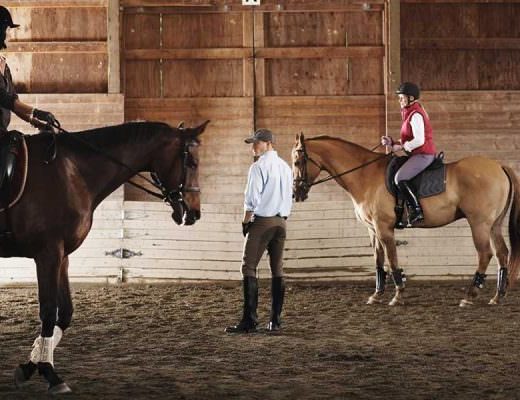
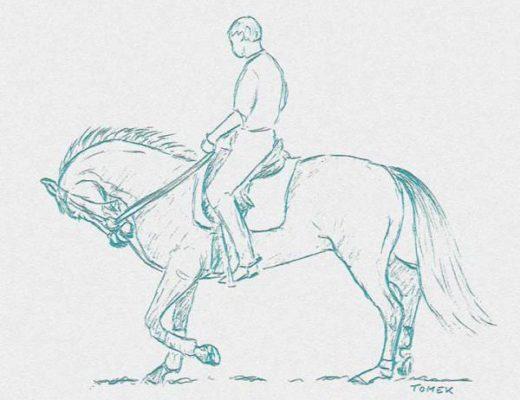
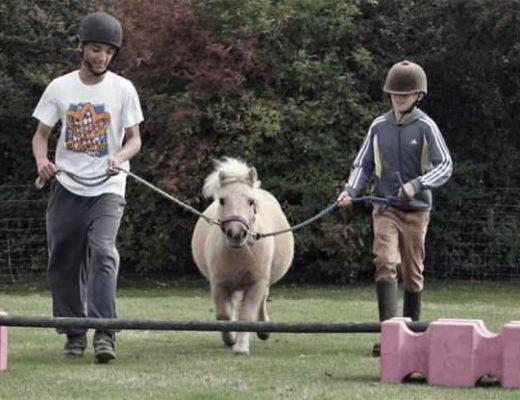
When we think of training a horse, it may or may not be apparent that without relaxation everything else is a compromise. The horse can never fully give himself to your requests if he is tense or nervous. And, interestingly enough, tension is often what many methods of horsemanship are built upon. Perhaps that is why so many of them work with only so many horses and riders, or with a limited amount of success in the right hands.
Read the rest of this entry »


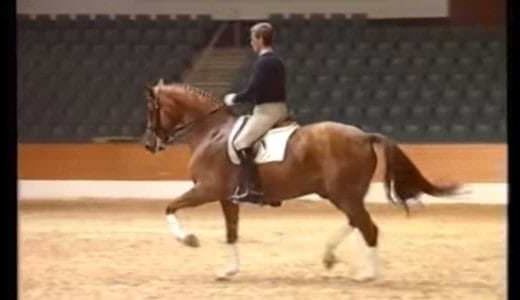
What can be said about one of the most prized elements of a well trained horse, that of a well-executed, light, balanced and beautifully collected piaffe? The stepping stone from basic gaits to airs above the ground, and while it is so sought after it also continues to be one movement that is considered difficult to train or ride well, and for many people simply a complete befuddlement over where to start.
Breaking It Down
What exactly is the piaffe? It has often been mistaken for or compared to the horse trotting in place. While this can give the lay-person a good visual, to those seeking to ride or train the piaffe it leaves much to be desired. The piaffe combines two elements – forward and half halt, in order to create a new movement borne out of the two. The forward gives the horse the trot steps in just the right dose, which is to be regular and even in timing, and without disruption in the diagonal steps (i.e. two beat changing to a four beat trot). The half halt provides the collection and lack of forward acceleration in the piaffe.

Both forward, and the half halt, are widely misunderstood and this in and of itself sets the stage for a degradation in the quality and ability to ride and train piaffe. Forward does not refer to the speed with which the horse is moving its legs or at which it covers ground. Forward can be used in reference to the horse’s tracking, but more specifically it is applied to the amount of energy that is being channeled into movement by the horse. A horse that is well forward, is not necessarily moving fast, and a fast horse is not necessarily moving forward correctly.
Read the rest of this entry »

Posted April 20th by
Erica K. in
Thought
While at the Midwest Horse Fair this weekend in Madison, Wisconsin, I was asked about correcting a gaited horse who would no longer gait. My first horse was a Paso Fino, and over the years I’ve played with a variety of gaited horses. To me, they are intriguing and fun, playful and energetic, and at the same token widely misunderstood in developing the gait. I was happy to offer to play with the mare, rarely wanting to pass up the opportunity to learn something from the horse itself.
I want to reflect that, it wasn’t the gait which was at fault. The mare was perfectly capable of gaiting, given the right conditions. This is normally the case, and it is then left up to us as the rider to know how to enable the right conditions for that gait to not only occur but to flourish.
Read the rest of this entry »

Posted April 11th by
Erica K. in
Touch
I’ve written about the importance of bend in previous posts, but I would like to once again emphasize its use, as well as expand upon and explore the benefits of correct bend further.
Read the rest of this entry »

Posted April 7th by
Erica K. in
Touch
The importance of the half halt is considered bar-none to correct riding, however I think little is emphasized in the use of lateral suppling and it’s effect on the half halt. In my observations of riding, the presence of lateral suppleness maximizes the use of the half halt, while minimizing the pressure needed in the action of the aid. The horse’s balance is easier to influence and mold to our liking. Lateral movements find ease and fluidity.
Read the rest of this entry »

I’ve rekindled my need for physical activity. Still cold, still snowy after a new accumulation of 19+ inches just this week alone. I’ve got a bit of cabin fever, combined with watching videos of my old teacher talking about seat training… pushes me out the door. Scout, my love, was quite anxious to be brought into the barn today, perhaps because he enjoyed our last ride all that much, or maybe it is the vitamins he gets after workouts. Either way I am happy to oblige him as he waits at the gate eagerly.
Read the rest of this entry »

Scout’s overall improvement from yesterday to today has been very noticeable. We are looking for forward, forward, forward. A familiar sentiment from my work with Andie…
We are getting more energy, more involvement, more mental connection. We had less forward in leading today from yesterday, the temperature difference was noticeable and the horses were soaked today, so understandably he was more stiff during the warm-up. Less distraction towards the arena mirrors.
Read the rest of this entry »

Posted August 31st by
Erica K. in
Articles
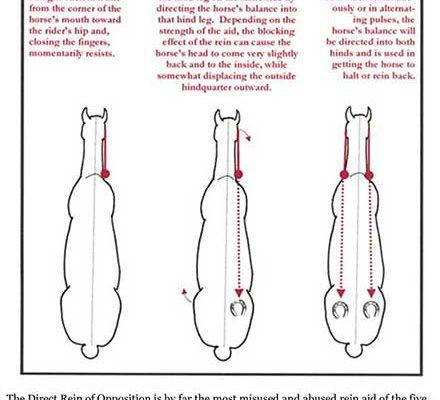
Part II : Direct & Indirect Rein
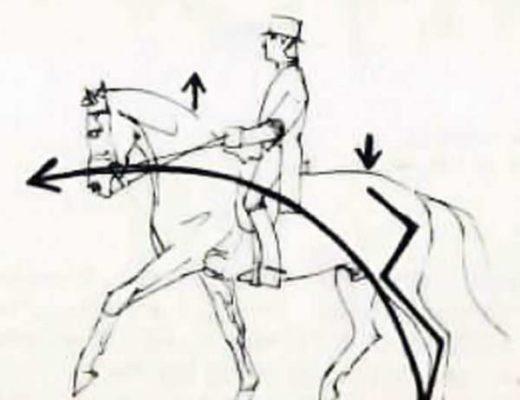
In the first part of this article, we covered the Rules of the Aids, along with introducing and describing the Half Halt and Reverse Half Halt. We now continue on, in a very logical way, to discuss the Direct and Indirect Rein. These two aids are the means of directing, guiding and helping to shape the horse.
Read the rest of this entry »

Posted August 31st by
Erica K. in
Articles
Part I; Introduction, Half Halt & Reverse Half Halt
I should think that the best place to begin with describing the aids we use to influence the horse, is to first find the exact meaning of aid. By Definition:
Read the rest of this entry »