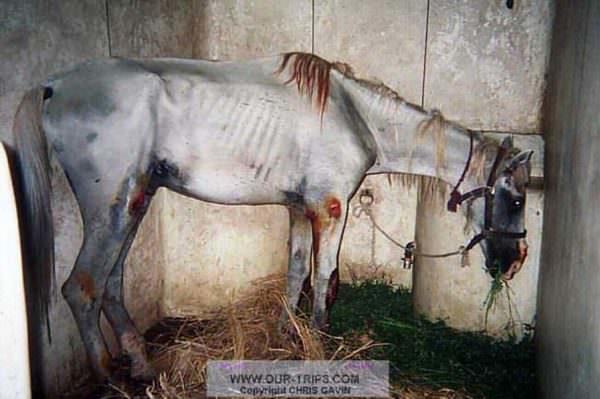
We have come down a long road with the horse, particularly in the last decade regarding slaughter and the laws that protect horses from such a fate. As a result, we have also found that banning slaughter is not the only issue to be tackled to keep the horse safe. Even prior to the economic recession we heard untold stories of horses being turned loose because the owners could not care for them, or horses being severely neglected coming on the rise. Now with hay prices high and so many people jobless, horses are getting the short end of the stick again.
What are some other options we can employ to help bring the number of unwanted horses being bred in the US to a more manageable number, as well as how to educate owners to the needs of horses before they run out and buy a horse and then realize just how much money and effort is involved.
From ChicoER.com, this article provides some insight to where people are turning to solve the over-population of horses. Also, the BLM had been proposing euthanasia of wild horses and burros to help solve the problem of over-population and under-adoption rates.
Euthanasia offers horse owners acceptable solution
Posted: 11/19/2008 10:35:05 PM PST
OROVILLE — Economic despair was brought to a new reality Wednesday, when NorCal Equine Rescue sponsored a free euthanasia clinic for horses.
The clinic, held at Look Ahead Veterinary Clinic on Clark Road, provided for 15 horses to be euthanized cost-free.
Tawnee Preisner, founder of NER, said the current economic situation sparked the need for the event, which she believes is the first in the nation.
With countless individuals facing dire financial circumstances and the price of hay ever increasing, caring for a horse can be financially challenging, Preisner said.
Since the rescue was founded in 2003 by Preisner and her husband, Jason, they have taken in more than 728 horses. This year, NER rescued 350 horses, a telling sign of the economic times, she said.
“With people losing their homes, horses are going to be the first thing to go,” Preisner said. “They can hang on to a dog or cat, but not a horse. The price of hay is literally killing horses. People can't afford to pay that much, especially now.”
Many people are abandoning their horses, Preisner said, leaving them to starve or are forced to sell them at livestock auctions, uncertain of their futures.
Though selling horses for slaughter in California is illegal, Preisner said countless horses bought at auctions in the state eventually do become meat.
The clinic gave horse owners another option Wednesday, allowing those who could no longer care for their horses a way out.
The owners signed the ownership of their horses over to NER. Along with veterinarian Michelle Weaver, NER staff will evaluate the horses, checking them for health. The horses that have a high chance of being adopted will go to the rescue, which is located in Oroville.
The remaining horses will be euthanized.
Preisner said she anticipates the clinic to run once a month over the next few months with 15 horses taken at each event. She said NER has raised enough funding for 60 horses to be euthanized.
Though the situation is less than ideal, Preisner said euthanasia is better than the alternative.
“We wish we would never have to do this,” Preisner said. “But we'd rather see horses given love and kindness and humanely euthanized than end up at a slaughterhouse.”
And while most horse owners would agree with Preisner, they might not always be able to euthanize their horses.
Preisner estimated the costs of euthanasia to average $500.
“I had a woman come by with a horse earlier,” Preisner said. “She's on Social Security. The cost of euthanasia would be an entire month's paycheck for her.”
Donna Kyle, founder of Home At Last horse rescue in Yankee Hill, empathized with horse owners Wednesday, saying she knows how expensive a horse can be.
Kyle and her husband, Jim, are currently caring for 42 horses, a significant number of which were acquired in the past few months.
“The need is horrendous,” Kyle said, referring to horse rescue services. “A good part of that is because of the economy.”
Kyle estimates the yearly feeding costs of a horse to be anywhere from $1,500-$2,000.
But those costs do not include veterinary bills or any other medical expenses for a horse that has special needs, which can quickly add up.
Preisner said a number of the animals the rescue obtains need a higher level of attention, which can ultimately force the owner to get rid of the animal.
While the rescue would ideally euthanize only those horses in the worst health, the high volume of horses turned over is tapping their financial resources.
“We do not want to see any healthy horses euthanized,” Preisner said. “But it is getting harder and harder to find homes.”
“It's the hardest decision any pet owner has to face,” Kyle said. “But they have to be willing to step out of their comfort level and do what is best for the animal. It's better to let them have a good death than starve.”
By TONI SCOTT – Staff Writer
Staff writer Toni Scott can be reached at 533-3131 or [email protected].
Even European countries face issues with horse slaughter and the regulations involved, like France.
Join 3,000 Equestrians
Receive New Articles In Your Email





This Norcal Rescue, now calls themselves Horse Plus Humane Society,
tells a lot of false information on their site and blog.
Horses are not refused at the Mexican border,
They slaughter for human consumption; and for other uses, sadly.
This rescue buys horses at Auction, and then kills them the next day
by the reports locally. Buying horses at auction and out bidding someone who wants
to give a horse a home, is disgusting. Then approx. 7 stallions were left on the trailer
and then euthanized the next day.
Nice horses that no one even TRIED to find a home for is pathetic and against the ethics of what a horse rescue is suppose to do.
There are great concerns for the actions of this rescue.
They say they do GELDING clinics on their site, but yet, when do they do them?
They got in studs in November and need funds to geld them, ever wonder where
those poor horses are, or already eaten?
This is no rescue, they take the publics money saying they are going to “rescue” horses,
then they take the horses to be killed. Is that what the public is asking them to do with
their donated money?
This Preisner? knows very little about horses, and feeds her horses once a day,
what kind of feeding plan is that? starving horses they supposedly take in need a feeding regimen, not old moldy hay once a day.
They adopt out horses that need the teeth floated, I would euthanize my horse before it
ever went to this horse ” death trap.”
I suggest you investigate them a bit more and then report back!!
Gayle,
I appreciate your comment – the post was merely spreading a news story but not confirming nor denying any of the information covered in it. If you have evidence proving the actions of Norcal Rescue – now named Horse Plus Humane Society? you are more than welcome to share them.
I agree that horses are crossing the border into both Mexico and Canada for continued horse slaughter. The progress we have made has been short-sighted as we now see horses suffering all the more in order to make the long distance travel outside of the country and to face other forms of grossly neglected slaughter house fates.
Cheers
How do people who can’t afford horses GET horses? I don’t understand. I know that some people meet with hardships after the fact, but I am asking: how can someone on a SS wage even think about getting or keeping a horse? I apologize…. no disrespect meant to those in the poor-house, but isn’t it better to team up with people in your community and co-own a horse than to let one starve at your hands? I’m sorry for my lack of understanding… I don’t mean to ask dumb questions.
Not a dumb question at all. People overextend themselves all the time.
Taking in too many cats or dogs they can’t afford to feed. Buying a new car on credit that they can’t afford the monthly payments for. We are accustomed to thinking “I want it now, I’ll get it now” instead of saving up or looking at alternatives. I’m guilty of this in certain facets of my own life.
BUT, I think the difference is when you get in a situation like this and fail to see the horse (or animal) is suffering and you refuse to ask for help, or even refuse help that is offered to you. I don’t understand what motivates that kind of behavior but it exists in these abuse/neglect cases. Maybe pride or ego, who knows.
Edited to add: Getting horses for cheap is really easy, given the horse market as it is right now. Horses for a few hundred dollars are normal, but horses being given away for free are also much more prevalent than they used to be. So someone with little or no cash gets a free/cheap horse. They keep them on their own property (no money for feed or other care) or sets them up at a boarding facility that doesn’t charge up front or? Probably thousands of different scenarios but they rarely turn out for the good of the horse.