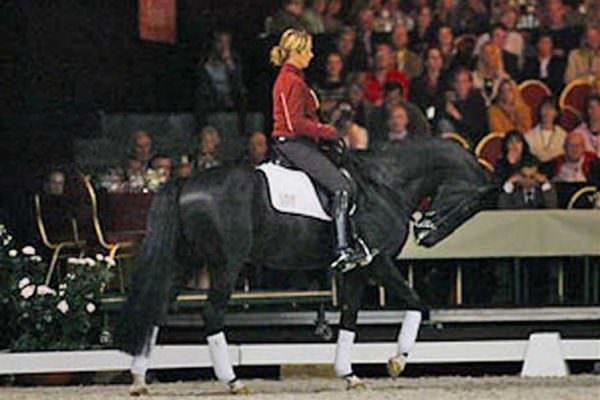
It's easy to talk about Rollkur from a distant point of view – perhaps not with a clear-cut opinion, but certainly a disjointed and ‘objective' one. What isn't easy is to address Rollkur when you've seen the effect it has; not on the horses who are succeeding and making money for their international-celebrity riders but, rather, on the horses who didn't make the cut. The ones who are ‘too sensitive‘ or ‘not talented enough' for the show ring.
I own one of those.
Her nickname is Andie, and she is one of the most beautiful dark bay mares. She is half Hanoverian, out of a well-bred (for sport that is, not just racing) Thoroughbred mare. When people come out to see our horses they instantly gravitate towards her, oohing and aahing. She has become a little less of an ‘in-your-pocket' horse now, in part because she doesn't seek reassurance for constant anxiety. Out of three foals that she's had only one has survived; one died of a fluke health problem before the idea of starting him could even cross anyone's mind and another was still-born. Her last foal I admire every morning and evening for his brilliant red coat and the loveliest personality you could ask for.
I bought Andie with the express purpose of being a broodmare, if I had any hopes of buying a riding horse I probably would have passed.
She had been in the Dressage show ring by the age of three at Training Level and by 5 had already been retired from riding and her breeding career started.
Maybe this doesn't sound all that different from the life of many broodmares – started under saddle only to prove they are rideable and then turned out to pasture for a spring foal. It is rare for a broodmare to be pulled from the field and put back into a riding career, at least for much more than hacking or lessons.
I was told that she was a “lovely mare to ride as long as the rider is tactful,” a skill her owner admitted not being particularly talented in.
She boasted that Andie had been ridden and trained in part by a bareiter from Germany.
I can still recall the sales video that was sent to me, the highlight in it being the footage of Andie with her first foal – a handsome bay colt. The rest of it spelled out a different picture: a mare who didn't know how to interact socially with her herd-mates and behaved quite stallion-like when loose; one who only knew how to run at a frenetic pace at the edge of the lunge line; a mare holding back in such a false frame under saddle at a show that I was convinced she must have been trained in draw reins.
All of this was before I had ever heard of Rollkur or Deep and Round. To me it just seemed like some poorly trained horse who was better at being a broodmare than interacting with a rider on her back.
She has always been splendid though. The first day Andie arrived everyone was entranced. Even in her nervousness on the ground at new surroundings she was regal and majestic in how she handled herself. Never pushy or rude, almost apologetic rather as she looked to everyone for reassurance with a pat or a stroke. She loved to rest her forehead against your chest and nearly nap that way. She was obese from a high calorie diet complete with more supplements than a homeopathic guru could assemble!
My first Dressage trainer warned me not to buy her, saying she looked too wasp-waisted, now recognized as a hallmark of Rollkur horses from the hours they spend in hyperflexion. She has filled out her waist-band since…
Her introduction into the herd was one of the messiest I had encountered up to that point. She roared at any horse that looked at her and would immediately take to striking – even when she was in a paddock with a hundred yards between her and another horse. Once she was gently turned into the group loose the other horses tolerated her but there was a sort of block between communication.
Why do I mention her herd interactions? It was like she wasn't a horse, but rather I had turned some other creature out with this herd of horses. She didn't know what the lingo meant, how to interpret it let alone how to respond. In the 7 years that Andie has been with me she has really only begun to mesh into the group and relax to their rhythms and language in the last 2. She is greatly attached to her son who is also pastured with her, but that bond is beginning to relax now as other horses are finally allowed in closer to mingle and give her reassurances.
It makes me think of children who are unsocialized, or even locked away into a room alone while growing up and disallowed the language to interact with other children or people even. Though they might learn the language later on they will always be an outcast.
At some point after Andie arrived here I began to think that her potential as a riding horse may not be such a far-off idea. I wondered if it wasn't simply that the riders had been just that bad on their own. Certainly a horse as sweet and lovey as this could not be so anxious and hyper-sensitive without due cause.
The first time I rode Andie I was met with a wonderful flying dismount! I landed on my feet beside her, one hand holding the buckle of the reins at the pommel of the saddle, just following the most impressive rear I've witnessed (and been involved in). Interestingly enough, it had nothing to do with the riding so much as it was her reaction to us riding near some horses she thought she should inform of her hatred and disgust. She did very kindly warn me ahead of rearing by roaring quite loudly, giving me just enough milliseconds to respond by kicking my feet out of the stirrups.
She was a nervous nelly with almost anything to do with riding. She would grind her teeth and champ constantly in the cross-ties if there was a saddle anywhere to be found. She would fidget being saddled, swish her tail being girthed. Bridling was a challenge only because she would dive her head downwards as quickly as possible.
I've never had to bend over more to bridle a horse as I did with Andie.
Once I got the bit in her mouth and one ear in the headstall she would then change it up and put her head out of reach in the air. Once the bit was in her mouth there wouldn't be another quiet moment to be found until after she had been turned loose in the pasture. She created a plethora of foam I had never before seen the likes of – from her mouth. It was similar to what is seen in competition today.
Getting in the saddle was a laugh; a mash-up of a tall horse, at the time somewhat short rider (I've done a bit of growing since then, thankfully), and her inability to stand still. Once I was in the saddle the only gait she knew was a jig – half walk and half trot. If I managed to keep her anxiety at a cool level after getting in the saddle I had no control because she was behind the bit with no forward energy, and had not been truly educated on what legs or hands meant in any fashion.
When she became more anxious she would put herself into hyperflexion and there was no hope but to have my ground person step in so I could dismount. To me there is no point in talking to a wall.
Andie has come a long ways since then. She is for the most part quiet when you get her ready to ride, unless it is fly season. She stands rock solid for mounting and is quite good at positioning herself to a mounting block. She has a walk with variable speeds. She has a trot with variable speeds. Her back swings from time to time! You can canter her but it isn't pretty. Best of all… she has a quiet mouth, she stretches down and forward, she sighs and relaxes. Her skills on the lunge line developed along a similar track – from horrid anxiety and no communication, to the point that I used her in a lunging demonstration to show how in one session you can help release a horse's tension.
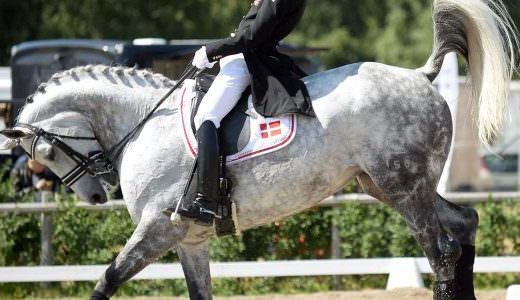
When I watch video of today's top competitors who are openly using (though they may not publicly admit to it) Rollkur / hyperflexion, I see Andie in their eyes. I see the inability to stand still for the salute – beginning and end. I see the lateralized walk that is no longer a walk. The jiggy trot. I see a horse who is shut down and just going through the motions, much like a puppet at the mercy of it's puppeteer.
Even when Andie first arrived she could be made to piaffe, passage, terre a terre and even do a passable pesade. She offered them all up in place of a simple walk step. She could do poor (though visually exciting to the layperson) lateral work but couldn't take one straight step forward with energy.
She has the breeding to be a great jumper. She has the breeding to do great Dressage. But neither of those talents can be realized to their potential because it has been cut short with the shortcut of Rollkur.
When I look at her son, I can't help but to feel disheartened knowing that Andie wasn't given the opportunity to learn at her own pace in an environment that nurtured calmness over a rider's personal goals. I almost feel jealous of him for her, when I think of the anxious rushed training sessions and the started-then-ended-much-too-soon show career that he will miss out on but were very much a daily reality for Andie. He is now 5 and has barely begun as a riding horse, meanwhile Andie's riding career had already been retired due to her ‘sensitivity‘.
Andie is enjoying semi-retirement from everything right now, her only “job” is to mingle with the herd. She is fluffy with winter hair and occasionally sassy with the younger members of the herd. She has come a long ways since she first stepped off the trailer at my farm, but no matter how far she will progress she still carries one permanent physical reminder of her past. The tell-tale “bump” at the 3rd cervical vertebrae. I feel it, agonizingly, when I rub her down at each feeding – the only place I don't linger at with my attention.
Join 3,000 Equestrians
Receive New Articles In Your Email


That’s so sad to read. How differant her life would have been if she had been properly ridden/trained/cared for from the beginning!
I own a mare that from birth to six years old the man that owned her was very abusive. He didn’t bother to put work/training into his horses…but when he wanted to do something with them they had better do it. Or else! A friend of mine bought the mare from him when he decided to get out of horses (thank god!!) and put six more years of calm, patient training into her. When she decided to down-size her herd (do to her age) she sold her to me 2 years ago. She still has some ‘problems’. She likes things to go the same every day…change upsets her. She is wary of anybody new, especially men. I have to take everything step-by-step, day-by-day with her. But when she relaxes and opens up she is such a wonderful, loving horse. It makes me wonder how differently she would have turned out given the proper upbringing.
People need to think. A horse has good, long memory! Just because some short-cut might get the owner/rider what they want now…what about how it will affect the horse?? Both in the near future and for years to come.
I agree Valerie. Thank you for sharing on your own mare!
I think that is the biggest factor – people aren’t thinking about the future with these horses because they are disposable to them. They are merely a vehicle to attain some goal – for equestrians it is usually reaching for the Olympics and international competition, what comes with it is recognition and money. If their drive is stronger than their ability to see what the horse has to sacrifice then they certainly won’t stop to allow one “bad apple” to ruin their chance at the dream career. 🙁
Thanks for another great insghtful post. I am so happy for Andie that after such a sad start she ended up in a great home…but how many like her are out there? so sad…
just today I was riding a beautiful most gentle giant -Dutch WB gelding – he was started too hard, too soon, ridden in rollkur…and at 6 he completely shut down, no expression, no life, going through the motions…now with a different trainer, soft hands and lot’s of schmoozing :o) he comes out of his shell…I love getting him lick and chew, I love when you see the gratitude in his eyes for not handling him like another Grand Prix riding machine, I love to play with him and show him that it can be fun and it’s not just about drilling and drilling…
What a wonderful picture you presented Petra of your gelding! It is truly a gift when you are able to look into their eyes and them look back at you… something that doesn’t always happen once they’ve shut down.
It makes me so angry and sad to know that all over the world there are horses like Andy. Horses will always carry the scars given to them from abusive humans. On the other hand I am so happy to read about people, like you, who gives these horses a chance! People who respects that some horses cant be fixed, but that it is possible to teach them how to cope with their traumas. Horses like Andy is the very reason I will never (as far as it is possible) sell a horse, there are just too many crazy people out there! Also I will never breed one of my horses, unless I am going to keep the foal for myself. The thought of bringing an innocent foal into this world, only to sell it into a life of agony and pain almost makes me cry… Sometime in the future I will rescue and “Andy” and make sure that she/he can live the rest of their days as a happy horse.
What a sad story that , unfortunately. is shared by many horses. Yet people are oohing and aahing at horses like Totilas that have these exalted gaits. Even judges get fooled by this. The only recourse is education and publishing many stories like that.
But Rollkur, LRD(low, round, deep by Anky van Grunsven) are not new methods. Look at the frieses of churchesand paintings in museums throughout Europe, those methods have reoccured through the centuries since Xenophon only to be discarded because they cause more harm than good.
We just have better medical treatment at our disposal than those riders of the past which keeps horses sound longer in body if not in mind. The mental state of your mare is one I encounter often in horses that have been trained wrong, meaning not in the classical way. And they come from all walk of life, not just riding dressage.
Some horses like yours are lucky, the majority is deemed unridable and mean and gets discarded as being useless. Their fate is not one I try to think of too often or I would get too depressed. We can only help the ones we have in our care and try to reach out ( I am a trainer) to as many students that let you ‘in’.
I agree, Rollkur has been used for a long time. It’s been a marketing tactic to avoid the negative presses that it was first proclaimed a new method, then denounced and renamed as LDR, and yet we are still seeing the same hyperflexion as before Rollkur was “banned” by the FEI including more public incidences of blue tongues and blood in the mouth.
Kudos to you for doing your part to help horses and riders, we need more trainers out there who are willing to do so instead of telling riders to dump their damaged horses and buy something else; and trainers who support riders through their own learning curve instead of belittling and abusing them for it.
Cheers,
Erica
“Never pushy or rude, almost apologetic rather as she looked to everyone for reassurance with a pat or a stroke.” So, a horse that is mistreated can act as if it really likes people…how are we supposed to stop abuse when the horse is looking like it loves its life as far as the human is concerned? There is so much that is considered normal because it is common (poor interaction with other horses, chomping,grinding,frothing) that it is very difficult to show someone that the horse does not have to live life with those common practices.
I see I am very late to join the discussion, but I would like to know more about this bump on Andie’s neck please! Is it really at the spine or more muscular, can you mistake it for something else? My mare’s neck seems to curve at the 3rd vertebrae when she is at rest (at least, that is the highest part of her neck when she is in her stall eating, looking out the window, etc.) – and I have certainly never used rollkur or tied or pulled her head at all. Is the bump you are referring to positioning, or is there really a bump?