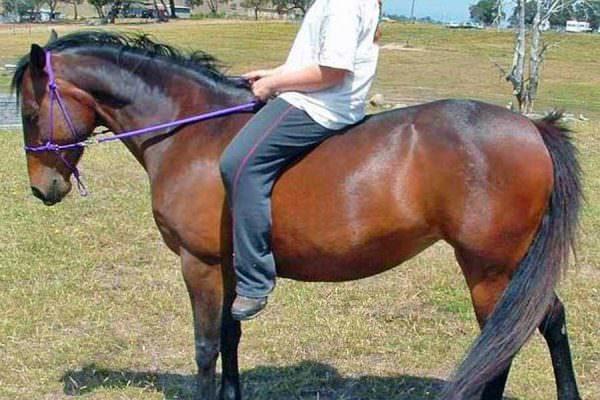
This post is no longer reflective of my opinion on bitless bridles. I have left it in-tact as a reminder that it is okay for our opinions and ideals to change in the process of learning and growing as equestrians. I will follow up with a post the covers how I feel about bitless bridles in the near future.
One of the most difficult things for a rider to learn is how to use their hands properly. Wait, no. Let me restate that. THE most difficult thing for a rider to learn is how to use their hands properly. Why you may ask.. because the hands are connected to the wrist bone, the wrist bone is connected to the arm bone… and so on right down to your ten little piggies and the hair on your chinny chin chin.
Joking aside though, good hands require a rider to have a balanced seat, which requires the rider to be in the proper position for their individual center of gravity, which requires the proper muscle suppleness and flexibility which is not innate in us human beings. Good hands also require the proper education, something that the vast majority of riders never get and are unlikely to encounter in their average riding lessons. Why? Because their instructors never received it and so can't pass it on.
Essentially all of these requirements make it nearly impossible for a rider to gain good hands without going through and learning a properly balanced seat so that their hands, seat and legs can work independently from one another.
Now, let's go back to the original question about bitless bridles, or bridle-less riding. The usual reason behind using either of these ‘tools', or ‘methods' if you will, is to circumvent some sort of problem that the horse is having with a bit in it's mouth. The horse tosses it's head, has a hard mouth, can't relax, over-salivates or is anxiously gnawing at the bit, runs through the bridle, etc. Let us also keep in mind that the horse's mouth is one of the most sensitive areas on his body without losing sight of just how sensitive his skin is alone to a single fly's presence… ahem.
Essentially it boils down to this – the rider is replacing his lack of skill with a piece of equipment designed to relieve him of ever having to go through the process of developing a seat and thus independent aids and eventually having educated hands that no longer cause all of these “bit issues”. It is for this reason I don't recommend these tools but instead continue to champion the learning process that first develops a rider's balance WITHOUT allowing them access to the reins and only after they've acquired a seat and independent legs are the reins introduced with education. Never haphazardly as seems to be common – to throw a beginner rider on a horse and leave them wander about the ring not knowing the first thing about how to communicate with the horse and without any balance to then abuse the horse's mouth and blame the horse's resistances on the bridle…
I love visuals, so thought I would put some commentary on my observations from some video I just browsed. I have some history on the horse but will wait to share it until after you've watched the video to keep from pre-suppositions if possible.
In The Bitless Bridle –
http://www.youtube.com/watch?v=DgolyvVjO5k
I watched this video first so am posting in the order that I viewed them. The background information was highlighting that the horse was moving in free extension, self carriage, even collection. I will admit that he is different in certain superficial ways from the video showing him ridden in a bit but I would never say that his actions are that of true extension in the gaits, self carriage or collection. He is not relaxed, is not stepping underneath of himself, is not round in the back, etc. Instead he is a horse who is moving swiftly forward, braced in the neck, tense in the gaits and who is at the same time also doing a commendable job at (imo) trying to do as his rider is requesting.
The problem is that he cannot be in self-carriage, it is not possible with both his level of tension and the rider's lack of balance. She is not falling off the horse but she is behind his movement and falling downwards at every sitting stride and having to work too hard to push herself out of the saddle in the rising portion. His walk is completely lateralized as is the canter, i.e. both legs on the same side are moving in unison rather than separated into the 4-beat tempo that should be the walk and the three beat canter tempo. His neck is raised but not from the base, rather more inverted and that is shown by the thickness of the underside of the neck.
What bit of extension the rider may be feeling is simply the horse moving more swiftly, or there are a few small moments (if not in this video there is a second one also showing him in the bitless bridle) where he is getting closer to stepping under himself. His hind hooves are not stepping into the front hoof prints and therefore his hind legs are by definition trailing.
Compared to the video of him in a bit he is more confident appearing in his forward movement and less confused about whether he should be going forward or slowing down, which is very common if the rider uses their hands too much in conflict when riding in a bit that they will improve in this way in the bitless bridle.
In a Kimberwicke –
This video I watched immediately after my observations on the bitless bridle video, I was curious to see how changed he would go in a bit. Again, the rider is behind the movement of her horse and as a result her rein aids are in conflict with the forward movement she is asking out of him – she is using the reins to aid in balance which she has to because her seat is not developed, her legs are neither suppled into position nor independent and therefore her hands will be affected by whatever happens with the seat and legs. The horse responds through confusion – her legs say go forward, her seat cannot follow the movement because it has to work harder than necessary, and her hands say slow down or stop. He in turn reacts out of frustration and confusion.
I don't want you thinking I am picking on this rider, simply my observations and nothing personal. I could pick out a million other videos and point to the same issues, she is not alone and I have been in her place myself. I have ridden the horses with terrible bit problems, head tossers, balkers, horses that were sucked back and behind the bit, that would bobble between running forward and running backward in confusion. I have ridden with poor balance, heavy hands and the thought that my horses were collected or balanced when they were anything but.
I'd really love to throw up a quick video but alas do not at the moment have free access to a horse so this post will have to suffice for now. Be wary however the trap that is easy to fall into believing that a bit of tack can solve all of your troubles. The bit has a specific purpose and that purpose is to allow for some of the most refined communication available with your hands. The horse's nose cannot compare in sensitivity to the horse's mouth – which is the good and the bad. It is why a bitless bridle allows for more refined appearing riding when there is no tact in the rider's hands or balance in his body and why that same rider can develop a horse with the most horrendous evasions when riding with a bit.
My first dressage instructor used to bring up with a sort of endearing tone and mystical hope in her voice this idea she had heard about – something to the effect of master equestrians riding their horses with a single thread of silk to connect their hand to the bit their touch so refined, subtle and effective. Later I came to experience the power of riding with that refined of communication with the hand – where less is louder to the horse than more. Where a mere 5 grams (the weight of a nickel!) is all that is needed to convey your wishes to the horse and have them be understood. But… that kind of tact is not available when your hands are connected to your feet which are connected to a body that is out of sync with the horse's movement, space and time.
Food for thought…
Join 3,000 Equestrians
Receive New Articles In Your Email

I didn’t find any videos to watch, so I can’t see what you were critiquing.
Perhaps the use of the bitless bridle is most effective when used for pleasure riding. I ride my horse bitless, and strictly for pleasure. I’m not interested in becoming a world class equestrian. I merely want to ride my horse outside the arena, wander out by the river and through the woods and back again. We walk, jog, and trot, cross creeks, climb small hills, and work on leg cues (move over, trot) and verbal commands (WHOA!!!), which is enough for me. Her reward is not “release from pain”, but, hopefully, no pain to begin with.
Uh, there is no pain. It’s pressure. If I rest my hand firmly on your arm, I am not hurting you, I am applying pressure to your arm. The horses are trained to move away from the pressure. If there’s pain involved you’re doing it wrong. That was the entire point the author was trying to make. Being refined in the seat is required to be in tune with your horse. In my honest opinion… the person who takes the time to become great at equitation and refining the aids cares a whole lot more about their horse than the person who genuinely believes it’s friendlier to the animal to plod around on its back just doing the “basics”.
Not everyone uses a bitless bridle because of some kind of problem. They are quite handy in the wintertime when bits are a pain to get and keep warm. It also comes in handy when the children ride. They are still learning and I don’t want them to damage my horse’s mouth because they made a mistake. My horse has a great mouth, and I want to keep it that way.
All very good points Trish. I need to write a retraction post to this as I’ve recently switched all my horses over to bitless… 🙂
I so agree Lil Morgan,
What I got was the same. I spend a great deal interacting with my horse on a more relaxed, pleasurable atmosphere. I also do distance trail. There’s a lot of partnership and trust going up and down mountain cliffs. I worry about my horse everyday. What I don’t worry about is his mouth, his swallowing, free range, or even breathing. Why? Because he is pain free and bitless. I wouldn’t want it any other way, and I don’t think he would either!
Is there a subsequent post on this subject? And may I ask, if I were to purchase a bitless bridle, which one/brand would you recommend?
http://www.writingofriding.com/in-the-media/if-you-must-ride-with-a-metal-bit/ is the follow-up post I wrote.
Essentially I would suggest first wrapping your bit in Sealtex, and secondly working with an instructor to improve your seat, balance and use of the aids (hands and legs). Addressing all of these issues will likely solve the majority of problems of riding with a bit.
Also, if a bit issue is caused by our riding technique (bad hands, compromised balance, confusing aids, etc) then moving to a bitless bridle will only change the way we’re causing problems for the horse but not solve the whole issue. 🙂
Cheers!
Is there a subsequent post on this subject? And may I ask, if I were to purchase a bitless bridle, which one/brand would you recommend?
http://www.writingofriding.com/in-the-media/if-you-must-ride-with-a-metal-bit/ is the follow-up post I wrote.
Essentially I would suggest first wrapping your bit in Sealtex, and secondly working with an instructor to improve your seat, balance and use of the aids (hands and legs). Addressing all of these issues will likely solve the majority of problems of riding with a bit.
Also, if a bit issue is caused by our riding technique (bad hands, compromised balance, confusing aids, etc) then moving to a bitless bridle will only change the way we’re causing problems for the horse but not solve the whole issue. 🙂
Cheers!
I think the premise that all problems using a bit being due to rider imbalance etc. is flawed in too many ways to mention. I also disagree that the mouth is more sensitive than the nose. The recent research demonstrating that a bit prevents the mouth sealing during exercise interferes with proper breathing convinced me that bitless is preferable. Several videos of world class dressage riders demonstrating passage & piaffe with just a halter or nothing on the horse’s head speaks to the superfluousness of the bit.