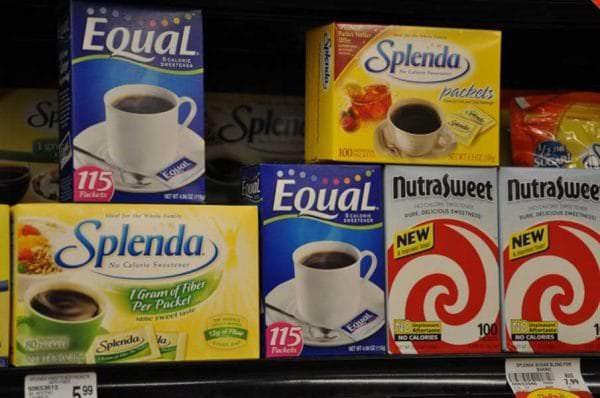
You may be surprised to learn that Aspartame isn't just a low-calorie alternative to sugar, and it isn't *just* a potential link to cancer. Aspartame is derived from sugar, but the information we are marketed about the benefits of Aspartame are misleading and also help keep us in the dark about our health.
Aspartame is marketed under several trademarked names including Equal, NutraSweet and Canderel.
[…] an ingredient of approximately 6,000 consumer foods and beverages sold worldwide, including (but not limited to) diet sodas and other soft drinks, instant breakfasts, breath mints, cereals, sugar-free chewing gum, cocoa mixes, frozen desserts, gelatin desserts, juices, laxatives, chewable vitamins supplements, milk drinks, pharmaceutical drugs and supplements, shake mixes, tabletop sweeteners, teas, instant coffees, topping mixes, wine coolers and yogurt.
Although Aspartame has lost some of its favor to Sucralose, which retains its flavor better when heated, Aspartame is still found in a plethora of food items. Common knowledge, but what you may not know is that it is a derivative of the natural amino acids (as opposed to essential amino acids) L-aspartic acid and L-phenylalanine. As a physiology reminder, amino acids are the building blocks to proteins.
Why is Aspartame so evil on the body? Unlike Sucralose it isn't created through chlorination…
According to some sources, Aspartame acts similar to MSG or L-glutamate on the body, that is, as a excitotoxin which is linked to what is known as the ischemic cascade and neurodegenerative conditions including: sulfite oxidase deficiency; epilepsy, hypoglycemia and hypoxic/ischemic brain damage; central nervous system trauma; dementia pugilistica; domoate dementia; olivopontocerebellar degeneration; neurolathyrism; amyotrophic lateral sclerosis, Parkinson's, Alzheimer's dementia; Huntington's disease; and Wernicke/Korsakoff syndrome(231), stroke, autism and some forms of mental retardation.
With little research I found :
- Approximately 10% is broken down into Methanol, most of which is then converted to Formaldehyde. This process is considered inconsequential because Formaldehyde is then dealt with by your body's enzymes and poses no health risk. But… what is the impact on our body if our average diet (based on the average American diet) consists of foods which have been cooked or pasteurized to such a temperature that kills most if not all naturally occuring enzymes? Or in the case of medical treatments which include anti-biotics – known for killing the natural flora (aka enzymatic bacteria) in our digestive tract? Also… Methanol is toxic. Drinking 10ml (approximately 2 teaspoons) will cause blindness, and as little as 100ml (less than 1/2 cup) can cause death. Methanol is also known as wood alcohol, methyl alcohol, carbinol, wood spirits.
- 50% is broken down into Phenylalanine, a non-essential amino acid and precursor to tyrosine (which in high doses reduces levels of dopamine – which has been shown to reduce motivation and cause the ‘inability to experience pleasure' – tyrosine has also been used as a replacement to wean people off of cocaine, caffeine and nicotine). Maintained high blood levels of Phenylalanine has shown to cause adverse effects on fetuses. Phenylalanine is also linked to the genetic disorder phenylketonuria.
- 40% is broken down into the amino acid aspartic acid (aspartate). High concentrations act as an excitotoxin, damaging the brain and nerve cells.
- There is controversy over whether Aspartame actually spurs an insulin response, which would trump the notion that it is a smart sugar replacement for Diabetics, or useful for weight-loss diets.
What does this mean to us as Equestrians?
Riding horses is a very physically demanding activity. Not only that, the mental aspect is stunningly complex just like any relationship. If Aspartame does indeed function as an excitotoxin, inhibit dopamine production and cause insulin spikes it will affect our mood (i.e. the level of patience we have as well as how we perceive responses we receive from the horse); our ability to respond physically, mentally and emotionally (i.e. reaction timing and speed, our learning curve, triggering faster fear/anger/aggression responses).
If you've ever had an experience where it feels that you were out of control of your responses/reactions, perhaps it is time to take a look at your diet… for example :
- The FDA considers 50mg/kg [longterm] daily consumption of Aspartame to pose no health risk (and yet has an official list of 92 symptoms caused by aspartame consumption). If you weight 165lbs, that's 21 cans of soda to surpass the safe level. Certainly the average person does not drink that much soda in a day, however in combination with other excitotoxins as well as other sources of aspartame in your daily diet this could pose a problem.
- At 20mg/kg body weight daily doses of Aspartame, the Ramazzini Study concluded that aspartame is “a multipotential carcinogenic agent…”
- A study at My Aspartame Experiment.com produced tumors, skin lesions, symptoms related to Grave's Disease, eye infections, birth defects, obesity and death in rats when fed the intake equivalent of a person drinking 3/4 of a can of diet soda per day over the course of 2 years and 8 months.
Suffer from headaches?
- A link to headaches caused by aspartame ingestion was made in one study with doses below the FDA's limit.
- Headache is the #1 complaint reported to the FDA, followed by dizziness/poor equilibrium (#2) and change of mood (#3).
Healthy alternatives to Aspartame…
There are many natural sugar replacers which don't act as excitotoxins available on the market. I used to use a lot of Stevia when I detoxed from refined and artificial sugars, a natural sweetener that is gaining in popularity but should not be mistaken as Rebiana, Truvia or PureVia – which are being substituted in many soft drinks now. I rarely use anything to sweeten my foods and drinks with anymore, though do occasionally use honey or sweeten my tea with licorice root (not to be mistaken with licorice candy). Many enjoy using Agave Nectar, but…
Agave syrup consists primarily of fructose and glucose. One source gives 92% fructose and 8% glucose; another gives 56% fructose and 20% glucose. These differences presumably reflect variation from one vendor of agave syrup to another. Due to its fructose content and the fact that the glycemic index only measures glucose levels, agave syrup is notable in that its glycemic index and glycemic load are lower than many other natural sweeteners on the market.However, the extremely high percentage of fructose (higher than that of high-fructose corn syrup) can be deleterious and can trigger fructose malabsorption, metabolic syndrome, hypertriglyceridemia, decreased glucose tolerance, hyperinsulinemia, and accelerated uric acid formation. Low-carb diet advocate Dr. Michael Eades M.D. advises to “avoid it [Agave syrup] like death”.
Some criticism has targeted agave syrup. In the late 1990s, the agave syrup on the market contained 90% thermally or chemically hydrolyzed fructose. However, while the salmiana variety syrup on the market today is still primarily fructose, it is enzymatically hydrolyzed using a black mold enzyme.
Aspartame-sweetened foods are often marketed for their ‘low-calorie' qualities, so be careful to check any foods which target consumers for weight loss or weight control. Be wary of labels which read “Sugar-Free” or “No Sugar Added” which are often sweetened artificially.
For More Information Check Out :
- DorWay To Discovery : Aspartame & Aspartame Poisoning
- Sweet Poison : Aspartame Dangers Revealed
- HolisticMed.com : Aspartame Toxicity Information Center
- My Aspartame Experiment
- Aspartame : Rumsfeld's Bioweapon Legacy
Tuberose.com : Aspartame- Aspartame Linked to Anxiety and Panic Attacks
- HolisticMed.com : Aspartame Dangers In Pregnancy
Caution!
There are a number of sites trying to say that Aspartame Poisoning is a hoax, and while I believe that doing your research is important and taking information from both sides – I also think it is vital to know what the source is. Sites such as aspartame.org [“Aspartame Information Center”], aspartame.net [“The Aspartame Information Service”], aspartame.info [“Aspartame Information Service” almost identical to aspartame.net], aspartametruth.net [“The Truth About Aspartame”], etc are all linked to the Calorie Control Council, which according to The Source Watch :
The Calorie Control Council is a non-profit group “representing the low-calorie and reduced-fat food and beverage industry. Today it represents 60 manufacturers and suppliers of low-calorie, low-fat and light foods and beverages, including the manufacturers and suppliers of more than a dozen different dietary sweeteners, fat replacers and other low-calorie ingredients.”
“The Council has sponsored numerous studies on low-calorie ingredients, foods and beverages — including investigations in the areas of mutagenicity, carcinogenicity, metabolism, consumer usage and public opinion,” it states on its website.It also published the website, The Truth About Aspartame.
The CCC website, according to a search at Joker.com, was registered in early January 1997 by The Kellen Company, a company which provides a range of support services to “association clients.” (The Kellen Company offers PR services to clients via its PR division, Kellen Communications). The office address and phone number for the CCC are shared by The Kellen Company and thirteen other associations comprising the Association For Dressing & Sauces, Chilled Food Association, the Concord Grape Association, the Enteral Nutrition Council, Exhibit Designers & Producers Association, Georgia Financial Services Association, Health Care Convention & Exhibitors Association, Horseradish Information Council, International Jelly & Preserve Association, National Association Of Margarine Manufacturers, National Institute For Oilseed Products, National Pecan Shellers Association and the Processed Apples Institute.
This, in my opinion, discredits much of the promotional information due to the corporate and financial connections tied to the Calorie Control Council.
Detox From Aspartame
Join 3,000 Equestrians
Receive New Articles In Your Email